Quick answer: In the local services ads vs SEO decision, Local Services Ads buy calls now: you pay per valid lead and can show above organic results as soon as you pass verification. Local SEO earns map pack and website rankings that take months but keep producing leads without a per-lead fee. Most contractors and law firms do best running both.
If you run a roofing company, an HVAC shop or a small law firm, the local services ads vs SEO question usually comes up when the phone goes quiet. One option charges you for every lead. The other takes months but keeps working after you stop paying for it. Both put you in front of people searching for your service in your town.
This guide explains how Google Local Services Ads work today (including the 2026 badge and platform changes), how they compare with organic local SEO, and how to combine them in a 90-day plan that does not waste budget.
Key Takeaways
- Google Local Services Ads charge per valid lead (calls, messages and booking requests), not per click, and lead prices vary by trade, market and lead type.
- Google Guaranteed and Google Screened have been replaced by a single Google Verified badge, and the Google money back guarantee has been discontinued.
- Local SEO (Google Business Profile plus a strong website) is slower to build but has no per-lead cost and keeps working when ad budgets pause.
- Your reviews and Google Business Profile feed both channels, so improving them helps your ads and your organic rankings at the same time.
- Most service businesses get the best results by using LSAs for immediate demand while building SEO for long-term, lower-cost leads.
What Are Google Local Services Ads?
Google Local Services Ads (LSAs) are pay-per-lead ads that appear at the top of Google Search, and on Google Maps, for local service searches like “plumber near me” or “divorce lawyer.” Instead of paying for clicks, you pay when a customer contacts you through the ad.
Each ad shows your business name, star rating, review count, hours and a verification badge. Customers can call, message or, in the US and Canada, request a booking from the ad.
How does pay per lead work?
Pay per lead means you are charged for each valid lead, not for impressions or clicks. According to Google’s help page on how Local Services Ads leads work, a valid lead includes a phone call you answer, a missed call during business hours where the caller stays on the line more than 20 seconds, a text or email message, a voicemail, or a booking request.
Google says lead prices vary by location, job type, lead type and your bidding mode, and message leads are typically priced lower than phone leads. Google does not publish a fixed price list, so expect costs to depend on your trade and market.
What happened to Google Guaranteed and Google Screened?
Google Guaranteed (for home services) and Google Screened (for professional services like law firms) were the two classic LSA trust badges. Google has now consolidated them into a single Google Verified badge, and existing advertisers who completed verification received it automatically.
Google also discontinued the money back guarantee that came with the old Google Guaranteed badge, with final reimbursement requests accepted for services booked before December 7, 2025.
To earn the badge, businesses go through screening that varies by category and region. Depending on your trade and location, that can include license checks, insurance checks, business owner and field worker background checks, and a verified Google Business Profile. Verification can take several weeks, so start early.
Where do LSAs show and how do they rank?
LSAs appear in a dedicated block above the regular paid ads and organic results on many local service searches. They are keywordless: you choose service categories, job types and service areas, and Google decides which searches match.
Ranking blends your bid with profile quality: star rating, number of reviews, responsiveness (missed calls hurt), photos and completed verification checks.
Can you dispute a bad lead?
The old manual dispute process has been replaced by automated lead credits. Google filters out spam and duplicate contacts before charging, then re-checks charged leads for about 30 days and credits low-quality ones automatically. You can also rate leads through a feedback survey on the Leads page.
Two limits matter: Google no longer credits leads for job types or locations you do not serve, and automated credits are not available for health care, tax specialists or advertisers in Europe, the Middle East and Africa. Keep your service areas and job types tight.
What changed for LSAs in 2026?
Google is moving Local Services Ads into the main Google Ads platform as Performance Max campaigns with pay-per-lead goals. The rollout started in August 2026 for select US home service trades, including plumbing, HVAC, electrical, roofing, pest control and moving, with more categories following in late 2026 and 2027.
The pay-per-lead model and the Search and Maps placements stay the same. What changes: weekly budgets become daily budgets, manual max-per-lead bidding goes away, and your old LSA performance reports do not carry over, so download or screenshot them before your account migrates.
What Is Local SEO, and How Is It Different?
Local SEO is the work of earning unpaid visibility in Google’s map pack and organic results for searches in your service area. It has two main parts: your Google Business Profile, which drives map rankings, and your website, which ranks in the regular results and turns visitors into calls.
Google states in its guide to improving local ranking that local results are mainly based on relevance, distance and popularity, and that there is no way to pay for a better local ranking. You earn it with a complete, verified profile, steady reviews and a website that clearly explains your services and towns. Our Google Business Profile optimization checklist covers the profile side step by step.
Local Services Ads vs SEO: How Do They Compare?
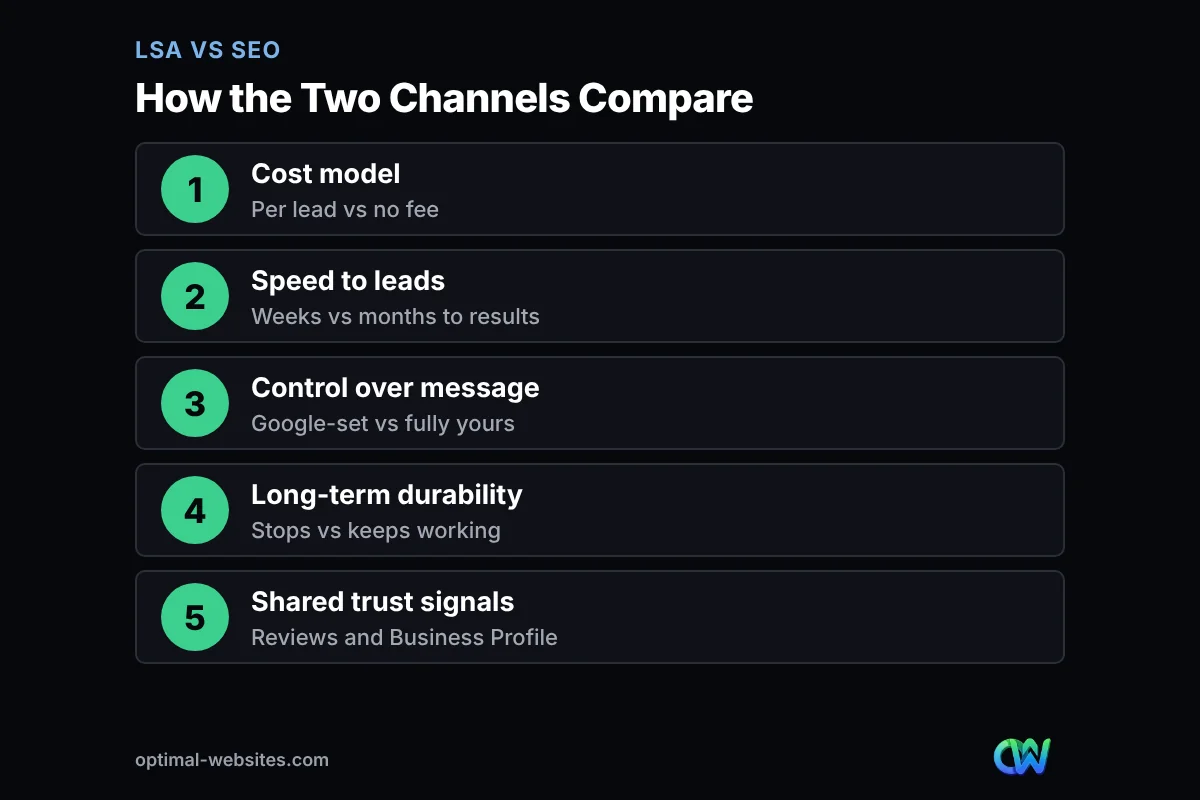
Local Services Ads are faster in the short term, while local SEO is cheaper per lead and more durable over time. Here is how they compare for contractors, home service companies and law firms.
| Factor | Local Services Ads | Local SEO (GBP + website) |
|---|---|---|
| Cost model | Pay per valid lead; price varies by trade, market and lead type | No per-lead fee; you invest time or pay for SEO work and content |
| Speed | Leads can start soon after verification, which can take several weeks | Usually months to build rankings, depending on competition |
| Control | Limited: Google sets placement, and you choose categories, areas, budget and bidding goals | High: you control your pages, messaging, offers and calls to action |
| Durability | Leads stop when the budget stops | Rankings and content keep working after the work is done |
| Lead quality | Strong intent, but you pay for some leads that never book; low-quality leads may be credited | Strong intent, and visitors often read your site before calling |
| Trust signals | Google Verified badge, star rating and review count | Reviews, photos, case examples and detailed service pages |
| Where it shows | Top LSA block on Search, plus Maps | Map pack, Google Maps and organic results |
Notice that reviews and your Google Business Profile appear on both sides. LSA reviews come from your Business Profile, so every review you earn helps your ads rank and your map listing compete. A simple routine for getting more Google reviews pays off twice.
When Should You Use Local Services Ads?
Use Local Services Ads when you need leads quickly, your category is eligible in your area, and you can answer the phone fast. They suit companies with a dispatcher, answering service or intake team.
- You have open crew or attorney capacity that needs filling this month.
- Your trade has urgent, high-value jobs (roof leaks, no-heat calls, criminal defense) where a single booked job covers many leads.
- You already have solid reviews, which help both ad ranking and conversion.
LSAs are a weaker fit if your category is not eligible where you work, you cannot respond quickly, or your job values are too low to absorb lead costs.
When Is Local SEO the Better Investment?
Local SEO is the better investment when you want lower long-term cost per lead and leads that do not disappear when the ad budget runs out. It also wins for services people research before they call, such as remodeling, roof replacement, estate planning or personal injury.
SEO lets you rank for specific services and towns that the LSA block may not cover, like “metal roof installation in Newark” or “Delaware DUI first offense.” For a deeper plan, see our guide to lead generation for contractors, which builds on the same website-first approach.
Why Does Your Website Still Matter If You Run LSAs?
Your website matters because many LSA shoppers check you out before they call. They search your business name and visit your site to see your work and whether you look established.
From our experience building WordPress sites for contractors and law firms, including PCS Roofs, E & S Construction Engineers and F. J. Collins Law, the pages people visit after seeing your name are predictable: the homepage, the specific service page, the about page and the contact page. If those pages are slow, generic or hard to use on a phone, you can lose a lead you already paid Google to deliver.
A strong site for LSA shoppers should include:
- A clear service page for each major job type you advertise.
- Real project photos, licenses and credentials, and reviews.
- A tap-to-call button and a short quote form that work well on mobile.
- Fast load times, since most of these visitors are on their phones.
How Do You Decide Between LSAs and SEO?
The quickest way to decide is to check eligibility, response capacity, budget and timeline. Use this checklist with your team:
- Check whether Local Services Ads are available for your category and service area.
- Confirm you can pass the screening checks for your trade (licenses, insurance, background checks) and have a verified Google Business Profile.
- Estimate what one booked job is worth and how many leads it usually takes to win one.
- Decide whether you can answer calls and messages quickly during business hours.
- Review your Google Business Profile: categories, hours, photos and review count.
- Audit your website: Does each service have its own page? Does it load fast on a phone?
- Set a monthly budget for ads and a separate budget or time block for SEO.
If eligibility, response time and job values check out, test LSAs. Either way, start SEO, because it lowers your reliance on paid leads.
What Does a Combined 90-Day Plan Look Like?
A combined 90-day plan launches Local Services Ads for immediate leads while fixing the profile, reviews and website that feed both channels. It is the practical answer to local services ads vs SEO for most service businesses.
Days 1–30: Set up and verify
- Claim and complete your Google Business Profile with accurate categories, hours, service areas and photos.
- Start LSA sign-up and submit license, insurance and background check information right away.
- Fix your core website pages: homepage, top service pages, about and contact.
- Set up a lead log that records where each lead came from.
Days 31–60: Launch and respond
- Go live with LSAs once approved, using tight job types and service areas.
- Answer every call and message quickly, and rate leads in the feedback survey.
- Ask every happy customer for a Google review using your profile’s review link.
- Publish or improve service pages for your most profitable jobs and main towns.
Days 61–90: Measure and adjust
- Compare cost per booked job from LSAs with leads from your map listing and website.
- Trim job types or areas that produce poor leads, and raise budget where jobs close well.
- Download your LSA reports before any migration to Google Ads so you keep your history.
How Optimal Websites Can Help
Optimal Websites, a WordPress web design agency based in Delaware, builds fast, mobile-first websites that turn local searchers and LSA shoppers into calls. We build clear service pages and the trust signals people look for before they hire.
Our local SEO services help you build map and organic visibility over time, and our lead generation support helps you turn that traffic into conversations. Websites start at $999, most projects launch in 2–4 weeks, and every client gets video tutorials and training to update their own site.
Frequently Asked Questions
Are Local Services Ads better than SEO?
Neither is better in every case. Local Services Ads bring leads faster and charge per valid lead, while SEO takes months but produces leads without a per-lead fee. In the local services ads vs SEO choice, most contractors and law firms do best running LSAs for immediate demand while building SEO for durable, lower-cost leads.
How much do Google Local Services Ads cost?
Google does not publish a fixed price list. You pay per valid lead, and Google says lead prices vary by location, job type, lead type and bidding mode, with message leads usually priced lower than calls. You set a budget, and lead costs in competitive trades and large metro markets are typically higher.
Is Google Guaranteed still available?
No. Google replaced the Google Guaranteed and Google Screened badges with a single Google Verified badge. Existing advertisers who completed verification received it automatically. Google also discontinued the money back guarantee tied to Google Guaranteed, with final requests accepted for services booked before December 7, 2025.
Can I get a refund for a bad Local Services Ads lead?
Google now uses automated lead credits instead of manual disputes. It filters spam and duplicates before charging and re-checks charged leads for about 30 days, crediting low-quality ones. Leads for job types or areas you do not serve are no longer credited, and credits are not available in some verticals and regions.
Do Local Services Ads help my Google Maps ranking?
Not directly. Google says there is no way to pay for a better local ranking, and map results are based on relevance, distance and popularity. However, both channels rely on your Google Business Profile and reviews, so the reviews you earn while running LSAs also strengthen your organic map presence.
Can law firms use Local Services Ads?
Yes, in many areas. Google lists lawyer categories such as personal injury, family, criminal, DUI, estate and immigration law, though availability varies by country and location. Law firms go through screening that can include license checks and background checks, and they earn the Google Verified badge once verification is complete.
Do I still need a website if I run Local Services Ads?
Yes. Many people who see your ad search your name and visit your website before they call. A fast, mobile-friendly site with clear service pages, real project photos and reviews helps convert the pay per lead traffic you already paid for, and it supports your organic SEO at the same time.
Ready to Get Started?
Whether you run Local Services Ads, invest in SEO or both, a fast website that answers buyers’ questions makes every lead easier to win. Request a free quote or call us at (302) 554-9497.