
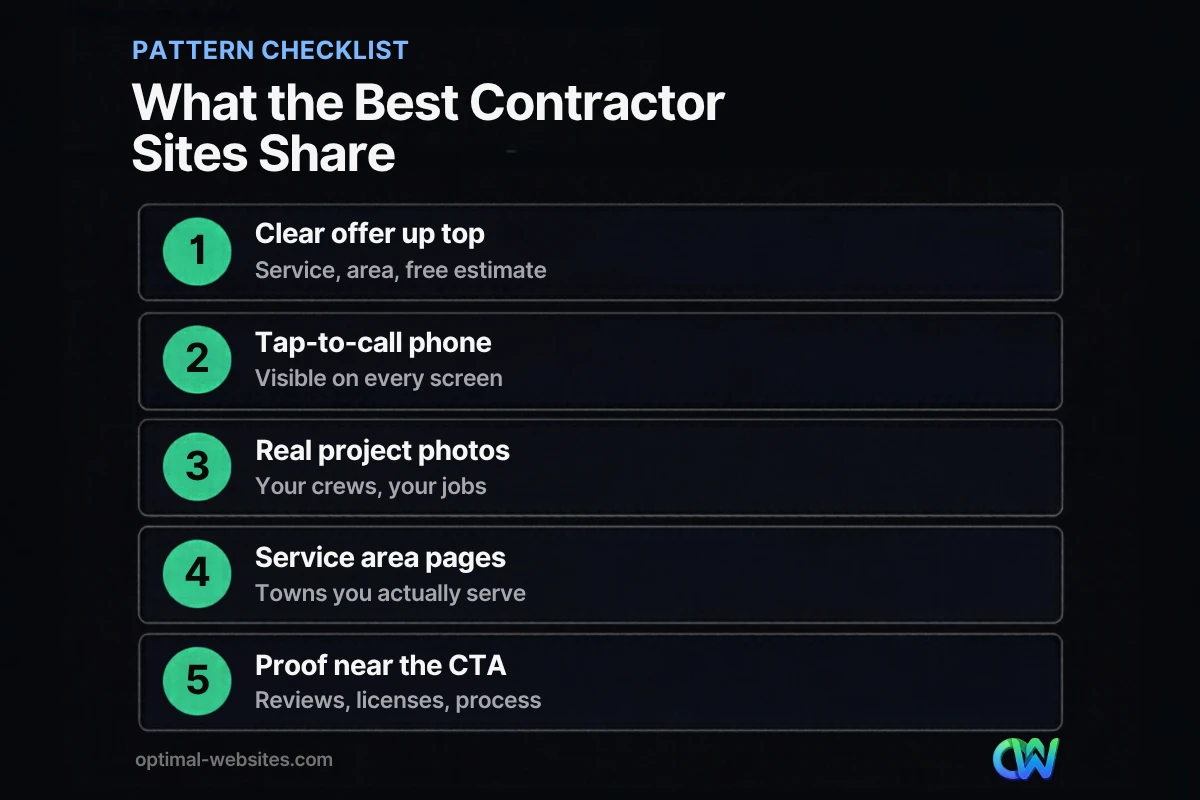
Quick answer: The best contractor website examples share a few patterns: a clear offer and service area above the fold, a tap-to-call number on every screen, real photos of their own projects, a page for each service and town they serve, and reviews placed right next to the estimate form. Copy the patterns, not the look.
You have probably browsed a dozen competitor sites and come away with a vague sense that some look better than yours. Looks are not the real difference, though. The contractor sites that win jobs make it easy for a homeowner or facility manager to understand what you do, trust you, and ask for an estimate in under a minute. This post walks through contractor website examples by pattern rather than by brand, using what we see across roofing, remodeling and commercial construction sites we build. You will leave with a checklist of contractor website ideas you can apply to your own site, whatever platform it runs on.
Key Takeaways
- The best contractor websites win on clarity and speed, not flashy design.
- Every strong example states the service, the area and the next step in the first screen.
- Real project photos and nearby reviews do more for trust than stock images and badges.
- Separate service and service area pages help both visitors and local search.
- Use contractor website examples for patterns; build your own site around your actual services and market.
Why Study Contractor Website Examples at All?
Studying contractor website examples shows you which layouts and features help visitors take action, so you can apply those patterns instead of guessing. The goal is not to copy a design, but to learn what the best contractor websites consistently get right.
Visitors decide quickly. Nielsen Norman Group found that users often leave web pages within 10–20 seconds, unless the page clearly shows value early. For a contractor, that means the first screen has to answer three questions: what do you do, where do you work, and how do I get a price?
If you are planning a full build rather than looking for inspiration, start with our contractor website design guide, which covers pages, features and budget.
What Do the Best Contractor Websites Show Above the Fold?
The best contractor websites put a plain headline, the service area and one main call to action in the first screen. Visitors should know within seconds whether you do their kind of job in their town.
Pattern 1: The offer and the area in one line
Strong examples say something like “Roof Replacement and Repair in North Fulton and Gwinnett County” rather than “Quality You Can Trust.” On the PCS Roofs site we built, the service area is named on the homepage and the main button offers a free inspection. Peachtree Corners Services leads with a headline that names its trades (roofing, decks and home renovation) and its town.
Pattern 2: One primary call to action
Pick one main action: free estimate, free inspection or a call. Repeat it in the header, after key sections and at the bottom. Two or three competing buttons with different wording slow people down.
Pattern 3: A phone number you can tap
Many contractor leads still come by phone, and most people browse on their phones. Pew Research Center’s mobile fact sheet reports that 91% of U.S. adults own a smartphone. A tap-to-call number in a sticky header removes a step between interest and a call.
How Do Strong Sites Build Trust Fast?
Strong contractor sites build trust by showing proof close to the decision point: reviews, real project photos, licenses and a simple explanation of the process. Proof works best when it sits right next to the estimate button, not on a separate page nobody visits.
Real project photos, not stock
Homeowners can spot stock photos of smiling models in hard hats. The best construction website examples use their own job photos: before and after shots, crews on site, finished kitchens or roofs. Photos do not need to be perfect, but they must be yours.
A clear process
Several sites we admire break the job into three to five steps, from inspection to cleanup. PCS Roofs uses a named process section on its homepage. A simple process removes the fear of the unknown, which is a big reason people delay calling.
Reviews with names and context
Short quotes with a first name, town and project type (“Kitchen remodel, Norcross”) read as real. Pull a few to the homepage and next to the form.
What Pages Do the Best Contractor Websites Include?
The best contractor websites include a separate page for each main service, pages for the towns or counties they serve, a project gallery, an about page with the team, and a contact page with a short form. Each page targets one kind of search and one kind of customer.
| Page | What it does | Common mistake |
|---|---|---|
| Home | States offer, area and main CTA | Vague slogan, no phone number |
| Service pages | One page per service with details and photos | One “Services” page listing everything |
| Service area pages | Shows local work in each town served | Copy-pasted pages with only the town name changed |
| Projects / gallery | Proves quality with your own photos | Stock images or an empty gallery |
| About | Shows the people, licensing and history | Generic mission statement |
| Contact / estimate | Short form, phone, hours, area | Long form with ten required fields |
For roofing in particular, our roofing website design guide goes deeper into storm damage, insurance and inspection pages.
How Do Commercial and Residential Examples Differ?
Residential contractor websites sell to homeowners making an emotional, high-stakes purchase. Commercial and construction company sites sell to owners, developers and facility managers who care about capability, safety and track record.
Care Facilities Construction is a good illustration of the commercial side. Its homepage talks about “critical spaces” and the organizations it supports, and it gives testimonials and a contact section a prominent place. E & S Construction Engineers keeps its site focused on services, business philosophy and a direct “let’s work together” contact path.
| Focus | Residential contractor | Commercial / construction firm |
|---|---|---|
| Main CTA | Free estimate or inspection | Contact for a project discussion |
| Proof | Reviews, before and after photos | Project portfolio, sectors served, safety |
| Tone | Friendly, reassuring | Professional, capability-focused |
| Key pages | Services, areas, financing, FAQ | Markets, capabilities, projects, team |
Our post on construction company website design covers the commercial side in more detail.
Which Contractor Website Ideas Help With Local SEO?
The contractor website ideas that help local SEO most are separate service pages, genuine service area pages, consistent business details and structured data. They help Google connect your site with searches in the places you actually work.
Add LocalBusiness structured data so search engines can read your name, address and hours. Keep your name, address and phone identical to your Google Business Profile. And write each area page around real work in that town (a project, a common local issue, a neighborhood you serve) instead of swapping the city name into the same template.
What Should You Avoid Copying?
Not everything on a popular site is worth copying. Watch out for these:
- Autoplay video backgrounds that slow the page on mobile data.
- Sliders that rotate messages before anyone reads them.
- Long forms asking for budget, timeline and how they heard about you before a first call.
- Badges without substance, such as award logos you cannot link to.
- Copied text from another contractor’s site, which hurts trust and search visibility.
The best contractor website examples look simple because someone made hard choices about what to leave out.
How We Apply These Patterns
At Optimal Websites, a WordPress web design agency based in Delaware, we build contractor sites in Elementor Pro with these patterns as defaults: mobile-first layouts, a sticky header with tap-to-call, one estimate CTA repeated through the page, real project galleries and separate service and area pages. You can see the roofing, construction and home service projects in our portfolio. Each site looks different because each business is different, but the structure that drives calls stays the same.
How Optimal Websites Can Help
If your site looks fine but the phone is quiet, the problem is usually structure, not style. Our web design services cover planning, design and a mobile-first build in WordPress and Elementor Pro, with packages starting at $999 and most projects launching in 2–4 weeks. We will review what your current site does well and what it is missing before recommending anything.
Frequently Asked Questions
What makes a good contractor website?
A good contractor website clearly states your services and service area, offers one obvious next step like a free estimate, and shows proof such as real project photos and reviews. It loads quickly on phones and makes the phone number easy to tap. Most strong contractor website examples have simple layouts with very clear wording.
Where can I find the best contractor websites for inspiration?
Search for your trade and a few large cities, then study the sites that rank in the top results and the map pack. Look at the first screen, the main call to action, the service pages and the contact form. Agency portfolios are also useful. Focus on patterns, and avoid copying text or images from any site.
How many pages should a contractor website have?
Most contractor websites need a home page, one page per main service, pages for the main towns or counties served, a project gallery, an about page and a contact page. For many local contractors, that adds up to a dozen pages or more. A single-service business can start smaller and add pages as it grows.
Should contractors show prices on their website?
Exact prices are rarely possible because every job differs, but you can still help. Many contractors share typical ranges, explain what affects cost, or describe their free estimate process. That kind of transparency answers a top question visitors have and filters out leads that are not a fit, without locking you into a quote.
Are construction website examples different from home service sites?
Yes. Construction website examples for commercial firms focus on capabilities, sectors served, safety and a project portfolio, and the main action is usually a project inquiry. Home service and residential contractor sites focus on reviews, before and after photos, financing and a free estimate. Both need clear structure and fast mobile pages.
Do roofing websites need anything special?
Roofing websites benefit from pages for repair, replacement, storm damage and inspections, plus clear information on insurance claims and warranties. Before and after photos of roofs you have completed are strong proof. For roofing website inspiration, look at how top local roofers handle emergency calls and inspection offers on mobile.
Ready to Get Started?
Want a contractor website built around the patterns that bring in estimates? Request a free quote or call (302) 554-9497 to talk about your services and service area.


