
Quick answer: An about us page tells visitors who runs your business, what you do, who you serve and why they can trust you. The best ones open with a clear one-line summary, tell a short company story, show real team photos with names, add proof such as licenses and reviews, and end with an easy next step to contact you.
Before someone calls a roofer, signs with a law firm or books a contractor for a six-figure project, they want to know who they are dealing with. Many of them click “About” to find out. If that page is a wall of vague text about “passion” and “quality,” with a stock photo of a handshake, the visitor leaves with more doubts than answers, and often calls a competitor instead. A strong about us page does the opposite: it answers the trust questions that stand between a visit and a lead. This guide covers what to include, how to structure it, examples by industry and the mistakes that make About pages fall flat.
Key Takeaways
- An about us page is a trust page: it answers “Who are these people, and can I rely on them?”
- Start with a plain summary of what you do and who you serve, then tell a short company story.
- Real photos of real people, with names and roles, beat stock imagery every time.
- Back up your claims with proof visitors can check: licenses, awards, reviews and past projects.
- End with a clear next step, such as a phone number or a free quote button.
What Is an About Us Page?
An about us page is the page on your website that explains who your business is, who works there, what you stand for and why customers should trust you. It is usually linked from the main menu and the footer, and it is one of the core pages on almost every business site.
It is not a place for your full résumé or a list of every service. Service details belong on service pages, and the full list of essential pages every business website needs covers the rest of your site. The About page has one job: turn a curious visitor into someone who believes you are real, qualified and easy to work with.
Why Does an About Us Page Matter for a Small Business?
An about us page matters because people check who is behind a business before they hand over their money, their home or their legal problem. For a small business without a household name, this page often does the job that brand recognition does for large companies.
Research backs this up. In Nielsen Norman Group’s research on About Us information, published in 2019 after testing with more than 70 users across 100 websites, the researchers found that users “now expect companies to demonstrate a heightened level of authenticity and transparency.” They also found that when users could not find answers on a company’s own site, they simply searched elsewhere.
The Stanford Guidelines for Web Credibility reached a similar conclusion years earlier. Two of its ten guidelines are to “show that there’s a real organization behind your site” and to show “that honest and trustworthy people stand behind your site.” An About page is the most natural place to do both.
Search engines care about “who,” too
Google’s own guidance on helpful, people-first content asks whether readers can find “background about the author or the site that publishes it.” A clear About page supports the signals Google describes as E-E-A-T: experience, expertise, authoritativeness and trust. It will not rank you on its own, but it makes the rest of your site more believable to people and search engines alike.
What Should You Include on an About Us Page?
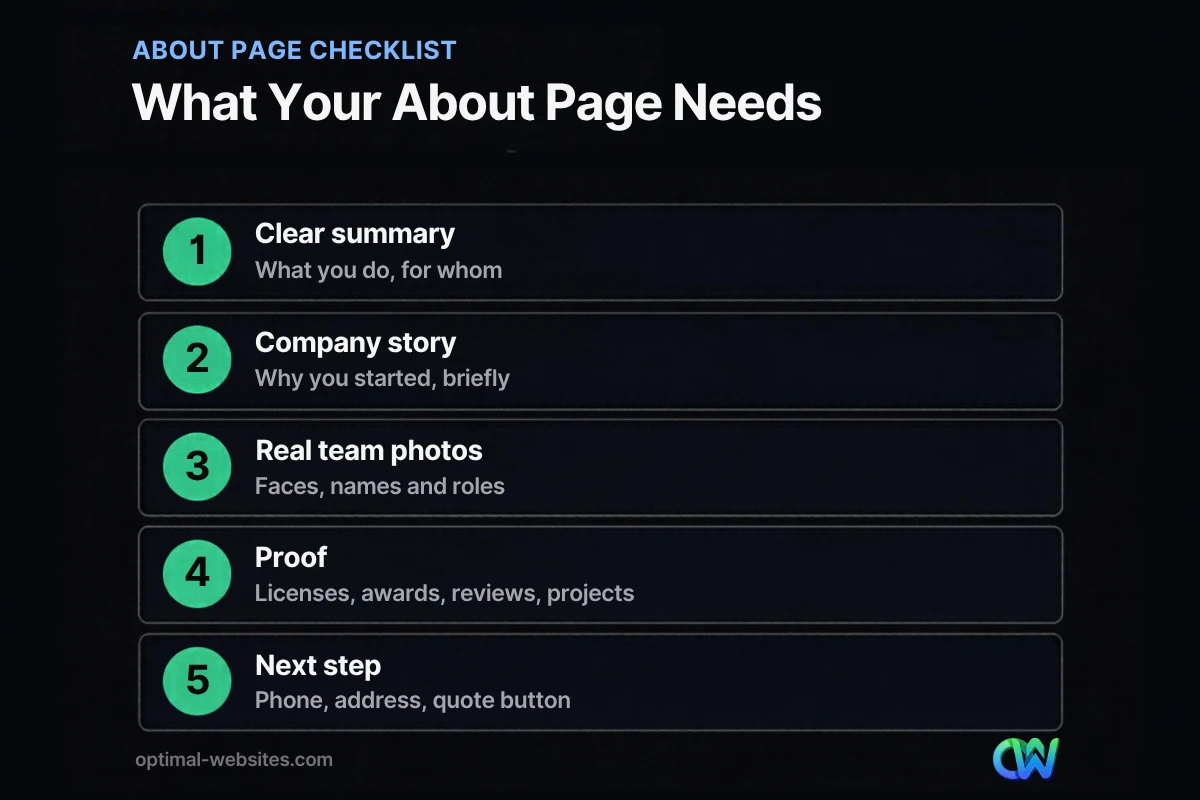
Include five things: a clear summary of what you do, a short company story, the real people behind the business, proof that you are qualified, and a simple next step. Everything else is optional.
1. A one-line summary at the top
Open with a sentence that says what you do, for whom and where. For example: “We are a family-owned roofing contractor serving homeowners and property managers in Gwinnett County since 2009.” NN/g’s researchers put it plainly: “you must provide a clear explanation of what your company does.” Visitors should not have to read three paragraphs to find out.
2. Your company story
A company story is a short explanation of why the business exists and how it got here. Keep it to a few paragraphs: when and why you started, what changed along the way, and what you still care about today. Specific details (the first truck, the year you hired your first employee, the type of client you built the firm around) are more memorable than adjectives.
3. The real people behind the business
Show faces. Use real photos of owners and key staff, each with a name, a role and one or two lines about their background. For many small businesses this section works as a team page in its own right. If you have a larger staff, keep leadership on the About page and link to a separate team page.
4. Proof you can back up
Claims like “trusted” and “experienced” mean little without evidence. Add things visitors can verify:
- Licenses, certifications and insurance (with numbers where your industry expects them)
- Industry memberships and awards, with the year and the awarding body
- A few short testimonials, ideally linked to reviews on Google or another third-party site
- Photos of completed projects or a link to your portfolio
NN/g found that reviews from trusted peers are “one of the most important criteria” people use to judge a company, and that users compare a site’s testimonials with outside review sites. For tips on picking and placing quotes, see our guide on how to use website testimonials.
5. A clear next step
End with a way to act: a phone number, your address or service area, and a button to request a quote or book a consultation. The Stanford guidelines recommend making it easy to contact you with a phone number, physical address and email address. A visitor who just decided to trust you should not have to hunt for how to reach you.
How Do You Write a Company Story People Actually Read?
Write it like you would tell it to a new client across a table: short, specific and in plain language. Lead with the customer’s problem you set out to solve, not with your founding date.
A simple structure works for most businesses:
- The start: what you noticed or what frustrated you that made you open the business.
- The turning point: a moment that shaped how you work today, such as a key hire, a new service line or a hard lesson.
- The promise: what clients can count on from you now.
- The proof: one or two facts that support that promise.
Keep sentences short and use “we” and “you.” Avoid filler words such as “passionate,” “innovative” and “world-class” unless you can show what they mean. The same clear, benefit-first writing approach we cover in writing a service page that converts applies here: say what the reader gets, then prove it.
What Do Good About Us Page Examples Have in Common?
Good about us page examples share three traits: they are specific to the industry, they show real people, and they make the next step obvious. What changes is the kind of proof each industry needs.
| Industry | What visitors want to know | Proof to feature |
|---|---|---|
| Roofing and home services | Are you licensed, insured and local? | License and insurance details, service area, project photos, review rating |
| Construction and engineering | Can you handle a project of our size? | Years in business, project types, safety record, certifications |
| Law firms | Who will handle my case, and are they qualified? | Attorney bios, bar admissions, practice areas, education |
| Healthcare and care facilities | Can I trust you with my family? | Credentials, staff photos, accreditations, values |
| Startups and founders | Who is behind this, and why now? | Founder story, mission, early customers or partners |
Notice that none of these require a long page. A roofing company’s About page can be short if it shows the crew, the license and the service area clearly. A law firm’s About page usually needs more depth because visitors choose a person, not just a firm.
What Are the Most Common About Us Page Mistakes?
The most common mistake is writing about yourself in general terms instead of answering the visitor’s trust questions. Most other problems come from that one.
- Vague copy. “We are committed to excellence” tells the reader nothing. Replace it with a fact.
- Stock photos of people who do not work there. NN/g lists stock photography among the factors that hurt users’ impressions, while authentic imagery helps.
- A wall of text. Break the page into short sections with headings, photos and bullet points.
- No contact information. Put a phone number and a quote button on the page itself.
- Outdated details. A team photo from eight years ago with people who have left raises doubts. Review the page at least once a year.
- Poor mobile layout. Many visitors check you out on a phone, so test that photos, bios and buttons work on small screens.
How Long Should an About Us Page Be?
Most small business About pages work well at roughly 300 to 800 words plus photos. That is enough to cover the summary, story, people and proof without losing the reader.
Length should follow what your visitors need. A plumber or landscaper can keep it short and visual. A law firm, engineering firm or healthcare provider may need longer bios and more detail on credentials. If a section grows too large, give it its own page, such as a team page or a page for each attorney, and link to it from the About page.
How We Build About Pages at Optimal Websites
When we build WordPress sites with Elementor Pro, we treat the About page as part of the sales path, not a formality. We plan it during content gathering, ask clients for real team and project photos early, and design the page mobile-first so bios and buttons are easy to read on a phone.
We have built sites for contractors such as PCS Roofs and E & S Construction Engineers, for law firms such as Wright Ryon & Maher and F. J. Collins Law, and for organizations like Care Facilities Construction and Peachtree Corners Services. The trust questions differ by industry, so the About page layout differs too: crews and project photos for builders, attorney bios and credentials for law firms. Because every site comes with video tutorials, clients can update team members and photos themselves as the business changes.
How Optimal Websites Can Help
If your About page is thin, outdated or missing, it may be costing you calls you never hear about. Optimal Websites, a WordPress web design agency based in Delaware, plans and builds About pages as part of complete, conversion-focused sites. Our web design services cover structure, copy guidance and mobile-first layout, and most projects launch in 2–4 weeks. You can compare our website packages and pricing, which start at $999 for the Starter package.
Frequently Asked Questions
What should be on an about us page?
An about us page should include a short summary of what your business does and who it serves, a brief company story, real photos and names of the people behind the business, proof such as licenses, awards and reviews, and a clear way to contact you. Keep each part short and specific so visitors can scan it quickly and decide whether to trust you.
How do you write an about page for a small business?
To write an about page for a small business, start with one sentence that says what you do, for whom and where. Then tell your company story in a few short paragraphs, introduce the owner and key staff with photos, add proof visitors can verify and finish with a phone number or quote button. Write in plain language, as if speaking to a new client.
What is the difference between an about us page and a team page?
An about us page explains the whole business: its story, purpose, proof and people. A team page focuses only on the people, with photos, roles and bios for each staff member. Small businesses often combine both on one page. Larger firms, such as law practices with several attorneys, usually keep a separate team page and link to it from the About page.
Should I put prices on my about us page?
Usually no. Your about us page is for building trust, so prices belong on a pricing or service page instead. You can mention how you work, such as free consultations, written quotes or a deposit structure, if that reassures visitors. Then link to your pricing page or quote form so people who are ready to talk numbers can find them quickly.
Does an about us page help SEO?
An about us page helps SEO indirectly. It rarely ranks for valuable keywords on its own, but it supports trust signals Google describes in its helpful content guidance, such as clear information about who runs the site. It can also rank for searches on your business name and strengthen the credibility of your service pages and blog posts.
How often should I update my about us page?
Review your about us page at least once a year and whenever something important changes, such as a new owner, key hire, award, license or service area. Outdated team photos and old numbers make visitors wonder whether the business is still active. If your site runs on WordPress, a quick update to text and images usually takes only a few minutes.
Where should I put the about us link on my website?
Put the about us link in your main navigation menu and in the footer. Usability research from Nielsen Norman Group found that users often scroll to the footer when they cannot find something in the main menu. Many businesses also link to the About page from the homepage, near a short intro section or a team photo.
Ready to Get Started?
Want an About page, and a full website, that makes visitors confident enough to call? Request a free quote or call us at (302) 554-9497 to talk about your project.


