
Quick answer: Website testimonials convert when they are real, specific and placed where visitors make decisions. Use a customer’s name, town and project type, quote what changed for them, put the best quotes next to forms and call buttons, match quotes to each service page, and never fake, buy or edit reviews to change their meaning.
Visitors do not take your word for it. They want to know that people like them hired you and were glad they did. That is what social proof does, and website testimonials are the most direct form of it. Yet on many small business sites, testimonials sit on a forgotten page, carry no names, and say little more than “Great service!” In this guide you will learn how to collect testimonials worth showing, where to place them so they help conversions, how to use customer reviews on website pages without breaking platform rules, and what the FTC’s rule on fake reviews means for your business.
Key Takeaways
- Specific, attributed testimonials build more trust than short, anonymous praise.
- Place testimonials next to calls to action and on service pages, not only on a separate testimonial page.
- Match each testimonial to the service or audience of the page it appears on.
- The FTC prohibits fake reviews, insider reviews without disclosure, and paying for reviews with a particular sentiment.
- Google does not show star ratings for reviews a business publishes about itself on its own site.
What Are Website Testimonials and Why Do They Work?
Website testimonials are short statements from real customers describing their experience with your business, published on your website. They work because they are social proof: evidence that other people chose you and were satisfied, which lowers the risk a new visitor feels.
For local services, that risk is real. Hiring a roofer, a lawyer or a contractor means letting a stranger into your home or your affairs. A testimonial from someone in the same town, describing the same kind of job, answers the question “will this work out for me?” better than anything you say about yourself.
Testimonials are one of several conversion tools covered in our guide on how to get more leads from your website.
What Makes a Testimonial Convincing?
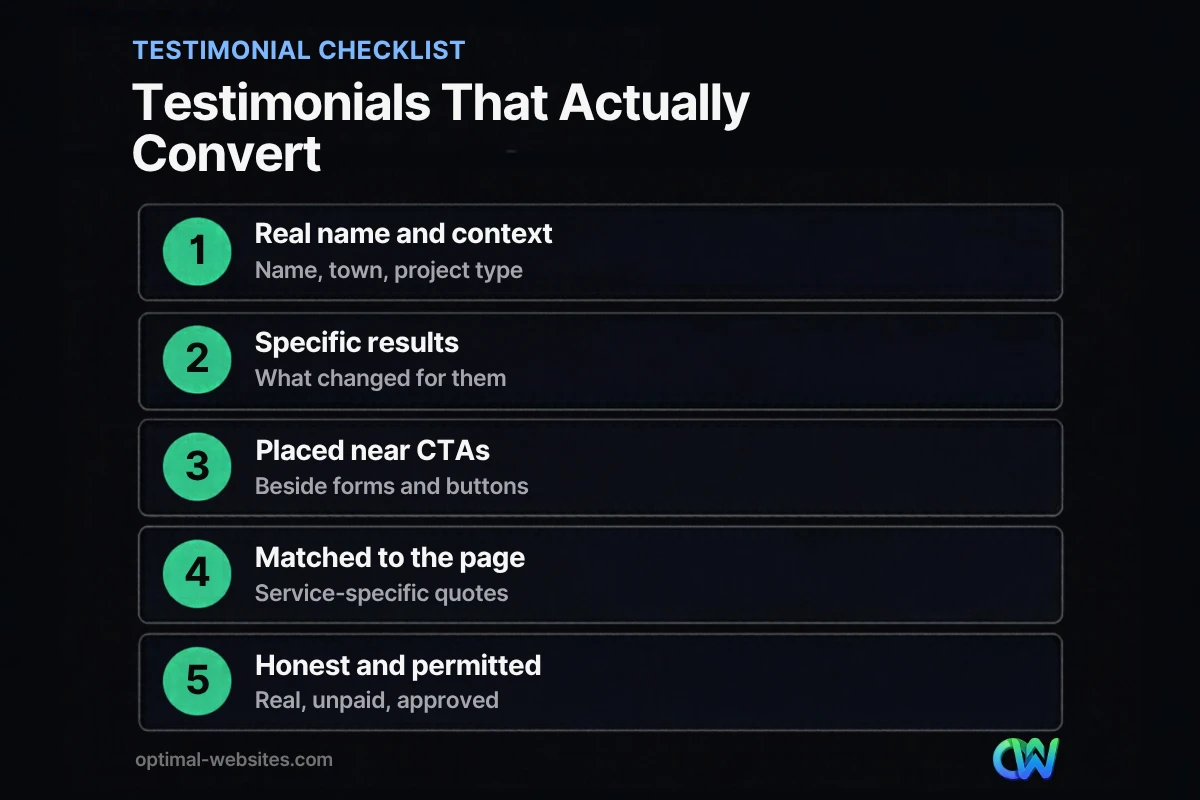
A convincing testimonial is specific, attributed and relevant. It names who said it, describes the situation, and mentions a concrete outcome or detail that only a real customer would know.
| Weak testimonial | Strong testimonial |
|---|---|
| “Great service, highly recommend!” | “They replaced our roof in two days and cleaned up every nail. The crew explained each step.” |
| Anonymous | First name, town, project type |
| Generic praise | Specific detail and outcome |
| Same quote on every page | Matched to the service on that page |
| Text only | Text plus photo of the person or project, with permission |
What to include with each testimonial
- Name: full name or first name and last initial, with permission
- Context: town, company (for B2B), and the service they used
- Specific detail: timeline, problem solved, how they felt
- Optional photo: a headshot or photo of the finished project
Where Should You Place Testimonials on Your Website?
Place testimonials where visitors hesitate: next to forms, near call-to-action buttons, on service pages and on the homepage. A testimonial page alone is rarely enough, because few visitors go looking for it.
- Next to your contact form. A short quote beside the form answers last-second doubts.
- On each service page. Use quotes from customers who bought that service.
- On the homepage. Two or three of your strongest, near the main call to action.
- On landing pages. Match the testimonial to the offer in the ad.
- On a testimonial page. Useful as a full archive and for visitors who want more proof.
This placement is one of the core patterns of a lead generation website: proof sits beside every action you want visitors to take.
How Do You Collect Better Testimonials?
You collect better testimonials by asking at the right moment and asking the right questions. The best time is right after a successful job or a milestone, when the customer is happiest and the details are fresh.
Ask three simple questions:
- What problem did you have before you contacted us?
- What was it like working with us?
- What changed after the job was done?
Their answers give you a natural before, during and after story. Ask permission to publish their name, town and any photo, and keep a record of that permission. If you tidy grammar or shorten a quote, keep the meaning intact and send the final version back for approval.
Many businesses also invite customers to leave a Google review at the same time. Our guide on how to get more Google reviews covers a simple request process.
Should You Use Review Widgets?
Review widgets pull reviews from Google, Facebook or other platforms and display them on your site. They are useful because they show reviews that visitors can verify on a third-party platform, and they update automatically.
The trade-offs:
- Speed: some widgets load heavy scripts and slow your pages. Test before and after adding one.
- Control: you cannot always choose which reviews appear or how they look.
- Platform terms: follow each platform’s rules for displaying its reviews.
A good compromise is a lightweight widget or a static selection of reviews with a link to your Google Business Profile, so visitors can read the rest.
What Are the Rules for Customer Reviews on Your Website?
The rules are simple: testimonials must be real, from real customers, reflecting their honest experience. The Federal Trade Commission’s final rule, announced in August 2024, bans fake reviews and testimonials, prohibits paying or offering incentives for reviews with a particular sentiment, requires clear disclosure when reviews come from company insiders, and prohibits threats or intimidation to suppress negative reviews.
Practical guardrails:
- Never write testimonials yourself or have staff pose as customers.
- Do not offer discounts or gifts only for positive reviews.
- Do not edit a quote in a way that changes what the customer meant.
- Disclose relationships, such as a review from a relative or employee.
- Check any extra rules in your industry, such as professional conduct rules for attorneys or privacy rules for healthcare providers.
Will testimonials show stars in Google?
Usually not for your own business. Google’s review snippet guidelines say star ratings for local businesses and organizations are only eligible when a site captures reviews about other businesses. Reviews you publish about yourself are considered self-serving, so adding review markup for them will not produce stars in search results.
How to Build a Testimonial Page That Works
A testimonial page works best as an organized archive, not a wall of text. Group testimonials by service or industry, add photos where you have permission, and include a call to action at the top and bottom.
Checklist for a testimonial page:
- Clear headline (“What our customers say about our roofing work”)
- Filters or sections by service
- Mix of short quotes and a few longer stories
- Project photos alongside related testimonials
- Link to your Google reviews for independent proof
- A contact form or quote button
How We Use Social Proof in Our Builds
At Optimal Websites, a WordPress web design agency based in Delaware, we design social proof into every page instead of treating it as an afterthought. In Elementor Pro builds for contractors, law firms and local service businesses, we place testimonials beside forms, match quotes to service pages, and keep review displays light so they do not slow the site. You can see how this looks across industries in our portfolio.
How Optimal Websites Can Help
If your testimonials are hidden or generic, we can help you collect better ones and put them where they matter. Our lead generation services cover page structure, forms, social proof placement and tracking, so you can see which changes bring in more inquiries.
Frequently Asked Questions
Where should I put testimonials on my website?
Put website testimonials where visitors decide: next to contact forms, near call-to-action buttons, on each service page and on the homepage. A separate testimonial page is useful as an archive, but most visitors never visit it, so the best quotes should appear on the pages where people take action.
How many testimonials should a website have?
There is no fixed number. Aim for two or three strong, relevant testimonials on each key page, plus a fuller collection on a testimonial page. Quality matters more than quantity: a few specific, attributed quotes from real customers do more than a long list of short, anonymous praise.
Can I edit customer testimonials?
You can fix spelling or shorten a testimonial for length, but you should not change its meaning or add claims the customer did not make. Send the edited version back to the customer for approval and keep a record of their permission. Editing that misrepresents their experience can mislead visitors and break FTC rules.
Is it legal to pay for testimonials or reviews?
The FTC’s rule prohibits offering compensation or incentives conditioned on reviews expressing a particular sentiment, and it bans fake reviews and undisclosed insider reviews. You can ask every customer for honest feedback, but you should never reward only positive reviews. Check any extra rules that apply to your industry.
Are review widgets good for SEO?
Review widgets mainly help conversions, not rankings. They show verifiable social proof from platforms like Google, which builds trust. Some widgets load heavy scripts that slow pages, so test speed after adding one. Google also does not show stars in search results for reviews a business displays about itself.
What is the difference between testimonials and reviews?
Testimonials are statements you collect directly from customers and publish on your website with permission. Reviews are posted by customers on third-party platforms such as Google or Facebook. Both are social proof. Reviews are independent and verifiable, while testimonials let you choose relevant, detailed stories for specific pages.
Ready to Get Started?
Want social proof that turns more visitors into leads? Request a free quote or call (302) 554-9497 to talk about your website.


