
Quick answer: To choose a domain name for your business, pick something short, easy to say and spell, and close to your brand name. Prefer .com when it is available, avoid hyphens and numbers, check trademarks before you buy, and register it in your business’s name with an accredited registrar and auto-renew turned on.
Your domain name shows up everywhere: on your website, every email, your truck wraps, business cards, invoices and Google results. Pick a confusing one and customers mistype it, forget it or land on someone else’s site. Pick one you do not control and you can lose it at renewal time. Learning how to choose a domain name takes an hour, but the decision usually lasts for the life of the business, so it is worth getting right. This guide covers practical domain name tips, how to compare .com vs other extensions, what to check before you buy and how to register a business domain name so it stays yours.
Key Takeaways
- The best business domain name is short, easy to spell after hearing it once, and matches how customers already say your name.
- Choose .com if you can get it. Google treats newer extensions the same in search, but customers still default to .com.
- Check trademarks and existing businesses before you buy, not after you print signs.
- Register the domain in your business’s name, keep the registrar login yourself and turn on auto-renew.
- Changing domains later is possible but slow and disruptive, so choose one that fits your long-term plans.
What Is a Domain Name?
A domain name is your business’s address on the internet, such as yourbusiness.com. It points visitors to your website and powers your email addresses, so customers use it every time they find or contact you.
Every domain has two main parts: the name itself (yourbusiness) and the extension, also called the top-level domain or TLD (.com). You do not buy a domain forever. You register it for a set period through a domain registrar and renew it before it expires. As the SBA’s guide to choosing a business name explains, a registered domain stays yours as long as you keep renewing it.
The scale is large. Verisign’s Domain Name Industry Brief reported 401.6 million domain name registrations across all top-level domains at the end of the second quarter of 2026. That is why short, obvious names are hard to find and why a little creativity helps.
How to Choose a Domain Name: 10 Practical Tips
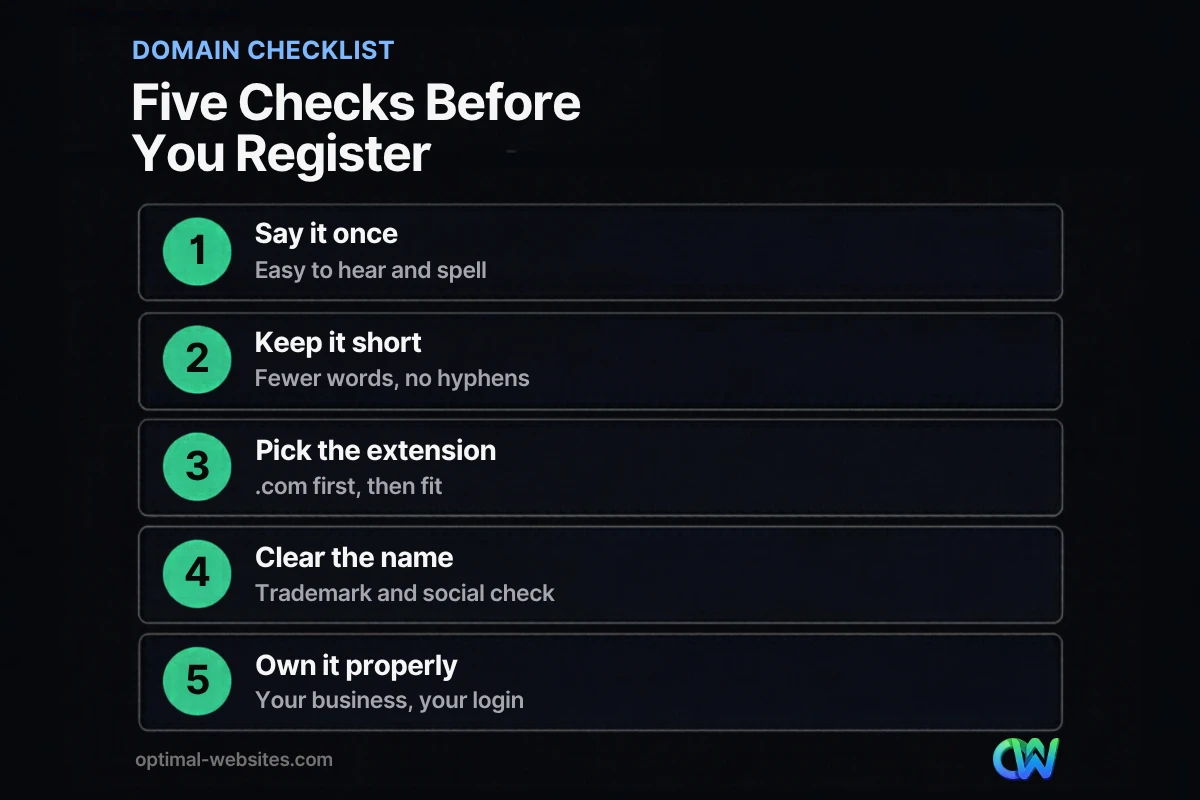
The short version of how to choose a domain name: make it easy to say, easy to spell, short, on-brand and legally clear. These ten domain name tips cover what we check with clients before a single page gets designed.
1. Start with your business name
Your domain should match the name customers already use. If people call you “Smith Roofing,” then smithroofing.com beats a clever phrase they have never heard.
2. Pass the “radio test”
Say the domain out loud to someone and ask them to type it. If they hesitate over spelling, double letters or homophones (for vs four, to vs two), customers will too. A name that only works in writing loses phone and word-of-mouth referrals.
3. Keep it short
Shorter domains are easier to remember and fit better on vehicles, yard signs and email signatures. There is no magic character limit, but two or three simple words is a practical ceiling for most small businesses.
4. Avoid hyphens and numbers
Hyphens and numerals are hard to communicate verbally (“is that dash or no dash?”) and often send traffic to the unhyphenated version owned by someone else.
5. Add a location or service if the name is taken
If yourname.com is gone, adding a city, region or service word is a clean fix: yournamedelaware.com or yournamelaw.com. The SBA even gives a location-based example and notes that your domain does not have to match your legal business name exactly.
6. Do not stuff keywords
Exact-match domains like best-cheap-plumber-dover.com look spammy, are hard to brand and do not give you a shortcut in rankings. Strong content, a fast site and real reviews matter far more for SEO than keywords in the address.
7. Think long term
Avoid names that box you in. A domain built around one product, one town or one founder’s nickname can become a problem when you expand. Google has said that domain changes can take time to be processed for Search and that it is generally best to choose a domain that fits your long-term needs.
8. Check for trademark conflicts
A domain that infringes on someone else’s trademark can lead to a dispute or even a lawsuit. The SBA recommends searching the U.S. Patent and Trademark Office database before settling on a name. Under ICANN’s Uniform Domain-Name Dispute-Resolution Policy, trademark holders can also file complaints against abusive registrations.
9. Check social handles at the same time
Before you buy, check whether the same name is available on the social platforms you plan to use. Matching handles make your brand consistent and easier to tag, search and recommend.
10. Buy the obvious variations
If budget allows, register common misspellings or the .net version and redirect them to your main domain. This protects customers who mistype and makes it harder for someone else to use a confusingly similar address.
.com vs Other Extensions: Which Should You Choose?
For most US small businesses, .com is still the safest choice because it is the extension customers assume and type by default. Other extensions can work well when the .com is taken or a specific extension fits your industry.
There are now more than 1,400 top-level domains in the IANA root zone, from .net and .org to .law, .roofing and .construction. Search engines do not reward or punish most of them. Google’s guidance on new top-level domains states that its systems treat new gTLDs like other gTLDs, and that keywords in a TLD do not give any advantage or disadvantage in search.
| Extension | Best for | Watch out for |
|---|---|---|
| .com | Almost any US business | Short names are scarce |
| .net / .co | A close alternative when .com is taken | Customers may still type .com |
| .org | Nonprofits and associations | Can confuse buyers of a for-profit service |
| .us | US-focused businesses | Less familiar to some customers |
| Industry TLDs (.law, .roofing, .construction) | Memorable, descriptive brands | Renewal prices can be higher |
| Country codes (.uk, .ca) | Businesses targeting that country | Google uses most of them to geotarget |
Google uses most country codes to geotarget a site, so a US business should not pick a foreign country code just because it looks like a word.
How Do You Pick a Domain Registrar?
A domain registrar is the company that registers the domain on your behalf and lets you renew, transfer and manage it. Choose an ICANN-accredited registrar with clear renewal pricing, simple DNS management, two-factor login and easy transfers.
ICANN publishes a searchable list of accredited registrars, and the SBA recommends using an accredited registrar for your registration. Rather than chasing the lowest first-year price, compare these points:
- Renewal price, not just the introductory price. The second year is often what you will pay for the next decade.
- Privacy options, so your personal contact details are not exposed where the registrar offers it.
- Security features, including two-factor authentication and a transfer lock. ICANN describes the “clientTransferProhibited” status as one that tells the registry to reject transfer requests until you remove it.
- DNS management that lets you or your web team add records for your website and email without support tickets.
- Transfer policy and fees, so you can move later if service slips.
ICANN’s registrant rights and responsibilities says registrars must give you clear information about pricing, renewals and transfers, and must not use deceptive practices or hidden fees. It also puts responsibilities on you: keep your contact details accurate, respond to your registrar within 15 days when asked, and keep payment information current if you use auto-renew.
You can register the domain with your hosting company or separately. Keeping them separate adds one more login, but it means a hosting problem never puts your domain at risk. Our guide to website hosting cost explains how hosting and domain fees fit into your yearly budget.
How Do You Register a Business Domain Name the Right Way?
Register your business domain name in the company’s name, using an email address the business controls, with auto-renew on and a calendar reminder as backup. Those three steps prevent most of the domain problems we see.
- Search availability at an accredited registrar and shortlist two or three options.
- Run your checks: say it out loud, search trademarks and look up social handles.
- Register in the business’s name, not a former employee’s or a designer’s personal account.
- Use a shared business email for the account, such as admin@ or office@, so access does not leave with one person.
- Turn on auto-renew and two-factor authentication, and keep your payment card up to date.
- Store the login safely in a password manager that more than one owner or manager can access.
Renewal reminders are required, but do not rely on them alone. Under ICANN’s Expired Registration Recovery Policy, registrars must send at least two notices before a gTLD domain expires, roughly one month and one week ahead, plus another shortly after expiration. Those emails go to the contact on file, which is exactly why an outdated personal address causes so many lost domains.
Also plan for transfers. ICANN’s Transfer Policy allows a registrar to deny a transfer requested within 60 days of a domain’s creation or a previous transfer, and a change of registrant can trigger a 60-day transfer lock unless you opt out. If you are buying a domain to move it elsewhere, expect that waiting period.
What Mistakes Should You Avoid When Choosing a Domain?
The most expensive domain mistakes are about ownership and long-term fit, not spelling. Letting someone else own your domain or picking a name you will outgrow costs far more to fix than choosing carefully up front.
- Letting a web designer or employee register it in their name. If the relationship ends, you may lose your website and email at the same time.
- Ignoring renewal emails sent to an inbox nobody checks.
- Buying a foreign country code like .co.uk or .ly as a design choice without understanding how it affects search.
- Changing domains casually. A domain move means redirects, updated listings, new email addresses and time for search engines to process the change.
Your domain also becomes your email address. Once it is registered, take the next step and set up a business email domain so every message matches your website.
When we start a new WordPress build at Optimal Websites, one of the first questions we ask is simple: “Who has the login to your domain registrar?” For contractors, law firms and local service businesses, the answer is often a former employee or a past designer, and sorting that out before launch saves real headaches later.
How Optimal Websites Can Help
Optimal Websites, a WordPress web design agency based in Delaware, helps small businesses get the foundation right before the first page is designed. We can help you compare domain options, confirm ownership is in your business’s name, and connect your domain to a fast, mobile-first website built with Elementor Pro.
Our web design services cover everything from planning to launch, and most projects go live in 2–4 weeks. If you are just getting started, our guides on small business website design and startup website design walk through the pages and features you will need next. You can review our website packages and pricing, with plans starting at $999.
Frequently Asked Questions
What makes a good business domain name?
A good business domain name is short, easy to spell after hearing it once, and matches the name customers already use for you. It avoids hyphens and numbers, does not conflict with existing trademarks and fits where your business is headed, not just where it is today. If you can, choose a .com and register it in your business’s name.
Is .com still better than other extensions?
For most US small businesses, yes. Comparing .com vs other extensions, the difference is not search rankings, since Google treats new extensions like other generic domains. The difference is habit: customers assume and type .com first. If the .com is taken, a clear alternative like .net, .co or an industry extension can work, especially if you also own a close .com variation.
Does my domain name affect SEO?
Only a little, and mostly indirectly. Google has said that keywords in a top-level domain give no advantage or disadvantage, and stuffing keywords into the name itself does not replace good content. A memorable, trustworthy domain does help people click, remember and return to your site, which supports your overall search visibility over time.
How much does a domain name cost?
Most standard domains cost a modest yearly registration fee, while premium names already owned by someone else can cost far more. Prices vary by extension and domain registrar, and the renewal price can be higher than the first-year promotional price. Always compare renewal costs and any extra fees for privacy or transfers before you buy.
What is a domain registrar?
A domain registrar is a company accredited to register domain names for the public and manage them for you. Through your registrar you renew the domain, update DNS records for your website and email, turn on transfer locks and move the domain if needed. ICANN maintains a public list of accredited registrars you can check before choosing one.
What happens if my domain expires?
If your domain expires, your website and email can stop working, and after a grace period someone else may be able to register it. ICANN rules require registrars to send renewal reminders and, for most generic domains, offer a 30-day redemption period after deletion. Turn on auto-renew to avoid the risk.
Can I change my domain name later?
Yes, but it takes work. Changing domains means setting up redirects from every old page, updating your Google Business Profile, listings, email addresses and printed materials, and giving search engines time to process the move. That is why learning how to choose a domain name carefully at the start saves time, money and lost visibility later.
Ready to Get Started?
Have a domain in mind, or not sure who controls the one you have? We can help you sort it out and build a website around it. Request a free quote or call us at (302) 554-9497.