
Quick answer: Good startup website design gets a credible site live in weeks, not months, while leaving room to grow. Launch with a clear value proposition, one main call to action, proof that real people are behind the company and analytics from day one, on a flexible platform with clean URLs, so you can add pages later instead of rebuilding.
Founders face a familiar dilemma with their first website. Spend too little and the site looks like a weekend project, which hurts credibility with investors, partners and early customers. Spend too much too early and you lock months of budget into pages and features you will rewrite once you learn what the market wants. Smart startup website design avoids both traps. This guide explains what a minimum viable website needs, what you can safely skip at launch, how to choose a platform that will not force a rebuild, and how to plan the site so it grows with each funding round, product change and new customer segment.
Key Takeaways
- A startup website should launch quickly with only the pages needed to explain the offer and capture interest.
- The value proposition and one primary call to action matter more than visual polish at the MVP stage.
- Choose a platform your team can update without a developer, with reusable templates and clean URLs.
- Plan the structure for growth (product pages, use cases, blog) even if you only build a few pages now.
- If you do change URLs later, permanent redirects protect the search visibility you have earned.
What makes startup website design different?
Startup website design is different because the business itself is still changing. A local plumber’s services are stable for years; a startup may change its positioning, pricing or target customer within months. The website has to communicate clearly today and adapt quickly tomorrow.
Startups also have more audiences than most small businesses: early customers, investors, potential hires, partners and press. Each wants different information, but none of them wants to wade through vague copy. That makes clarity and speed of updates more important than elaborate design.
What should a startup website include at launch?
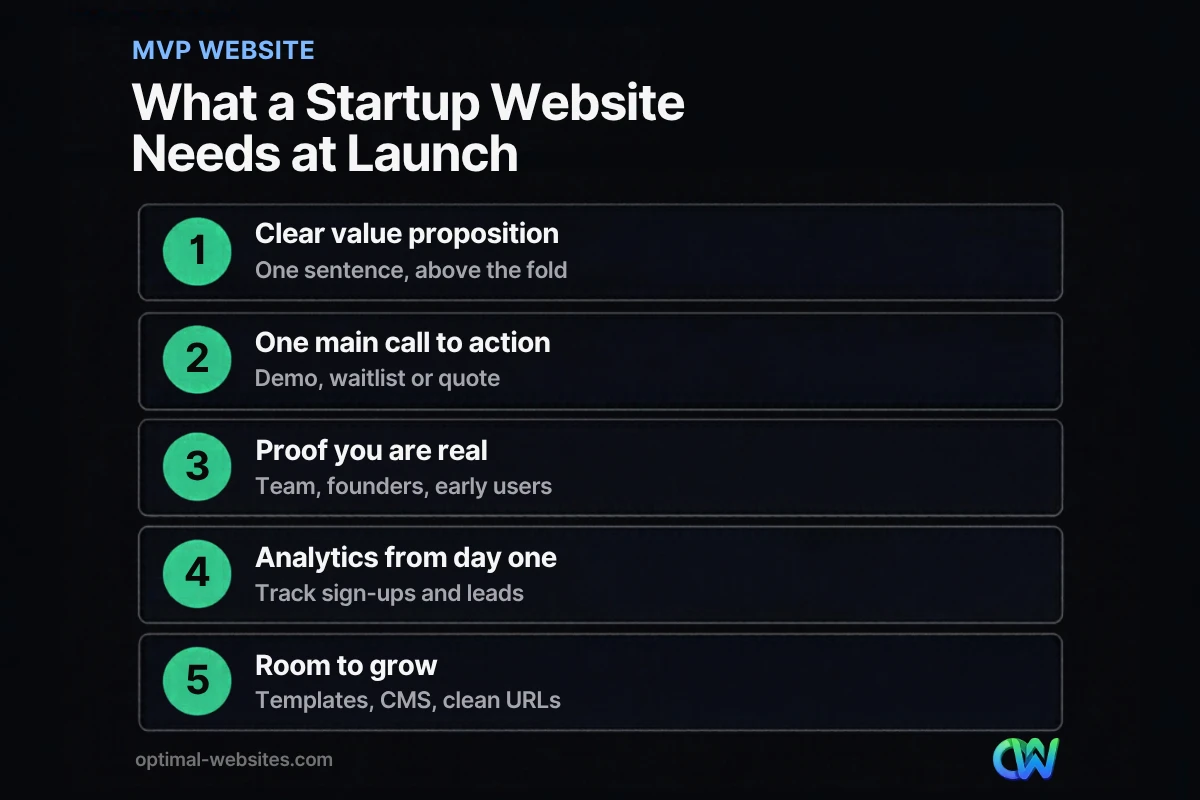
At launch, a startup website should include only what helps the right people understand the offer and take one step: a clear value proposition, a primary call to action, proof that the company is real, and analytics to learn from visitors.
The minimum viable website
- Homepage with a sharp value proposition. One sentence that says who it is for and what problem it solves, above the fold.
- One primary call to action. Book a demo, join the waitlist, start a trial or request a quote. Pick one and repeat it.
- Product or service overview. How it works in three or four steps, with real screenshots or photos.
- About or team section. Founders’ names, photos and short backgrounds. Anonymous startups look risky.
- Contact options. A simple form plus an email address that reaches a person.
- Legal basics. Privacy policy and terms, especially if you collect sign-ups or payments.
- Analytics and conversion tracking. Set up from day one so every visitor teaches you something.
What you can skip at launch
- A full blog (start with one or two strong articles if you have something to say)
- Complex animations and custom illustrations
- Multiple language versions
- Detailed case studies before you have real customers
- A large resources section or help center
The SBA’s guide to marketing and sales recommends registering a domain name to establish an online presence and protect your brand. Do that early, even before the site is finished, and set up a professional email on the same domain.
How fast can a startup website launch?
A focused startup website can usually launch in two to four weeks if the founder has the core message and assets ready. Most delays come from content, not design: unclear positioning, missing photos or waiting on approvals.
| Phase | Typical time | What speeds it up |
|---|---|---|
| Positioning and sitemap | 2 to 5 days | A one-paragraph pitch and a list of target customers |
| Copywriting | 3 to 7 days | Notes from sales calls and investor decks |
| Design and build | 1 to 2 weeks | Reusing a proven layout instead of a blank canvas |
| Review and launch | 2 to 5 days | One decision-maker for approvals |
For a deeper look at timelines in general, see our guide to small business website design.
How do you avoid rebuilding your startup website later?
You avoid a rebuild by separating what will change (copy, pages, offers) from what should stay stable (platform, design system, URL structure). If the foundation is flexible, you can change everything else in hours.
Choose a platform your team can edit
The biggest reason startups rebuild is that every small change requires a developer. A CMS with a visual builder, such as WordPress with Elementor Pro, lets non-technical team members update headlines, add pages and test new offers. Hand-coded landing pages look great on day one and become a bottleneck by month three.
Build with reusable templates
Create a small design system at launch: colors, fonts, buttons and a few section layouts (hero, features, testimonials, pricing, call to action). New pages then reuse those sections, so the site stays consistent as it grows from five pages to fifty. Our comparison of custom website vs template explains when each approach makes sense.
Plan URLs and structure for growth
Even if you launch with five pages, sketch where future content will live: /product/, /use-cases/, /pricing/, /blog/. Keep URLs short and descriptive. If you later need to change them, Google’s guidance on site moves with URL changes recommends permanent server-side redirects such as 301s, avoiding redirect chains and keeping redirects in place for at least a year.
Keep performance and accessibility in the foundation
Fast loading, mobile-first layouts and accessible design are much easier to build in than to retrofit. A lean theme, optimized images and readable contrast from the start save expensive fixes later.
Should a startup use a template, a builder or a custom design?
Most early-stage startups should use a professional builder-based site with a light custom design layer, then invest in deeper custom work after product-market fit. Here is how the options compare.
| Option | Speed | Cost | Flexibility | Best for |
|---|---|---|---|---|
| DIY site builder | Fastest | Lowest | Limited as you grow | Testing an idea for a few weeks |
| WordPress + Elementor Pro, professionally built | Fast | Moderate | High, team can edit | Most funded or revenue-stage startups |
| Fully custom coded | Slowest | Highest | High but developer-dependent | Product-led companies with dev resources |
What we see when building founder websites
Founders and startups are one of the client groups we work with regularly. The pattern we see most is a founder who launched with a quick DIY page, raised a round or landed a big customer, and suddenly needed a site that looked established and could grow. Rebuilding on WordPress with Elementor Pro, using a small set of reusable sections, lets the team add product pages, hiring pages and announcements on their own. We also provide video tutorials so founders are not dependent on us for every change.
How much does startup website design cost?
Startup website design costs vary with the number of pages, the amount of custom design and whether you need copywriting, e-commerce or integrations. At Optimal Websites, packages start at $999 for Starter, $1,499 for Professional and $1,999 for Advanced Custom, and most projects launch in 2–4 weeks. You can compare what each includes in our guide to website design packages or see our pricing.
How Optimal Websites Can Help
Optimal Websites, a WordPress web design agency based in Delaware, helps founders launch quickly on a foundation that will not need replacing after the next pivot. Our web design services cover positioning-focused page planning, mobile-first design in Elementor Pro, analytics setup and training videos, with a 50% deposit to start and the final 50% after your approval.
Frequently Asked Questions
What should a startup website include?
A startup website should include a homepage with a clear value proposition, one primary call to action, a short product or service overview, an about or team section, contact options, a privacy policy and analytics. Skip extras like large blogs or complex animations until you know what resonates with customers.
How much does a startup website cost?
Costs depend on pages, design depth and features. A professionally built startup website on WordPress typically costs far less than a fully custom coded site, and can launch in weeks. At Optimal Websites, packages start at $999, $1,499 and $1,999, with most projects launching in two to four weeks.
What is an MVP website?
An MVP website is a minimum viable website: the smallest set of pages that clearly explains your offer, builds trust and captures interest, launched quickly so you can learn from real visitors. It focuses on a value proposition, one call to action and analytics, then grows based on what you learn.
Should a startup build its website on WordPress?
WordPress is a strong choice for many startups because non-technical team members can update content, it scales from a few pages to hundreds, and it supports blogs, landing pages and integrations. Paired with a visual builder like Elementor Pro, it gives a startup website speed at launch and flexibility later.
How do I make my startup website scalable?
Make a startup website scalable by choosing a flexible CMS, building a small library of reusable sections, planning a clear URL structure for future pages and keeping performance high from the start. That way you add pages and change messaging without redesigning. If URLs ever change, use permanent 301 redirects.
When should a startup redesign its website?
Redesign when the website no longer reflects the business: a new positioning, a new target customer, a funding stage that needs more credibility, or a site your team cannot update easily. If the foundation is flexible, many of these changes can be handled with new pages and copy instead of a full rebuild.
Ready to Get Started?
Ready to launch a site that keeps up with your startup? Get a free quote or call (302) 554-9497 to talk through your launch plan.


