
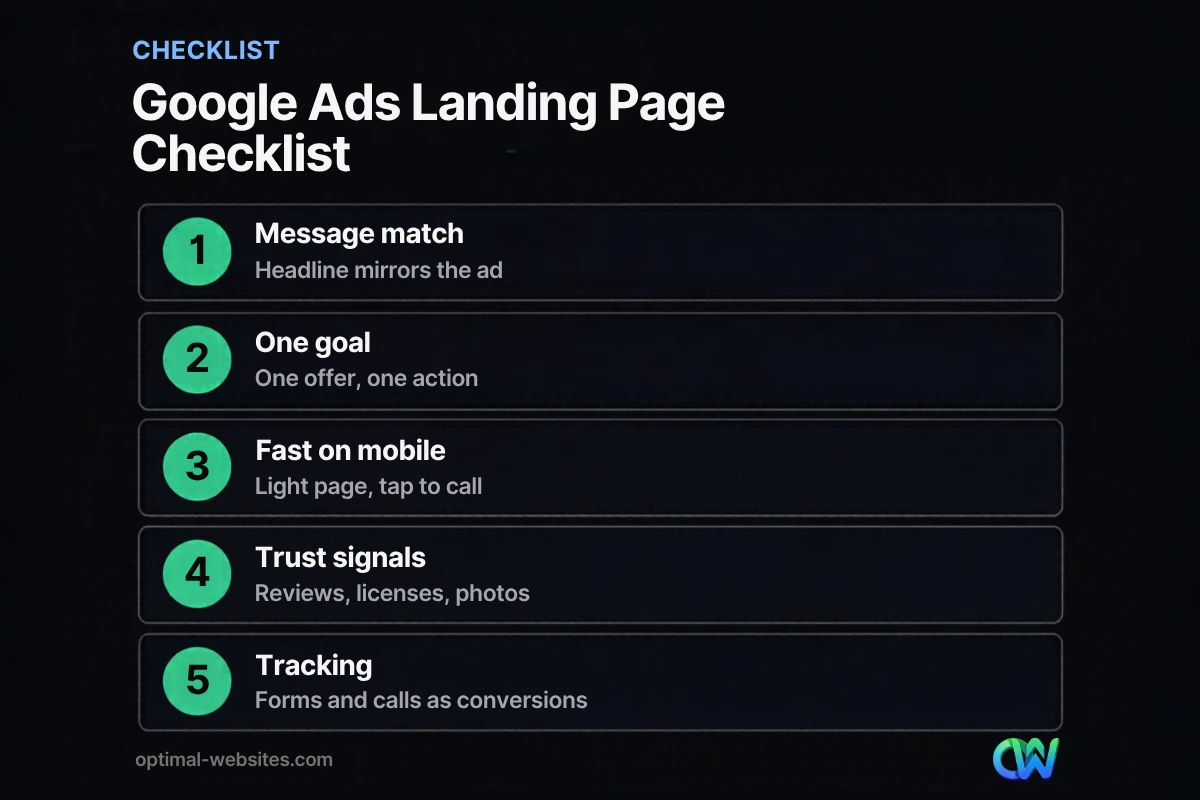
Quick answer: A Google Ads landing page is the page people reach after clicking your ad. To improve quality and conversions, match its headline to the ad and keyword, focus on one offer and one action, load fast on mobile, show trust signals and track forms and calls as conversions. Better landing page experience also supports Quality Score.
Many small businesses pay for Google Ads clicks and send every one of them to the homepage. The visitor searched for “emergency water heater repair,” clicked an ad promising same-day service, and landed on a page about the whole company. Some of them dig around. Most hit the back button, and you paid for the click anyway. A dedicated Google Ads landing page fixes that mismatch. It continues the conversation the ad started and makes the next step obvious. This guide explains how Google judges landing pages, what to put on the page, how to connect it to conversion tracking, and the mistakes that quietly waste ad budget.
Key Takeaways
- Send each ad group to a page that matches its keywords and promise, not to your homepage.
- Landing page experience is one of the three components of Quality Score, with expected clickthrough rate and ad relevance.
- One offer and one primary action (call or short form) usually convert better than a page with many choices.
- Mobile speed and tap-to-call matter, because many paid clicks for local services happen on phones.
- Without conversion tracking, you cannot tell which keywords bring leads and which just spend money.
What is a Google Ads landing page?
A Google Ads landing page is the destination URL people reach after clicking a search, display or other Google ad. For lead generation, it is usually a focused page built for one service or offer, designed to turn the click into a call, form submission or booking.
It differs from a regular website page in focus. A service page on your site serves many visitors from many sources. A Google Ads landing page serves one specific group of searchers with one specific intent, so everything on it points toward a single action. For the basics of layout and copy, see our guide to landing page design.
How does Google judge your landing page?
Google evaluates your landing page as part of Quality Score, a 1 to 10 diagnostic rating for each keyword. According to Google’s help page on Quality Score, it has three components: expected clickthrough rate, ad relevance and landing page experience.
Google describes landing page experience as how relevant and useful your landing page is to people who click your ad. Each component is rated “Above average,” “Average” or “Below average” compared with other advertisers whose ads showed for the same search.
Two points are worth knowing:
- Quality Score is a diagnostic tool. Google states that Quality Score itself is not an input in the ad auction, but the underlying factors it summarizes (relevance, expected clicks, landing page quality) do affect how your ads perform.
- It is measured per keyword. One landing page can score well for some keywords and poorly for others if it does not match them.
What landing page experience usually depends on
| Factor | What it means in practice |
|---|---|
| Relevance | The page clearly offers what the keyword and ad promised |
| Useful, original content | Real details about your service, area, pricing approach and process |
| Transparency | Business name, contact information and clear terms are easy to find |
| Mobile usability | Readable text, tappable buttons, no layout jumping |
| Load speed | The page appears quickly, especially on mobile data |
| Easy next step | A clear call to action without hunting through menus |
What should a Google Ads landing page include?
A high-converting Google Ads landing page includes a headline that matches the ad, a clear offer, proof, a simple form or tap-to-call button and nothing that distracts from that action.
Above the fold
- Headline that mirrors the ad and keyword. If the ad says “Same-Day Water Heater Repair in Dover,” the headline should say almost exactly that.
- One-sentence supporting line with the main benefit or guarantee you actually offer.
- Primary call to action: a tap-to-call button on mobile and a short form on desktop.
- A real photo of your team, truck or work, not a generic stock image.
Below the fold
- Three to five benefits or reasons to choose you, written for this specific service
- Reviews or testimonials relevant to the service (real and attributed with permission)
- Licenses, insurance, certifications and service areas
- A short “how it works” section with three steps
- An FAQ that answers price, timing and coverage questions
- The call to action repeated at the end
What to remove
- The full site navigation menu, or at least most of it
- Links to unrelated services, blog posts and social media
- Long paragraphs about company history
- Sliders and auto-playing videos that slow the page down
Keep the form short. Name, phone, email and a brief description are enough for most service businesses. Our lead capture form guide covers form layout, field order and button copy in detail.
How do you match ads and landing pages?
You match ads and landing pages by building one page per service (and sometimes per location) and pointing each ad group to the page that answers its exact search. This is called message match, and it is one of the most reliable ways to improve both ad relevance and conversions.
A simple structure for a home service company:
| Ad group | Example keywords | Landing page |
|---|---|---|
| Water heater repair | water heater repair near me, no hot water repair | /water-heater-repair-offer/ |
| Drain cleaning | clogged drain service, drain cleaning cost | /drain-cleaning-offer/ |
| Emergency plumbing | 24 hour plumber, emergency plumber [city] | /emergency-plumber/ |
Once the structure exists, duplicating and adapting a proven page for a new service takes very little time, especially when it is built from reusable templates.
How do you track conversions from your landing page?
You track conversions by recording every form submission and phone call from the landing page as a conversion in Google Ads, ideally imported from or shared with Google Analytics 4. Without tracking, Google’s bidding systems and your own decisions are based on clicks rather than leads.
Set up at least:
- Form submissions: fire a conversion when the thank-you page loads or the form reports success.
- Calls from ads: use call extensions or call assets with call reporting where available.
- Calls from the landing page: Google Ads lets you track calls from your website using a Google forwarding number that replaces your number for visitors who clicked an ad, counting calls longer than a minimum length you choose.
- Lead quality: note in your CRM or a spreadsheet which leads became customers, so you can see which keywords actually pay off.
What mistakes waste Google Ads budget on landing pages?
The most expensive mistakes are sending traffic to the homepage, offering too many choices and failing to track results. Others we see often:
- Using the same landing page for every ad group and keyword
- A headline that does not mention the service or location from the ad
- Slow pages with large images and heavy plugins
- Forms with ten fields when four would do
- No phone number, or a number that is not clickable on mobile
- Running ads without checking that the form actually sends leads to the right inbox
What we see when building ad landing pages
When we build landing pages for roofing, construction and other local service companies, we use Elementor Pro templates designed for paid traffic: no main menu, a headline block that is easy to change per ad group, a short form and a sticky tap-to-call bar on mobile. That lets owners or their ad managers duplicate a page for a new service in minutes while keeping speed and tracking intact. If you are budgeting for this, our guide to landing page cost explains what affects the price.
How Optimal Websites Can Help
Optimal Websites, a WordPress web design agency based in Delaware, designs fast, mobile-first landing pages built to match your ads and convert paid clicks into calls and leads. Our lead generation services include landing page planning, copy structure, form setup and conversion tracking support. You can see pricing for website packages, which start at $999.
Frequently Asked Questions
What makes a good Google Ads landing page?
A good Google Ads landing page matches the ad’s keyword and promise, focuses on one offer and one action, loads quickly on mobile, shows trust signals like reviews and licenses, and makes calling or submitting a short form effortless. It also has conversion tracking so you know which keywords produce real leads.
Does the landing page affect Quality Score?
Yes. Landing page experience is one of the three components of Quality Score, alongside expected clickthrough rate and ad relevance. Google rates it compared with other advertisers for the same searches. A relevant, useful, fast landing page helps this component and usually improves conversion rates as well.
Should I send Google Ads traffic to my homepage?
Usually not. A homepage speaks to everyone, so it rarely matches a specific ad and keyword. Sending each ad group to a focused Google Ads landing page about that exact service improves relevance and makes it easier for visitors to take action, which typically means more leads from the same budget.
How many landing pages do I need for Google Ads?
Plan one landing page per main service or ad group, and consider separate versions for major locations or offers. A small local business might start with three to five pages. Building them from a shared template keeps design consistent and makes adding new pages quick and affordable.
What is landing page experience in Google Ads?
Landing page experience is Google’s measure of how relevant and useful your landing page is to people who click your ad. It is rated above average, average or below average. Relevant content, transparency about your business, easy navigation, mobile usability and fast loading all help create a good experience.
How do I track phone calls from a Google Ads landing page?
Use Google Ads call tracking. Google can show a forwarding number on your landing page to visitors who arrived from an ad and count calls longer than a minimum length as conversions. Add tracking for form submissions too, and record which leads become customers to measure real return on ad spend.
Ready to Get Started?
Paying for clicks that do not turn into calls? Request a free quote or call (302) 554-9497 and we will help you build landing pages that match your ads.


