
Quick answer: E-E-A-T stands for Experience, Expertise, Authoritativeness and Trustworthiness, the qualities Google uses to describe helpful, reliable content. It is not a single ranking factor, but small businesses can show it with real author bios, first-hand project details, genuine reviews, clear contact information and accurate, well-maintained pages.
If you have read anything about SEO lately, you have probably seen the acronym E-E-A-T. It sounds technical, but the idea is simple: Google wants to show content from people and businesses that clearly know what they are talking about and can be trusted. For a small business, that is good news. You already have real experience, real customers and real expertise. The problem is that many websites hide all of it behind generic copy, stock photos and anonymous pages. This guide explains what E-E-A-T means, what Google actually says about it, and the practical trust signals you can add to your site this month.
Key Takeaways
- E-E-A-T means Experience, Expertise, Authoritativeness and Trustworthiness, and Google says trust is the most important of the four.
- Google states that E-E-A-T itself is not a specific ranking factor; it describes what its systems try to reward.
- Small businesses can show E-E-A-T with author bios, real project photos, reviews, credentials and transparent contact details.
- Google encourages accurate authorship information such as bylines, and warns against fake author profiles.
- The same signals that build trust with Google also build trust with customers deciding whether to call.
What is E-E-A-T?
E-E-A-T is a framework from Google’s Search Quality Rater Guidelines that stands for Experience, Expertise, Authoritativeness and Trustworthiness. Google uses human quality raters to evaluate how well its search results work, and E-E-A-T describes what high-quality, reliable content looks like.
Originally the framework was called E-A-T. In December 2022, Google added Experience to its rater guidelines, recognizing that first-hand experience with a topic, such as having actually used a product or completed a project, is a valuable quality signal in its own right.
The four parts of E-E-A-T
| Letter | Stands for | What it means for a small business |
|---|---|---|
| E | Experience | You have done the work: real jobs, real clients, real results described honestly |
| E | Expertise | You have the knowledge and credentials: licenses, training, years in the trade |
| A | Authoritativeness | Others recognize you: reviews, mentions, memberships, local press |
| T | Trustworthiness | You are honest, accurate and transparent: contact details, policies, secure site |
Is E-E-A-T a ranking factor?
No, not directly. Google’s guide to creating helpful, reliable, people-first content states that “E-E-A-T itself isn’t a specific ranking factor.” Instead, Google uses a mix of signals to identify content that shows good experience, expertise, authoritativeness and trust.
The same page adds that “of these aspects, trust is most important.” Experience, expertise and authority all feed into trust, but a page does not need to show every element to be helpful. A plumber’s post about fixing a common leak may show plenty of experience without formal credentials, and that can be enough.
In practice, this means there is no E-E-A-T checkbox or plugin. You improve E-E-A-T by improving the real signals behind it.
Why does E-E-A-T matter for small businesses?
E-E-A-T matters for small businesses because the qualities Google describes are the same ones customers use to decide who to hire. A visitor comparing three contractors or three law firms is asking the same questions: Have they done this before? Do they know what they are doing? Do other people trust them? Can I trust them?
It also matters for topics that affect people’s money, health or safety. Google holds pages about legal, medical and financial topics to a higher standard, so law firms, healthcare practices and financial services need especially clear trust signals. For more on how this fits into your overall strategy, see our guide to SEO for small business.
How do you show E-E-A-T on a small business website?
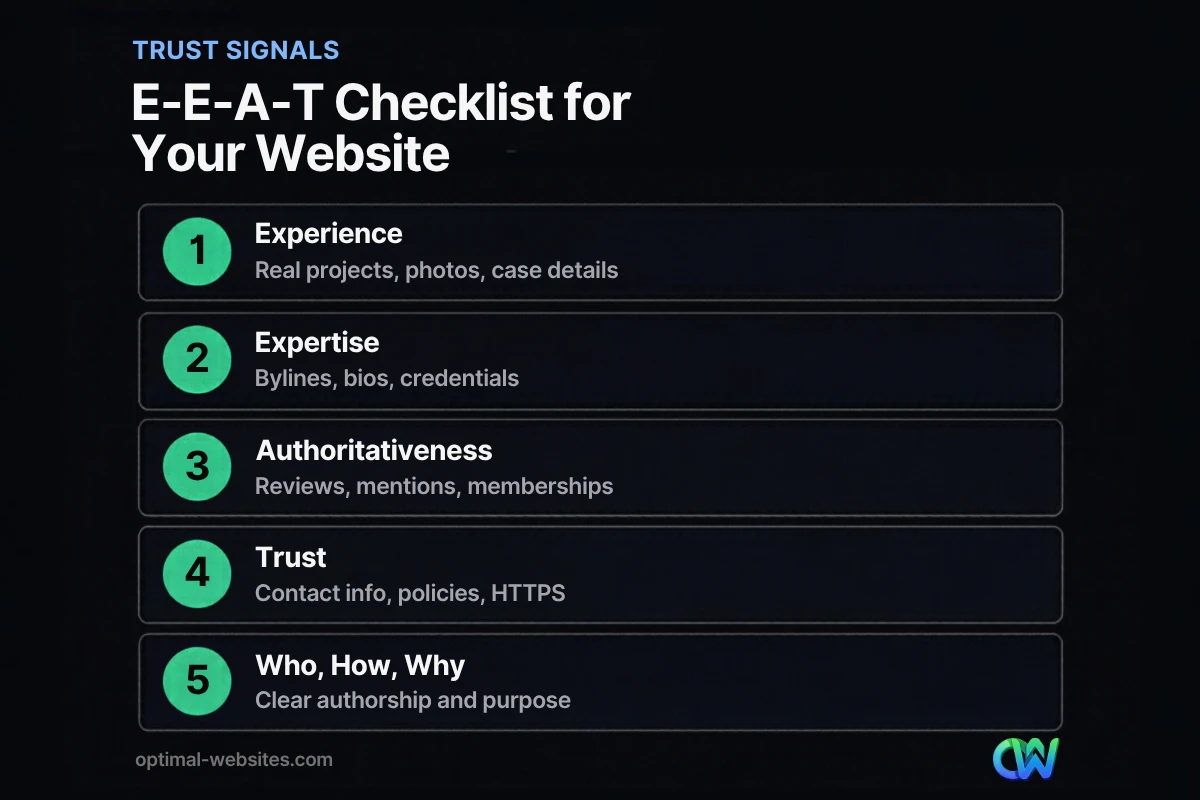
You show E-E-A-T by making your real experience, people and reputation visible on the pages that matter. Here is a practical checklist by category.
Show experience
- Describe real projects with your own photos, the problem, what you did and the outcome, with client permission.
- Write blog posts from first-hand knowledge: what you see on job sites, mistakes you fix, questions clients ask.
- Include specific local details: neighborhoods, building types, local regulations.
Show expertise
- Add author bylines to blog posts and link each one to a bio page.
- Write short, specific bios: role, years of experience, licenses, certifications and specialties.
- Explain processes in detail on service pages instead of generic marketing claims.
Show authoritativeness
- Display genuine reviews and link to your Google Business Profile. Our guide on how to get more Google reviews covers ethical ways to ask.
- List professional memberships, licenses and industry associations you actually belong to.
- Mention real awards and recognition, with the year and the source.
Show trustworthiness
- Make your phone number, address or service area, and business hours easy to find.
- Add a clear About page with your story and team.
- Keep a privacy policy, terms where relevant and secure HTTPS across the whole site.
- Keep facts current: prices, staff, service areas and copyright year.
- Correct errors and update old blog posts instead of leaving outdated advice live.
What does Google say about authors and bylines?
Google says it strongly encourages accurate authorship information, such as bylines, where readers would expect it. Its helpful content guidance suggests evaluating content by “Who, How, and Why”: who created it, how it was created and why it exists.
- Who: Is it clear who wrote the content? A byline that links to a real bio answers that.
- How: Is it clear how the content was produced? If automation or AI was used in a meaningful way, Google suggests being transparent about it.
- Why: Was the content created mainly to help people, rather than mainly to attract search traffic?
Google also warns against deceptive authorship, such as invented author profiles or false credentials. A real owner or team member with a short, honest bio is always better than a made-up expert. The same principle applies when you write content for AI search: clear, attributable, first-hand information is easier for any system to trust and cite.
What hurts E-E-A-T on a small business site?
The signals that hurt E-E-A-T are usually the opposite of the ones above: anonymity, generic content and anything that looks deceptive. Common problems we see:
| Problem | Why it hurts trust | Fix |
|---|---|---|
| No author names on blog posts | Readers cannot tell who is behind the advice | Add bylines and bio pages |
| Only stock photos | Nothing proves the work is real | Use your own project and team photos |
| Fake or unattributed testimonials | Looks deceptive and may break advertising rules | Use real reviews with permission |
| Outdated pages | Wrong prices or old staff signal neglect | Review key pages every quarter |
| Hidden contact information | Feels evasive | Show phone, area served and hours on every page |
| Thin, generic service pages | No sign of real expertise | Explain process, materials, timelines, FAQs |
What we see when building trust-focused sites
When we build WordPress sites for law firms, contractors and healthcare-related businesses, we treat trust signals as part of the design, not an afterthought. In Elementor Pro, we create reusable sections for attorney or team bios, review highlights, credentials and service areas, so they appear consistently on every relevant page. Owners can then update bios and add new projects themselves, which keeps the site accurate long after launch.
How do you measure progress on E-E-A-T?
You cannot measure E-E-A-T directly, but you can track the outcomes it supports. Watch impressions and clicks for key service pages in Google Search Console, the number and quality of your reviews, branded searches for your business name and, most important, the number of calls and form submissions from your website.
If those trend up after you add bios, project details and reviews, your trust signals are doing their job for both people and search engines.
How Optimal Websites Can Help
Optimal Websites, a WordPress web design agency based in Delaware, builds small business websites that put real experience and trust front and center. Our SEO services include auditing your trust signals, adding author bios and structured service pages, and planning content that reflects what you actually know. We never invent credentials, reviews or results; we help you show the ones you already have.
Frequently Asked Questions
What does E-E-A-T stand for?
E-E-A-T stands for Experience, Expertise, Authoritativeness and Trustworthiness. It comes from Google’s Search Quality Rater Guidelines and describes the qualities of helpful, reliable content. Google added the first E, for Experience, in December 2022, and says trust is the most important of the four parts.
Is E-E-A-T a Google ranking factor?
Not directly. Google says E-E-A-T itself is not a specific ranking factor. Instead, its systems use many signals to identify content that demonstrates experience, expertise, authoritativeness and trust. Improving the real signals behind E-E-A-T, such as author bios, accurate content and genuine reviews, supports better visibility over time.
How can a small business improve E-E-A-T?
A small business can improve E-E-A-T by adding author bylines and bios, showing real project photos and details, displaying genuine reviews, listing real credentials and memberships, and making contact information easy to find. Keeping pages accurate and up to date also matters, because outdated information quietly erodes trust with visitors and search engines.
Do author bios help SEO?
Author bios support SEO indirectly by making it clear who created the content and why they are qualified. Google strongly encourages accurate authorship information such as bylines. A short bio with role, experience and credentials, linked from each post, helps readers and search engines trust the advice on your site.
What are trust signals on a website?
Trust signals are elements that help visitors feel confident about a business: real reviews, clear contact information, team photos and bios, licenses, certifications, professional memberships, privacy policies, secure HTTPS and accurate, current content. They support E-E-A-T and also directly improve conversion rates on service pages.
Does E-E-A-T matter more for some industries?
Yes. Google applies a higher standard to topics that can affect people’s health, finances, safety or legal situations. Law firms, medical and dental practices, and financial services should be especially careful to show credentials, accurate information and clear authorship, because trust carries even more weight on those pages.
Ready to Get Started?
Want a website that shows customers and Google exactly why they can trust you? Request a free quote or call (302) 554-9497 to get started.


