
Quick answer: Content for AI search is written so tools like Google AI Overviews, AI Mode and ChatGPT can understand it and quote it. Answer the question in the first sentences, cover one topic per page, use specific facts, show who wrote it and why they know, and keep the page fast, crawlable and in plain text.
More people now ask questions in AI tools and get a summarized answer with a few cited sources. If your pages are vague, padded or buried under long intros, those tools skip them and quote a competitor. Writing content for AI search is not a new discipline with secret rules. It is clear, specific, trustworthy writing, organized so a machine can pull the right sentence out of context. This guide shows how AI tools pick sources, how to structure an answer-first page, what makes a sentence worth citing and how to update the pages you already have.
Key Takeaways
- Google says there are no special tricks for AI features: the same helpful-content and technical basics apply.
- Lead every section with a direct answer, then add detail. AI tools quote short, self-contained statements.
- Specific facts (prices, service areas, timelines, steps) are more citable than general claims.
- Show expertise: real authors, credentials and first-hand experience build trust with people and systems.
- Start by rewriting your most important service and FAQ pages before writing anything new.
How do AI search tools choose which pages to cite?
AI search tools pull from pages they can crawl and index, then pick passages that answer the user’s question clearly and come from sources they trust. Pages that state the answer plainly, stay on topic and show expertise are the easiest to cite.
Google’s advice on succeeding in AI search, published in May 2025, is direct: focus on unique, satisfying content for people, provide a good page experience, make sure Googlebot can access your pages and keep structured data consistent with visible content. It also notes that people ask longer, more specific questions in AI experiences, which rewards pages with depth on a narrow topic.
Other AI assistants work in a similar way. When ChatGPT search or a similar tool browses the web, it looks for pages that answer the query and can be summarized accurately. Vague marketing copy gives it nothing to summarize.
What AI search changes, and what it does not
AI search changes how answers are displayed. It does not change what makes a page good. If you already follow the ideas in our guide to generative engine optimization, you are most of the way there. The remaining work is mostly in how you write each section.
How do you write content for AI search?
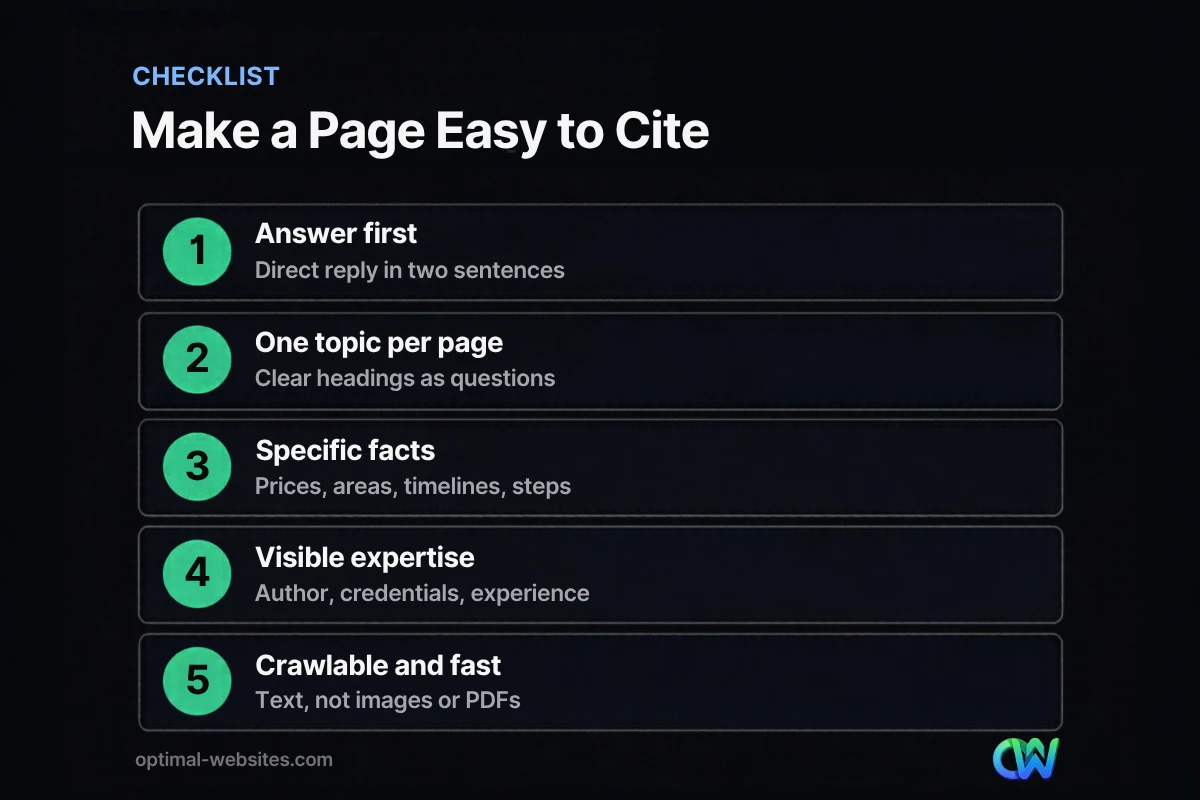
Write content for AI search by answering first, organizing around real questions and backing statements with specific facts and visible expertise. Every section should make sense on its own if it is quoted without the rest of the page.
1. Put the answer in the first two sentences
Open each page and each H2 with a direct answer. “A roof replacement in our area usually takes one to three days, depending on size and weather” can be quoted. “Roofing is a complex process with many factors” cannot. Detail, context and caveats come after the answer.
2. Use headings that match real questions
Phrase H2s and H3s the way customers ask: “How much does a water heater replacement cost?” rather than “Pricing.” Question headings help readers scan and help AI tools match a passage to a query. Google’s SEO Starter Guide recommends organizing content so readers can follow it, and question headings do exactly that.
3. Keep one topic per page
A page that covers five services in one long block is hard to cite. Give each service, location or major question its own page. Our guide on how to write a service page walks through a structure that works for both people and search.
4. State specific, checkable facts
AI tools prefer statements they can quote with confidence. Include:
- Starting prices or price ranges you actually charge
- Service areas by city or county
- Typical timelines and steps
- Licenses, certifications and warranties
- Hours, response times and how to book
5. Write short, self-contained paragraphs
Keep paragraphs to two to four sentences and avoid pronouns that only make sense with the previous paragraph. “It” and “this” should be replaced with the actual noun when a sentence might be quoted alone.
6. Add an FAQ section that answers follow-up questions
FAQ content captures the follow-up questions people ask in AI tools. Answer each question in 40–80 words, lead with the direct answer and avoid repeating the same text across pages.
What are E-E-A-T signals and why do they matter for AI citations?
E-E-A-T stands for experience, expertise, authoritativeness and trust. Google’s guidance on helpful, reliable, people-first content says trust is the most important of the four, and that content should make clear who created it, how and why.
For a small business, strong E-E-A-T signals look like this:
| Signal | How to show it on your site |
|---|---|
| Experience | Photos and details from real jobs, “what we see on site” notes, before and after examples |
| Expertise | Author bylines, team bios with licenses, certifications and years in the trade |
| Authoritativeness | Reviews, industry memberships, awards you can document, mentions from local media |
| Trust | Clear contact details, address, pricing transparency, privacy policy, secure forms |
These signals help AI tools decide whether your page is a safe source to quote. They also help the human who clicks through decide to call you.
Which technical basics affect content for AI search?
Technical basics decide whether AI tools can read your content at all. If a page is blocked, slow or hides its text in images, it will not be cited no matter how good the writing is.
Check these items on every important page:
- Indexable. The page returns a 200 status, is not set to noindex and is not blocked in robots.txt.
- Text, not images. Prices, service lists and FAQs should be real text, not part of a graphic or a PDF.
- Fast on mobile. A good page experience is part of Google’s guidance for AI features.
- Structured data that matches. If you use schema, it must match what is visible on the page.
- Internal links. Link related pages so crawlers and readers can find your best answers.
On the WordPress and Elementor Pro sites we build, we check that key content is real HTML text inside the page, not locked in sliders, tabs that load later or background images. It is a small detail that makes a big difference to how machines read a page.
How do you update existing pages for AI search?
Start with the pages that already bring in leads: your main service pages, location pages and top FAQ answers. Rewriting five strong pages usually does more than publishing twenty new posts.
A simple update routine
- Pick one page and list the three questions customers ask most about that service.
- Rewrite the opening so it answers the main question in two sentences.
- Turn vague headings into question headings.
- Add specific facts: prices you charge, areas you serve, timelines.
- Add a short FAQ with the follow-up questions.
- Add an author or reviewer line and link to a bio.
- Check speed, mobile layout and indexing in Google Search Console.
Then measure. Watch for impressions on longer, question-style queries in Search Console and for referral visits from AI tools in your analytics.
What not to do
Do not stuff pages with keywords, create dozens of thin pages for every question variation or publish unedited AI-generated text. Google’s guidance warns against content made mainly to attract search visits. AI tools have the same problem with it: there is nothing original to cite.
How Optimal Websites Can Help
Optimal Websites, a WordPress web design agency based in Delaware, writes and structures website content for small businesses so it reads well for customers and is easy for search engines and AI tools to understand. Our blog writing service covers answer-first articles, FAQs and service page rewrites, and our builds keep content in clean, crawlable HTML.
For the bigger picture, see our guide to content marketing for small business, or check our pricing if you are planning a new site.
Frequently Asked Questions
What is content for AI search?
Content for AI search is website content written and structured so AI tools such as Google AI Overviews, AI Mode and ChatGPT can understand it and cite it in their answers. It leads with direct answers, covers one topic per page, includes specific facts and shows clear expertise, while still being written for human readers first.
How do I get my website cited in AI Overviews?
To be cited in AI Overviews, your page must be indexed and eligible to appear in Google Search, and it should answer the question clearly. Google says no special markup is needed. Focus on answer-first writing, specific facts, good page experience and E-E-A-T signals, then track impressions on longer queries in Search Console.
Does answer-first writing hurt engagement?
No, answer-first writing usually helps engagement because readers get what they came for and then read on for detail. Visitors who see a clear answer are more likely to trust the page and keep scrolling. Put the short answer at the top of each section, then expand with examples, steps and context.
Do FAQ sections still matter for SEO?
Yes. FAQ content still helps readers and gives AI tools clear question-and-answer pairs to cite, even though Google limited FAQ rich results in 2023. Keep answers short and specific, avoid repeating identical FAQs across many pages and only include questions customers actually ask.
Should I use AI to write content for AI search?
You can use AI tools to research, outline or draft, but publishing unedited AI text rarely works. Pages need original details, real experience and accurate facts to earn AI citations. Have someone who knows the business edit every draft, add specifics from real jobs and check every claim before publishing.
What are E-E-A-T signals?
E-E-A-T signals are the clues that show experience, expertise, authoritativeness and trust on a page. Examples include author bylines, team bios with credentials, real project photos, reviews, clear contact details and transparent pricing. Google says trust matters most, and these signals help both search systems and customers decide to rely on you.
Ready to Get Started?
Want your website content to be the answer people and AI tools find first? Request a free quote or call (302) 554-9497 and we will review your key pages with you.


