
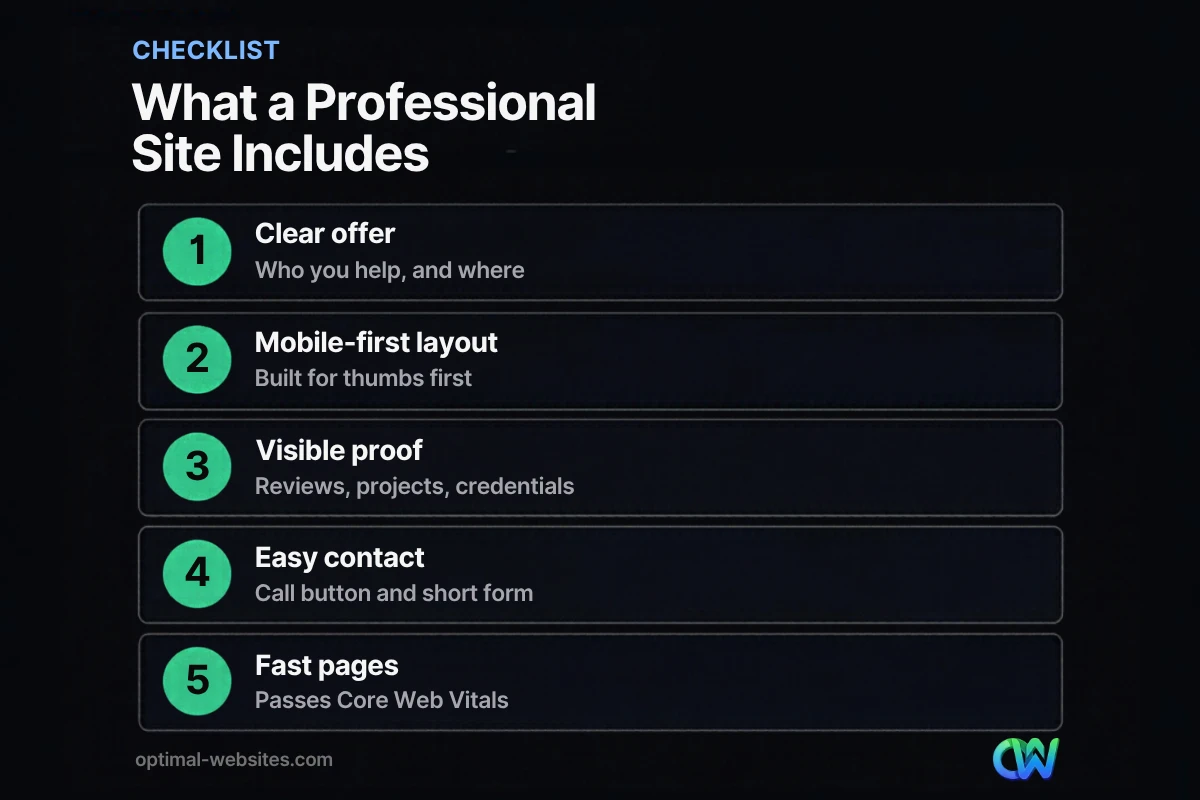
Quick answer: Professional small business website design combines a clear offer, a mobile-first layout, visible proof such as reviews and project photos, easy ways to call or request a quote, and fast, secure pages. The goal is not decoration. It is a site that turns local searchers into calls, quote requests and booked jobs.
Most small business owners know their website matters, but few can say exactly what separates a professional site from a page that just exists. That gap is expensive. When a visitor cannot tell what you do, where you work or how to reach you within a few seconds, they go back to the search results and call someone else. Good small business website design fixes that by treating the site as a sales tool. This guide walks through what a professional build includes, how it should be planned, what it typically costs, and how to tell whether a designer will deliver it.
Key Takeaways
- Small business website design is about clarity first: who you serve, what you offer, where you work and how to contact you.
- Design for phones first. Google indexes the mobile version of your site, and many local customers find you on a phone.
- Proof sells: reviews, project photos, licenses and real team photos do more than stock imagery.
- A professional build includes technical basics most visitors never see: speed, security, analytics and search-friendly structure.
- Fixed-price packages make budgeting predictable. Ask exactly what is included before you compare quotes.
What does small business website design actually include?
Small business website design is the planning, writing, layout and technical build of a website whose main job is to bring in customers for a local or specialized business. A professional version covers strategy, content, visual design, development and launch, not just a nice-looking homepage.
It helps to think of it in three layers:
- The message. A headline that says what you do and for whom, service descriptions written for customers, and a clear next step on every page.
- The experience. Navigation that makes sense, a layout that works on a phone, readable text, and forms that are short enough to finish.
- The foundation. Hosting, security, speed, analytics and the on-page basics search engines need to understand your pages.
Many cheap or DIY sites get the visual layer right and skip the other two. They look fine in a screenshot but do not answer a customer’s questions or show up for the searches that matter.
If you want the complete list of pages and must-have features, our full checklist of pages and features covers that in detail. This post focuses on the design and build standards that make those pages work.
What makes a professional website for small business look trustworthy?
A professional website for small business looks trustworthy when it is consistent, current and specific. Visitors judge credibility quickly, and they look for signs that a real, active business is behind the page.
Nielsen Norman Group’s research on credibility groups those signs into four factors: design quality, upfront disclosure of key information, content that is comprehensive and current, and connection to the rest of the web. In practice, that means:
- Consistent branding. One logo, one color palette, two fonts at most, used the same way on every page.
- Real photos. Your team, your trucks, your office, your finished projects. Stock photos of smiling models in hard hats are easy to spot.
- Specific claims. “Licensed roofing contractor serving New Castle County since 2009” beats “quality service you can trust.”
- Contact details in plain sight. Phone number in the header, address or service area in the footer, hours where people expect them.
- Fresh content. An old copyright year, a broken link or a “coming soon” page signals that nobody is minding the store.
Show proof where decisions happen
Reviews and project photos should not live only on a testimonials page. Place a short review next to the quote form, a project gallery on each service page, and badges for licenses or associations near the call to action. That puts reassurance exactly where a visitor is deciding whether to contact you.
Why does mobile-first design matter for small businesses?
Mobile-first design means planning every page for a small touchscreen first, then expanding the layout for larger screens. It matters because Google uses the mobile version of a site’s content for indexing and ranking, and because many local customers search on their phones when they need help.
A mobile-first site usually includes:
- A tap-to-call button that stays visible as visitors scroll.
- Text large enough to read without zooming, with short paragraphs.
- Buttons spaced so fingers do not hit the wrong one.
- Forms with as few fields as possible and the right keyboard for each field (number pad for phone numbers, for example).
- Images sized for phones so pages load quickly on cellular connections.
When we build with Elementor Pro, we check every section at phone, tablet and desktop widths before launch. A layout that looks balanced on a 27-inch monitor can bury the phone number below three screens of scrolling on a phone.
Which pages should a small business website have?
Most small business websites need a homepage, a page for each core service, an about page, a reviews or projects page, and a contact page with a quote form. Service businesses that cover several towns often add service area pages.
Here is how those pages typically map to what a visitor wants:
| Page | Visitor question it answers | Must include |
|---|---|---|
| Homepage | Can this business help me? | Clear headline, top services, proof, call button |
| Service pages | Do they do exactly what I need? | Process, photos, FAQs, pricing guidance if possible |
| About | Who are these people? | Team photos, history, licenses, values |
| Reviews / Projects | Have they done this well before? | Real reviews, before-and-after photos |
| Contact | How do I get started? | Phone, short form, service area, hours |
One page per service matters more than most owners expect. A single “Services” page that lists ten things in bullet points gives search engines and visitors very little to work with. A dedicated page for each main service lets you explain it properly and gives you a better chance to appear when someone searches for that specific job.
What technical features belong in website design for service businesses?
Website design for service businesses needs technical features that support speed, security and lead capture. Visitors rarely notice them when they work, but they notice immediately when they do not.
Speed and Core Web Vitals
Google’s Core Web Vitals measure loading (Largest Contentful Paint), responsiveness (Interaction to Next Paint) and visual stability (Cumulative Layout Shift). The “good” targets are an LCP of 2.5 seconds or less, an INP of 200 milliseconds or less and a CLS of 0.1 or less. A professional build plans for these from the start with compressed images, lean page structure, caching and quality hosting.
Security and reliability
Every site needs an SSL certificate (the padlock in the browser), regular backups, updated plugins and spam protection on forms. On WordPress, that also means choosing well-maintained plugins and keeping the number of plugins reasonable.
Lead capture and tracking
- Click-to-call links and a visible phone number.
- Short quote or contact forms that send notifications to the right inbox.
- Analytics and form tracking so you can see which pages produce leads.
- A thank-you page or message that confirms the request went through.
Search-friendly structure
Descriptive page titles, one main heading per page, clean URLs, image alt text, an XML sitemap and a Google Business Profile that matches the site. None of this guarantees rankings, but leaving it out makes ranking much harder.
How much does affordable web design cost for a small business?
Affordable web design for a small business usually means a fixed-price package rather than an open-ended hourly project. Costs depend on the number of pages, custom features, content help and integrations such as booking or online payments.
At Optimal Websites, a WordPress web design agency based in Delaware, packages start at $999 for Starter, $1,499 for Professional and $1,999 for Advanced Custom, and most projects launch in 2–4 weeks. We take a 50% deposit to start and the final 50% after you approve the site. You can see our package pricing for what each tier includes.
Whoever you hire, ask these questions before you compare prices:
- How many pages and revisions are included?
- Who writes the content, and who supplies the photos?
- Will I own the domain, hosting account and site login?
- Is training included so my team can make simple edits?
- What happens after launch if something breaks?
Two quotes with the same price can deliver very different sites. The one that includes copywriting, mobile testing and training is usually the better value even if it costs a little more. If you are weighing a pre-built theme against a bespoke layout, our comparison of custom design versus a template explains the trade-offs.
How do you choose a small business web designer?
Choose a small business web designer by looking at relevant work, a clear process and honest answers about ownership and support. Price matters, but process predicts results better.
- Review their portfolio for your industry. A designer who has built sites for contractors, law firms or medical practices already knows what your customers look for.
- Ask about their process. You want discovery, a sitemap, content planning, design review, development, testing and launch, in that order.
- Check the platform. WordPress gives you ownership and flexibility. Ask which page builder they use and whether you can edit content yourself.
- Confirm what happens after launch. Updates, backups and small edits should be covered by a plan or a clear hourly rate.
- Read the contract. Payment schedule, timeline, number of revisions and who owns what should all be in writing.
Our guide on how to choose a web design company goes deeper on vetting questions and red flags.
What we see when building small business websites
Across projects for roofing companies, construction firms, law practices and local service businesses, a few patterns repeat. The sites that perform best usually have fewer pages done well rather than many thin ones. Owners who gather photos and reviews before the project starts launch faster. And small details, such as a sticky call button on phones or a three-field quote form, tend to matter more than visual flourishes.
We build on WordPress with Elementor Pro so clients can update text, swap photos and add projects without calling a developer. Every client also gets video tutorials for the edits they make most often.
How Optimal Websites Can Help
If your current site looks dated, loads slowly or rarely produces a call, we can help you plan and build a replacement that does its job. Our WordPress web design and development service covers strategy, content structure, mobile-first design, speed and launch, with fixed pricing and a typical 2–4 week timeline. Start with a free quote and we will tell you which package fits your goals.
Frequently Asked Questions
What is small business website design?
Small business website design is the process of planning, writing, designing and building a website whose main purpose is to win customers for a smaller company. It covers the message, the layout, mobile usability, speed, security and the search basics that help people find the site. A good design makes it obvious what you do, where you work and how to contact you.
How many pages does a small business website need?
Most small business websites need between five and fifteen pages. A typical setup includes a homepage, one page for each main service, an about page, a reviews or projects page and a contact page. Businesses serving several towns often add service area pages. Quality matters more than count, so each page should answer a clear customer question.
How long does it take to build a professional website for a small business?
A professional website for a small business usually takes a few weeks once content and photos are ready. At Optimal Websites, most projects launch in 2–4 weeks. Delays almost always come from missing content, slow feedback or late changes in scope, so gathering text, photos and reviews before kickoff is the easiest way to stay on schedule.
Is WordPress good for small business websites?
Yes, WordPress is a strong choice for most small business websites. It is open source, so you are not locked into one company, and it can grow from a simple brochure site into a blog, store or booking platform. Paired with a visual builder such as Elementor Pro, it also lets owners edit their own content without code.
What should I look for in a small business web designer?
Look for a small business web designer with relevant portfolio work, a clear step-by-step process, written pricing and a plan for support after launch. Make sure you will own your domain, hosting and site login. Ask whether they handle content and mobile testing, and whether they provide training so you can make everyday updates yourself.
Can I design my own small business website with a builder?
You can, and it can work for very simple needs. The trade-off is time and results. DIY sites often miss mobile usability, speed, clear calls to action and search basics. If your website needs to generate calls and quote requests, a professional small business website design usually pays for itself faster than months of trial and error.
Ready to Get Started?
Tell us about your business and goals, and we will recommend the right package with a clear, fixed price. Request your free quote or call us at (302) 554-9497.


