
Quick answer: In the social media vs website debate, most small businesses should invest in a website first and use social media to drive people to it. A website is an asset you own, it shows up in search and it is built to capture leads. Social profiles are great for reach and relationships, but the platform controls them.
Many small businesses start with a Facebook page or Instagram account because it is free and fast. Then the question comes up: do you still need a website if you already have social media? The social media vs website choice matters because it shapes where your time and budget go for years. Choose only social, and you build on land you rent, with limited control over who sees your posts. Choose only a website, and you may miss the conversations where customers spend their time. This guide compares both side by side, explains what each does best, and gives you a clear order of investment for a small business.
Key Takeaways
- A website is an owned asset; social media profiles are rented space governed by each platform’s rules.
- Websites are found through search when people are ready to buy; social reaches people while they browse.
- Social posts fade quickly, while good website pages keep working for years.
- The strongest setup uses social media to reach people and the website to convert them.
- If budget forces a choice, start with a simple, fast website and one well-run social channel.
Social Media vs Website: What Is the Difference?
A website is your business’s own home on the internet, on a domain you control, where you decide the content, layout and calls to action. A social media profile is an account on someone else’s platform, where reach, features and rules are set by that platform.
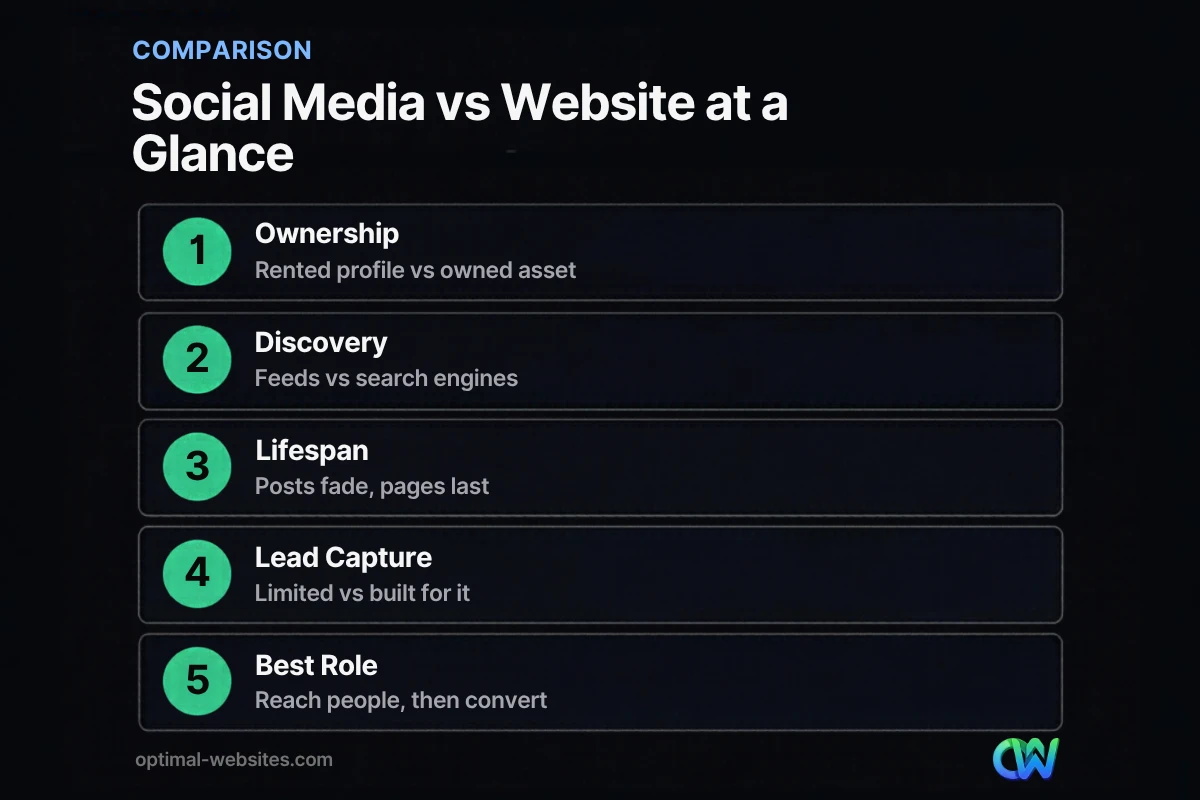
| Factor | Social media profile | Business website |
|---|---|---|
| Ownership | Platform controls the account | You own the domain and content |
| How people find you | Feeds, shares, platform search | Google, maps, AI answers, direct links |
| Content lifespan | Posts fade within days | Pages can rank and convert for years |
| Lead capture | Messages and basic buttons | Forms, booking, click-to-call, tracking |
| Design control | Fixed templates | Fully customizable |
| Cost to start | Free | Upfront build plus hosting |
| Best for | Reach, engagement, community | Credibility, search visibility, conversion |
Do I Need a Website If I Have Facebook?
Yes, most businesses need a website even if they have a Facebook page. Facebook is useful for staying in touch with people who already follow you, but a website is where new customers check your credibility, find details and contact you, especially when they search on Google.
Why a Facebook page alone falls short
- You do not control reach. The platform decides how many followers see each post.
- Not everyone uses Facebook. Pew Research Center’s social media fact sheet reports that about seven in ten U.S. adults use Facebook, which still leaves a large share of potential customers who do not.
- Search favors websites. People searching for a service near them are shown websites and business profiles, and a dedicated site gives you far more pages to rank.
- Accounts can be lost. Hacked or suspended accounts can take your audience and content with them.
- Limited sales tools. Detailed service pages, quote forms, booking and analytics work better on a site you control.
For more on making Facebook work alongside a website, see our guide to Facebook marketing for small business.
Why Should You Own Your Audience?
Owning your audience means building direct connections, like your website visitors, email list and customer contacts, that no platform can take away. It protects your marketing from algorithm changes, account problems and rising ad costs.
Social platforms change their rules regularly, and organic reach can drop without warning. If your only connection to customers is a follower count, every change hits your business directly.
Ways to own your audience:
- Send social followers to your website for offers, guides and quotes.
- Collect email addresses with a useful signup reason, like seasonal reminders or a checklist.
- Keep customer contact details in your own CRM or job software.
- Publish your best content on your website first, then share it on social.
The SBA’s guidance on marketing and building an online presence starts with registering your own domain name, the foundation for an online presence you control.
When Does Social Media Matter More?
Social media matters more when your business depends on visual discovery, community or frequent updates, such as restaurants, salons, events, boutiques and local makers. Even then, a website remains the place to send people for menus, bookings, pricing and contact details.
Social media is especially strong for:
- Showing work in progress. Contractors and builders can share project photos and short videos.
- Building familiarity. Behind-the-scenes posts make a local business feel personal.
- Customer service. Many people message businesses through social apps.
- Reaching new audiences. Shares and paid social put you in front of people who were not searching.
Pew’s data shows YouTube and Facebook are the most widely used platforms among U.S. adults, with Instagram used by about half. That reach is valuable, but it works best when it leads somewhere you control. Our overview of social media marketing for small business covers how to choose channels.
How Do Social Media and a Website Work Together?
Social media and a website work best as a system: social media builds awareness and trust, and the website turns that interest into calls, quote requests and sales. Each makes the other more effective.
A simple flow:
- Post a project photo, tip or offer on social media.
- Link to a relevant page on your website, not just the homepage.
- The page answers questions, shows proof and offers a clear next step.
- The visitor calls, fills out a form or books.
- You track which posts and channels produced leads.
Practical ways to connect them:
- Add social profile links in your website footer
- Embed reviews or recent posts where they add proof
- Share every new blog post or project page on social
- Use tracked links so you can see which posts bring visitors
- Keep your business name, phone and hours identical everywhere
Which Should a Small Business Invest in First?
Most small businesses should invest in a website first, then add one or two social channels they can maintain consistently. A website provides credibility and search visibility that social media cannot replace, and it gives social posts somewhere to send people.
A sensible order of investment:
- A fast, mobile-first website with clear services, contact options and basic SEO.
- A Google Business Profile, linked to your website.
- One social channel where your customers already spend time, posted to consistently.
- Email collection to keep in touch with past customers.
- A second social channel or paid social, once the basics are working.
If you plan to hire help for social, our guide to what social media management costs explains how to budget. From our experience building WordPress sites with Elementor Pro for contractors, law firms and local service businesses, the businesses that get the most from social media are the ones with a clear website to send people to.
How Optimal Websites Can Help
Optimal Websites, a WordPress web design agency based in Delaware, builds fast, mobile-first websites that turn social media attention into real leads. Our social media marketing services connect your posts to tracked pages on your site, so you can see what works. If you do not have a website yet, our fixed-price website packages start at $999, and most projects launch in 2–4 weeks.
Frequently Asked Questions
Is a website better than social media for a small business?
A website is usually the better foundation because you own it, it appears in search results and it is built to capture leads. Social media is better for reach and engagement. In the social media vs website choice, most small businesses do best with a website first and social media driving traffic to it.
Do I need a website if I have Facebook?
Most businesses still need a website. A Facebook page reaches some of your followers, but you do not control its reach, many people do not use Facebook, and search engines favor websites when people look for services. A website gives you credibility, detailed service pages, forms and tracking that a page cannot match.
What does it mean to own your audience?
To own your audience means building direct connections, like website visitors, email subscribers and customer contact lists, that you control. Unlike followers on a platform, these connections are not affected by algorithm changes or account suspensions. Sending social followers to your website and email list protects your marketing over the long term.
Can social media replace a business website?
Social media rarely replaces a business website. Profiles are limited in layout, search visibility and lead capture, and the platform can change rules or reach at any time. Some very small or event-based businesses start with social only, but most add a website once they want steady leads from search.
How do I connect my social media to my website?
Add social profile links to your website footer, share every new page or blog post on social, and link posts to specific pages rather than only the homepage. Use tracked links to measure which posts bring visitors, and keep your business name, phone number and hours consistent across every profile and your site.
How much does a small business website cost compared to social media?
Social media profiles are free to create, but managing them well takes time or a monthly fee. A website has an upfront build cost plus hosting and maintenance. At Optimal Websites, packages start at $999 for Starter, $1,499 for Professional and $1,999 for Advanced Custom, with a free quote before you commit.
Ready to Get Started?
Ready to build a website your social media can send people to? Request a free quote or call (302) 554-9497 and we will help you decide what to invest in first.


