
Last updated: October 15, 2026
Quick answer: Social media marketing for small business works best when you pick one or two platforms your customers already use, post a steady mix of helpful tips, proof of your work, and behind-the-scenes content, reply quickly to every comment, and send people to your website. Track clicks, leads, and calls, not just likes.
Most small business owners know they “should be on social media,” but few have time to post every day across five apps. The result is usually a burst of posts, a long silence, and no clear idea whether any of it brought in a single customer. Social media marketing for small business does not have to work that way. When it is focused, it builds trust with people who are about to buy, keeps you top of mind between jobs, and feeds steady traffic to your website. This guide gives you a platform-fit table, a two-hour weekly plan, and a simple way to measure results so you know what to keep and what to drop.
Key Takeaways
- Choose one or two platforms based on where your buyers spend time, not on what is trending.
- A realistic plan is three to four posts a week plus daily replies, roughly two hours in total.
- Mix four content types: helpful tips, proof of work, behind the scenes, and conversation starters.
- Your website does the selling. Every social profile and post should point people to a fast, clear page with a call to action.
- Measure website clicks, form fills, and calls from social, not follower counts.
What Is Social Media Marketing for Small Business?
Social media marketing for small business is the practice of using platforms like Facebook, Instagram, LinkedIn, and YouTube to build trust with local or niche customers and move them toward a call, quote request, or purchase. It combines organic posting, community replies, and sometimes paid ads.
Without a content team or a big ad budget, the goal is not to be everywhere. It is to be consistent and useful in the few places your customers already look: show real work, answer real questions, and make the next step easy.
Why does it still matter?
Many buyers check your Facebook or Instagram before they call to see if you are active and what your recent work looks like. An abandoned profile can raise doubts, even when your service is excellent.
Which Social Media Platforms Are Best for Small Businesses?
The best platform is the one your buyers already use every week. For most local service businesses, that means Facebook plus one visual or professional channel. Start with two at most and add more only when you can keep both active.
According to Pew Research Center’s 2025 social media data, 84% of U.S. adults say they use YouTube, 71% use Facebook, 50% use Instagram, and 37% use TikTok. Age matters a lot: 80% of adults ages 18–29 use Instagram, compared with 19% of adults 65 and older. Those numbers explain why Facebook remains the safest starting point for broad local audiences, while Instagram and TikTok skew younger.
Platform-fit table
| Platform | Best for | Typical buyer | Content that works | Effort level |
|---|---|---|---|---|
| Local service businesses, contractors, healthcare, home services | Broad adult audience, homeowners, local community | Project photos, reviews, event posts, community groups | Low to medium | |
| Visual businesses, restaurants, retail, design, construction | Younger adults, visual shoppers | Before-and-after photos, Reels, Stories, behind the scenes | Medium | |
| B2B services, law firms, consultants, engineering, startups | Decision-makers, partners, referral sources | Expertise posts, company news, case-style project summaries | Medium | |
| YouTube | Businesses with “how-to” knowledge or complex services | People researching before they buy | Short explainers, FAQs, project walkthroughs | High |
| TikTok | Brands with personality and a younger audience | Younger adults, impulse and trend-driven buyers | Short, casual videos, quick tips, day-in-the-life clips | Medium to high |
| Google Business Profile | Every local business (not a social network, but works like one) | People searching “near me” right now | Updates, offers, photos, review replies | Low |
Google Business Profile is not a social network, but its posts, photos, and review replies often reach more ready-to-buy local customers than any social app. If you serve a local area, keep it updated alongside your social profiles. Our guide to local SEO basics for small businesses explains how it fits into search.
One size does not fit all
A platform that works for one product line may not fit another. A construction engineering firm might use LinkedIn to reach developers and Facebook to recruit local crews. A law firm might use LinkedIn for referral partners and Facebook for community trust. Decide what each channel is for before you post on it.
How Effective Is Social Media for B2B Small Businesses?
Social media can be very effective for B2B companies when it is targeted at the specific people who make or influence buying decisions. It works less as a direct sales tool and more as a way to build relationships and credibility over a long sales cycle.
B2B buyers rarely purchase from a single post. They follow a firm, notice its expertise over months, and reach out when a need comes up. That is why LinkedIn is usually the core B2B channel.
A few B2B habits that pay off:
- Post from people, not just the company page. Owners and senior staff often get more reach than a logo.
- Talk about problems your clients face. Permit delays, budget overruns, compliance questions, and hiring are better topics than “we are proud to announce.”
- Engage before you pitch. Thoughtful comments on a prospect’s posts build familiarity.
- Connect social to your pipeline. For more on turning attention into conversations, see these B2B lead generation ideas that work.
What Should a Small Business Post on Social Media?
Post content that helps, proves, or connects. A healthy mix is roughly one-third helpful tips, one-third proof of your work, and one-third behind the scenes and conversation. Promotional “call us today” posts should be the exception, not the rule.
The four content types
- Helpful tips. Answer the questions customers ask on the phone. A roofer can explain storm damage signs; an attorney can explain what to bring to a first consultation.
- Proof of work. Before-and-after photos, finished projects, and customer reviews (shared with permission) show you deliver.
- Behind the scenes. People buy from people. Show your team, your shop, your job sites, and your daily routine. Seeing the real people behind the business builds trust and word of mouth.
- Conversation starters. Ask a simple question, run a quick poll, or invite opinions on a local topic. Replies tell the platforms your content is worth showing.
How do you keep your content fresh?
Rotate formats as well as topics. Turn one finished project into a photo post, a short video, a Story, and a tip. Repurpose blog articles into short posts that link back to the full piece. If you do not have time to write longer content, professional blog writing can give you a steady supply of material to share. Be clear about why someone should follow you: useful tips, local updates, or a look at great work.
Don’t spread yourself too thin
Running five accounts badly is worse than running two well. If a channel has gone quiet or never brings clicks, pause it and put that time into the platform that works.
How Often Should a Small Business Post on Social Media?
Three to four quality posts per week on each active platform is a realistic target for most small businesses. Consistency beats volume: a steady weekly rhythm for a year will do more than daily posting for a month.
Posting time matters too. Some people scroll first thing in the morning, others at lunch, and others in the evening. Instead of posting at the same hour every day, test different time slots for a few weeks and compare results in each platform’s insights. Most built-in analytics tools show when your followers are online.
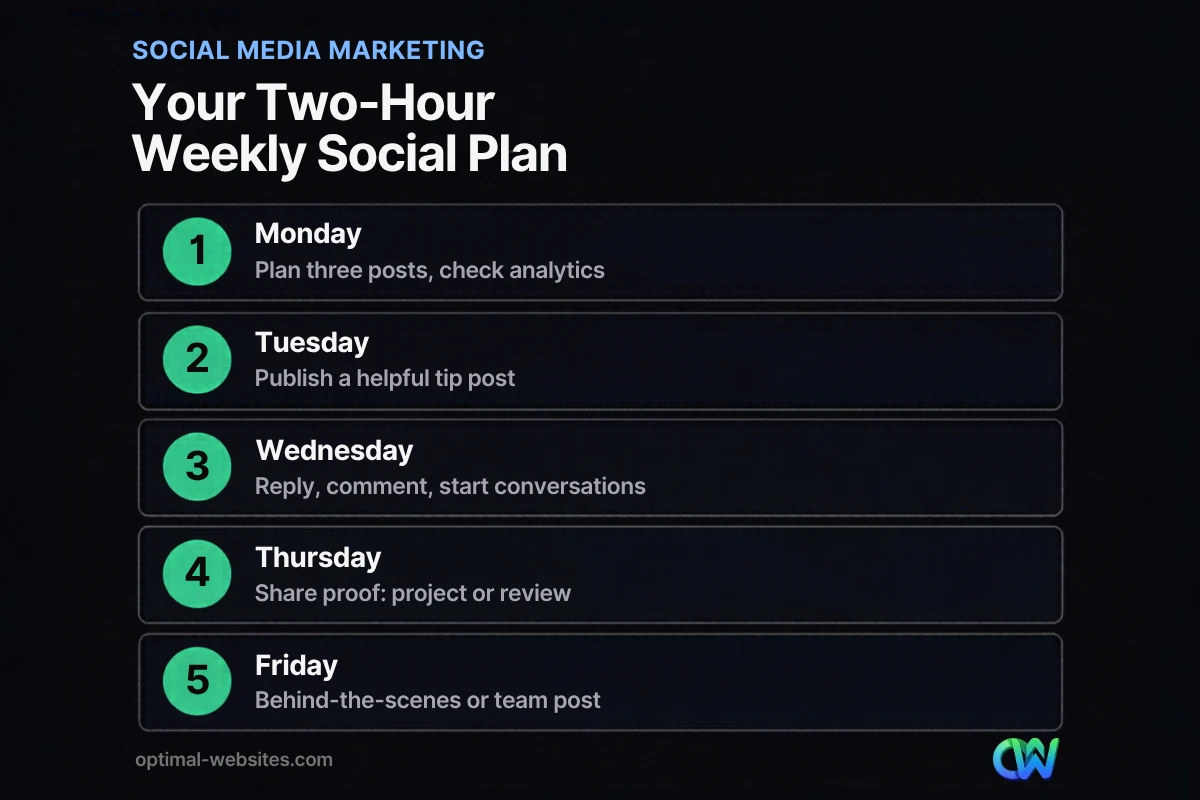
A two-hour weekly social media plan
Here is a simple schedule that fits around a busy week:
| Day | Task | Time |
|---|---|---|
| Monday | Review last week’s numbers, plan three posts, gather photos from jobs | 30 min |
| Tuesday | Publish a helpful tip or FAQ post | 10 min |
| Wednesday | Comment on customer, partner, and community posts; start one conversation | 15 min |
| Thursday | Share proof: a finished project, review, or before-and-after | 10 min |
| Friday | Post a behind-the-scenes or team update | 10 min |
| Daily | Reply to comments and direct messages within one business day | 15 min/day |
Scheduling tools built into Meta Business Suite and LinkedIn let you batch posts on Monday and publish them automatically through the week. That keeps the plan to about two hours.
How Do Social Media and Email Marketing Work Together?
Social media builds reach, and email builds a relationship you own. Use each to grow the other: invite followers to join your email list, and invite email subscribers to follow and share your social posts.
A follow or a like takes one tap. Joining an email list is a bigger commitment, so offer something worth it, such as a seasonal maintenance checklist, a pricing guide, or a short buyer’s FAQ. Promote that offer on your social profiles and in occasional posts. Then add social links and share buttons to your emails so subscribers can pass your content along. Platforms can change their algorithms overnight, but your email list stays with you.
How Do You Turn Followers Into Customers?
You turn followers into customers by sending them to a website that answers their questions and makes the next step obvious. Social media starts the conversation; your website and your response time close it.
Every profile should link to a specific page, not just your homepage. Send people to a service page, a project gallery, or a quote form. That page needs to load quickly on a phone, since social apps are mostly used on phones, and it needs a clear call to action. At Optimal Websites, a WordPress web design agency based in Delaware, we build sites with Elementor Pro on a mobile-first layout for exactly this reason: a visitor who taps a link on Instagram should see a fast page with a phone button and a short form, not a slow desktop layout. If your site struggles here, learn how to turn more website visitors into leads.
Respond like a person
Don’t post a link and walk away. Answer every comment and message, thank people for reviews, and handle complaints politely before moving details to a private message. Fast, human replies often turn a follower into a phone call.
Keep it honest
Never buy followers, likes, or reviews. The Federal Trade Commission’s final rule on fake reviews and fake social media indicators, announced in August 2024, prohibits buying or selling fake indicators of social media influence, such as bot-generated followers or views, when they are used to misrepresent influence for commercial purposes. Real, smaller numbers are worth far more than inflated ones.
How Do You Measure Social Media ROI?
Measure social media by the actions that lead to revenue: website visits from social, form submissions, calls, and booked jobs. Likes and follower counts are useful signals, but they are not results.
Start by tagging the links you share. Google’s guide to campaign URL parameters explains how adding utm_source, utm_medium, and utm_campaign to a link lets Google Analytics show exactly which posts and platforms send traffic. Use consistent lowercase values, such as “facebook” and “social,” so your reports stay clean.
Social media measurement checklist
- [ ] UTM tags on every link in posts, bios, and ads
- [ ] Google Analytics 4 set up with form submissions and phone clicks tracked as key events
- [ ] A “How did you hear about us?” question on your quote form
- [ ] Monthly review of each platform’s reach, engagement rate, and link clicks
- [ ] A simple spreadsheet tracking leads and jobs that came from social
- [ ] A decision each quarter: keep, adjust, or drop each channel
What numbers should you watch?
| Metric | What it tells you | Where to find it |
|---|---|---|
| Reach | How many people saw your posts | Platform insights |
| Engagement rate | Whether your content resonates | Platform insights |
| Link clicks | Whether posts drive website visits | Platform insights, GA4 |
| Sessions from social | Real traffic reaching your site | GA4 Traffic acquisition |
| Leads from social | Form fills and calls you can tie to social | GA4 key events, intake form |
| Cost per lead (ads) | Whether paid posts are worth it | Ads manager plus your lead count |
If a platform brings clicks but no leads over three months, the problem may be the landing page, not the post.
How Optimal Websites Can Help
Social media works best when it points to a website built to convert. Optimal Websites offers social media marketing services that help small businesses plan content, keep profiles active, and connect posts to measurable leads. We also build fast, mobile-first WordPress sites with Elementor Pro, so the traffic you earn on social lands on pages that work. We have worked with contractors, construction firms, roofing companies, law firms, and local service businesses, and every new site comes with video tutorials so your team can update it yourselves. You can compare our website packages and pricing, with most projects launching in 2–4 weeks.
Frequently Asked Questions
Is social media marketing worth it for a small business?
Yes, when it is focused. Social media marketing for small business is worth the effort if you pick one or two platforms your customers use, post consistently, reply quickly, and send people to a strong website. It builds trust before buyers call you. It is not worth it when profiles are abandoned or when you chase followers instead of tracking clicks, calls, and form submissions.
What is the best social media platform for a small business?
For most local small businesses, Facebook is the best starting point because it reaches a broad adult audience and supports reviews, events, and community groups. Add Instagram if your work is visual, LinkedIn if you sell to other businesses, and YouTube if you can explain your service on video. Keep your Google Business Profile updated too, since it reaches people searching right now.
How much time should I spend on social media each week?
About two hours a week is enough for most small businesses to stay consistent. Spend 30 minutes on Monday planning and scheduling three or four posts, then about 15 minutes a day replying to comments and messages. Batching your posts with built-in scheduling tools keeps the workload manageable and helps you avoid long gaps between updates.
How do I measure social media ROI for my small business?
Track actions, not likes. Add UTM parameters to every link you share, set up Google Analytics 4 to record form submissions and phone clicks, and ask new leads how they found you. Each month, compare leads and booked jobs from social against the time or ad money you spent. Review every channel quarterly and keep only the ones producing results.
Should a small business use paid social media ads?
Paid ads can make sense once your organic posts and website are working. Start with a small monthly budget, target a tight local area or audience, and send clicks to a specific landing page with a clear offer. Track cost per lead, not cost per click. If ads bring clicks but no inquiries, fix the landing page before increasing spend.
Does B2B social media marketing really work?
Yes. B2B social media marketing works well when it focuses on relationships and expertise rather than hard selling. LinkedIn is usually the main channel. Owners and senior staff sharing practical advice, project lessons, and industry insight build credibility with decision-makers over a long sales cycle, so the firm is top of mind when a project or contract comes up.
How often should a small business post on social media?
Three to four quality posts per week on each active platform is a realistic target. Consistency matters more than volume, so choose a pace you can keep for months. Test different posting times and use each platform’s insights to see when your followers are most active, then adjust your schedule based on what gets the most engagement and clicks.
Ready to Get Started?
Want your social media and website working together to bring in real leads? Request a free quote or call us at (302) 554-9497 to talk through a plan for your business.


