
Last updated: October 15, 2026
Quick answer: The best B2B lead generation ideas for small firms start with the website: case-study pages, industry landing pages and optimized service pages that answer buyer questions. Add a gated resource, a simple email nurture sequence, referral partners and LinkedIn, then use retargeting to bring back visitors who were not ready to call.
If you run a construction engineering firm, a contracting company or a professional services practice, you know the pattern: good work, steady referrals, then a quiet month nobody planned for. The right B2B lead generation ideas fix that by giving buyers more ways to find you, trust you and contact you. B2B deals are often large, so a few extra qualified conversations a quarter can change your year. This guide covers ten practical ideas, rates them by cost and time to results, and ends with a 30-day plan you can start this week.
Key Takeaways
- Your website is your main B2B lead generation tool. Case studies, industry pages and clear service pages do more than any single ad campaign.
- B2B buyers research for weeks or months, so you need ways to capture interest early, like a gated resource and an email nurture sequence.
- Referrals and partner relationships are usually the cheapest, warmest leads a small B2B firm can get. Make them a system, not luck.
- SEO for service pages is slow to start but keeps producing leads. Retargeting is fast but stops when the budget stops.
What is B2B lead generation, and why is it different?
B2B lead generation is the process of attracting businesses that might hire you and turning their interest into a conversation with your team. It differs from consumer marketing because the sale is usually larger, slower and decided by more than one person.
A developer hiring a structural engineer rarely buys on impulse. They compare firms, check past projects and often need sign-off from a partner. The Nielsen Norman Group’s B2B website usability research covers these patterns: long buying cycles, proof of business benefits such as case studies, and lead forms that encourage people to reach out.
So your lead generation has two jobs: get found by the right buyers, and give everyone in the decision enough proof to say yes.
Which B2B lead generation ideas work best for small firms?
The B2B lead generation ideas that work best for small and mid-sized firms build on assets you already have: completed projects, happy clients and expertise. Here are ten.
1. Case-study pages for real projects
A case study is a short page that shows a project from problem to finished result. For a contractor, that means scope, constraints, your solution and photos. Buyers trust proof from projects like theirs far more than general claims about quality.
Keep each one scannable, with a “Discuss a similar project” button, and publish only results the client has approved.
2. Industry landing pages
An industry landing page speaks to one type of buyer, such as healthcare facilities, multifamily developers or law firms. Instead of one generic “Services” page, each audience sees its own problems, its own examples and its own call to action. These pages also match how people search, because buyers often type the industry into Google along with the service.
3. Optimized service pages (SEO)
Service-page SEO means making each core service page clear enough for both people and search engines to understand what you do, where you do it and who it is for. Google’s SEO Starter Guide recommends page titles that are unique, clear and accurately describe the page, along with content that is useful, well organized and kept up to date.
In practice: one page per major service, with project examples, FAQs and a visible contact path. If you are unsure whether the investment makes sense for your firm, read our take on whether small business SEO is worth it.
4. Gated resources
A gated resource is a useful document a visitor can download in exchange for their name and email. For B2B firms, the best ones are practical: a pre-construction checklist, a budget planning worksheet, a code compliance guide or a “questions to ask before hiring an engineer” sheet.
Keep the form short: name, email and company is usually enough.
5. Webinars and short workshops
A webinar lets you teach a group of prospects at once and show your expertise live. Regulation updates, cost-saving approaches and project lessons all work well. A 30-minute session with slides and Q&A is plenty, and the recording becomes another gated resource.
6. Email nurture sequences
An email nurture sequence is a short series of automated emails sent to people who downloaded a resource, attended a webinar or asked for information. Its purpose is to stay helpful and visible during a long buying cycle. A simple sequence might send the resource, then a relevant case study, answers to common questions and an invitation to book a call.
7. LinkedIn lead generation
LinkedIn lead generation works best for B2B firms when it is personal and consistent. Keep your company page and your leadership profiles complete, post project updates and practical tips, and send personalized connection requests instead of generic ones. Share your case studies there too, so your website content does double duty.
8. Referrals and partner programs
Referrals are often the warmest B2B leads you can get, because trust transfers from the person who recommended you. Make it a system: ask happy clients for introductions at project close and build relationships with complementary firms, such as architects and specialty subcontractors who serve the same clients.
9. Account-based marketing basics
Account-based marketing (ABM) means choosing a short list of specific companies you want as clients and marketing to them directly, rather than waiting for them to find you. For a small firm, ABM basics can be as simple as listing 20 target accounts and sending their decision-makers tailored content, like a relevant case study.
10. Retargeting ads
Retargeting shows ads to people who already visited your website, reminding them of your firm while they continue their research. It is one of the faster B2B lead generation strategies because it focuses on warm visitors, but it only works if your site already gets meaningful traffic and gives those visitors a clear next step.
How do B2B lead generation strategies compare by cost and effort?
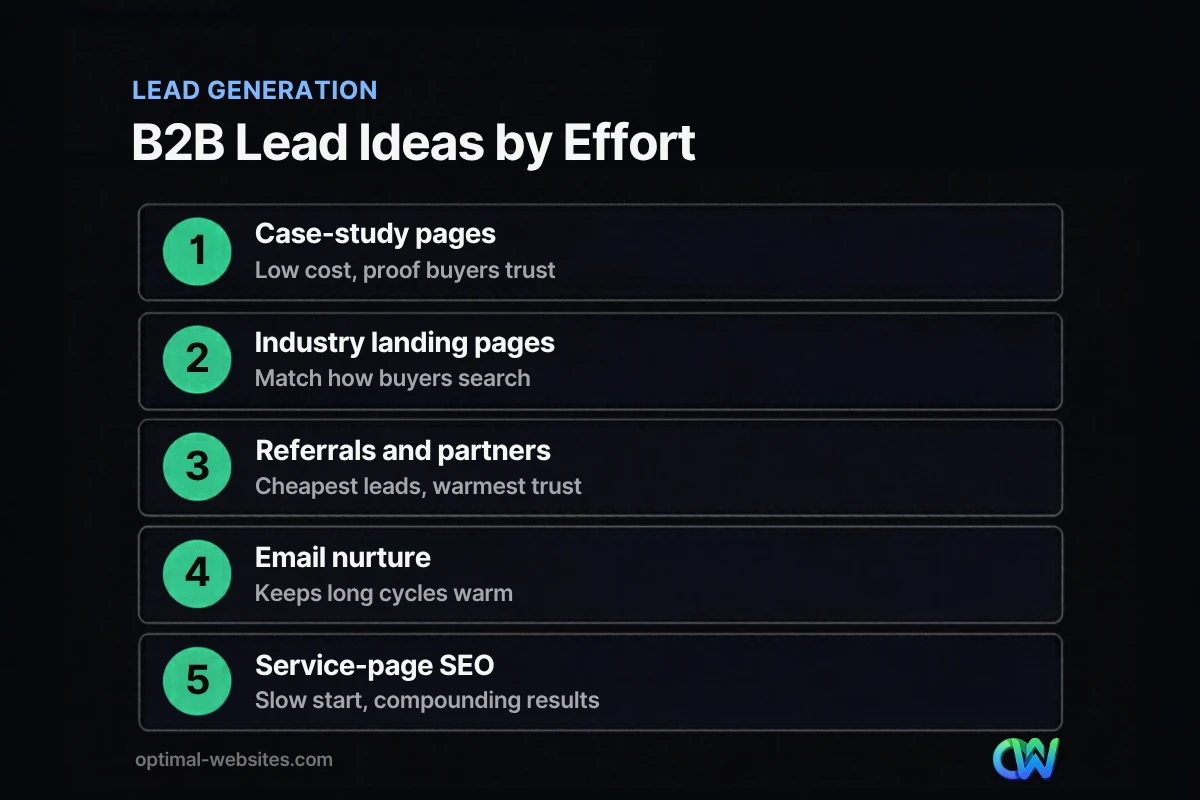
Most small B2B firms should start with low-cost, website-based ideas and add paid channels later. Here is how each idea rates.
| Idea | Cost | Effort | Time to results |
|---|---|---|---|
| Case-study pages | Low | Medium | Weeks |
| Industry landing pages | Low to medium | Medium | Weeks to months |
| Service-page SEO | Medium | Medium to high | 3–6 months or more |
| Gated resources | Low | Medium | Weeks |
| Webinars | Low | High | Weeks |
| Email nurture | Low | Medium (setup once) | Weeks to months |
| Low | Medium (ongoing) | Months | |
| Referrals and partners | Very low | Low to medium | Weeks |
| Account-based marketing | Low to medium | High | Months |
| Retargeting ads | Medium to high | Low to medium | Days to weeks |
These ratings are general guidance, not guarantees.
How does B2B website lead generation actually turn visitors into leads?
B2B website lead generation works when every important page answers a buyer’s question and offers an easy next step. A visitor who cannot quickly see what you do and how to reach you will call a competitor instead. Here is the checklist we use:
- Clear headline: What you do, for whom.
- Proof near the top: Project photos, client logos or a case-study link.
- One main call to action per page: For example, “Request a proposal.”
- Short forms: Ask only what you need.
- Mobile-friendly layout: Buyers often check sites on phones.
- Fast load times: Slow pages lose visitors.
- Pricing context: A typical project range helps buyers qualify themselves.
Google’s people-first content guidance makes the same point for search: content should help people and show real experience. For more, see what a business website needs to be useful and our ways to get more inbound leads from your website.
In our own work building WordPress sites with Elementor Pro for firms like E & S Construction Engineers and Care Facilities Construction, the pattern is consistent: B2B buyers want relevant past work and an easy way to start a conversation.
What does a 30-day B2B lead generation starter plan look like?
A 30-day plan should focus on a few assets that keep working after the month ends. Here is a realistic sequence for a small team.
- Days 1–3: Set your goal and audience. Pick one or two buyer types and define a qualified lead. The SBA’s guide to writing a marketing plan is a useful framework for defining your target market and competitive advantage.
- Days 4–6: Audit your website. Check service pages against the checklist above and fix broken forms first.
- Days 7–10: Publish one case study. Pick a recent project, get client approval and add photos.
- Days 11–14: Build one industry landing page. Speak to that buyer type and link the new case study.
- Days 15–18: Create one gated resource. A two-page checklist is enough. Add a short form to the landing page.
- Days 19–21: Set up a five-email nurture sequence. Connect it to the download form.
- Days 22–24: Ask for referrals. Contact five recent clients and two partner firms.
- Days 25–27: Update LinkedIn. Refresh profiles and share the case study.
- Days 28–30: Measure and plan the next month. Review form submissions and calls, then choose the next idea to add.
How Optimal Websites Can Help
Optimal Websites, a WordPress web design agency builds fast, mobile-first, conversion-focused websites with Elementor Pro for contractors, construction firms, law firms and other B2B service businesses. We build case-study templates, industry landing pages and lead forms, and our lead generation services and SEO for service businesses help you keep the pipeline full after launch.
Most projects launch in 2–4 weeks, with video training so your team can add case studies on its own. Review our website packages and pricing to see what fits your budget.
Frequently Asked Questions
What are the best B2B lead generation ideas for a small business?
The best B2B lead generation ideas for small businesses are case-study pages, industry landing pages, optimized service pages, referral programs and a simple email nurture sequence. They cost little, build on work you have already done and keep producing leads over time. Add paid channels like retargeting once your website converts the traffic it already gets.
How long does B2B lead generation take to show results?
It depends on the tactic. Referrals and retargeting can produce conversations within days or weeks. Case studies and landing pages usually help within a few weeks of publishing. SEO for service pages often takes three to six months or longer to build momentum, but it keeps working without ongoing ad spend once rankings improve.
Is LinkedIn good for B2B lead generation?
Yes, LinkedIn is useful for B2B lead generation because decision-makers use it to research firms and stay current in their industries. It works best when you post consistently, keep leadership profiles complete and send personalized connection requests. Treat it as a way to share your website content, like case studies and webinars, rather than a replacement for your site.
What is account-based marketing in simple terms?
Account-based marketing is a B2B lead generation strategy where you choose specific companies you want to win and market to them directly. For small firms, it means picking a short target list, identifying the key decision-makers and sending each one relevant content, such as a case study from their industry or an invitation to a webinar.
Should B2B companies gate their content?
Gate content that is detailed and valuable enough that a serious buyer would trade an email address for it, such as checklists, planning guides or webinar recordings. Keep basic information, service descriptions and case studies ungated so search engines and buyers can see them. Short forms with only name, email and company usually perform best.
How can my website generate more B2B leads?
Strong B2B website lead generation starts with clear service pages, visible proof like case studies and one obvious call to action on every page. Make sure the site loads fast, works well on phones and has short forms. Then add industry landing pages and a downloadable resource to capture visitors who are still researching.
Ready to Get Started?
Want a website that turns B2B research into real conversations? Request a free quote or call us at (302) 554-9497 to talk through your goals.


