
Quick answer: Roofing SEO is the work of getting your roofing company to show up when homeowners search Google for roof repair, replacement or storm damage help in your area. It combines a strong Google Business Profile, steady reviews, a dedicated page for each roofing service and city, and a fast mobile website that makes calling you easy.
When a homeowner finds a leak after a storm, they do not flip through a phone book. They grab their phone and search “roof repair near me.” The roofers in the map pack and the top few results get the calls; everyone else waits for referrals. Roofing is also one of the most competitive local searches, with national lead sellers and well-funded competitors bidding for the same homeowners. This roofing SEO guide explains which searches actually bring jobs, how to structure your website, how reviews and your Google Business Profile fit in, and what we see working on roofing websites.
Key Takeaways
- Roofing SEO has two battlefields: the Google Maps local pack and the regular organic results below it. You need both.
- Focus on buyer-intent roofing keywords such as “roof replacement,” “roof repair,” “storm damage roof repair” and “metal roofing,” plus your city names.
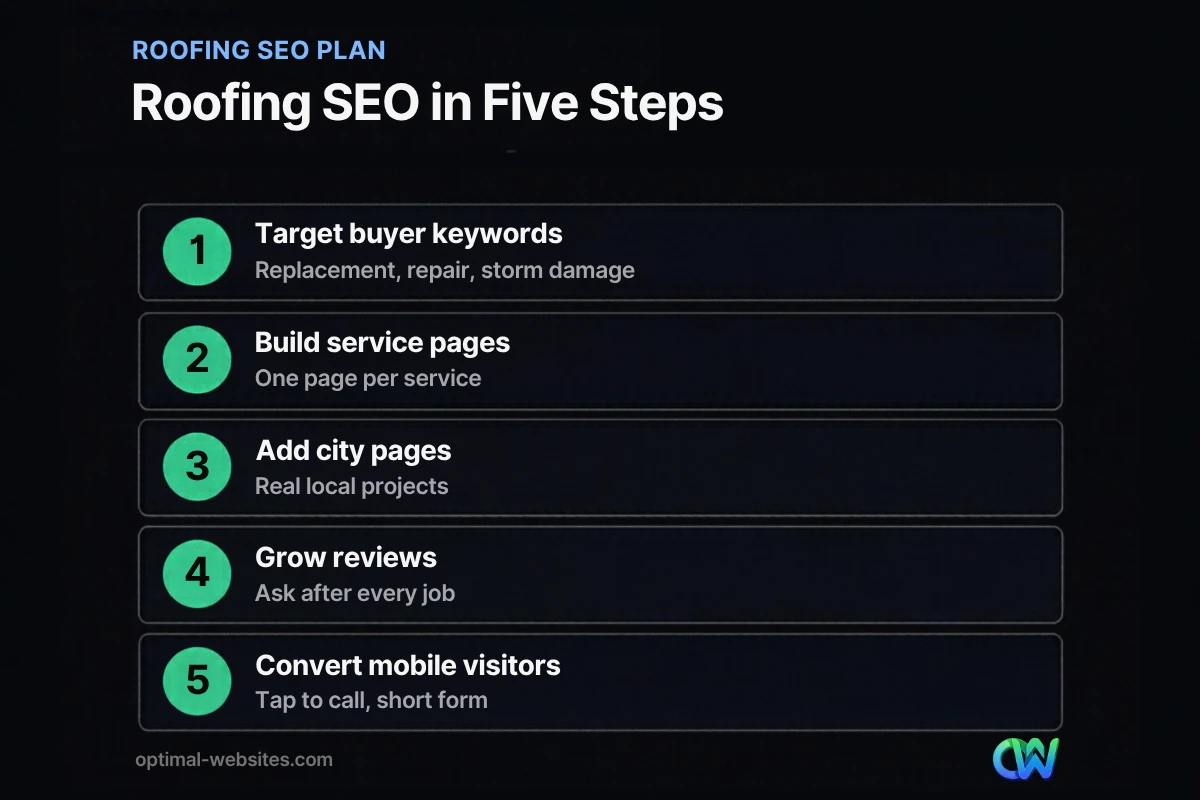
- One page per service and dedicated pages for key towns beat a single “Services” page every time.
- Reviews and a complete Google Business Profile drive local visibility; your website drives trust and conversions.
- Measure success in calls and booked inspections, not just rankings.
What is roofing SEO?
Roofing SEO is search engine optimization tailored to roofing contractors: making your website and online presence the best answer when people near you search for roofing services. It is a specialized form of local SEO because almost every roofing search has local intent.
There are two places to win. The local pack (the map with three businesses) is driven mainly by your Google Business Profile, reviews and proximity. The organic results below it are driven mainly by your website’s content, structure and authority. Most roofing leads from Google come from one of those two spots, so a roofing SEO plan has to cover both.
Why is SEO so important for roofing companies?
SEO matters for roofers because homeowners search at the exact moment they need help, and those searches turn into high-value jobs. A single roof replacement can pay for months of marketing.
Paid ads and lead-buying services can bring calls too, but the cost stops the moment you stop paying, and shared leads often go to three or four roofers at once. Organic visibility keeps working between campaigns and brings homeowners who chose you specifically. For most roofing companies, the healthiest mix is strong SEO as the foundation with ads to fill seasonal gaps.
Which roofing keywords should you target?
Target the searches homeowners use when they are ready to hire: the service plus a location or “near me.” Informational searches are useful for content, but service keywords bring the calls.
| Keyword type | Examples | Where it belongs |
|---|---|---|
| Core services | roof replacement, roof repair, new roof cost | Dedicated service pages |
| Emergency and storm | emergency roof repair, storm damage roof repair, hail damage roof | Storm damage page, homepage section |
| Materials | metal roofing, shingle roof installation, flat roof repair | Material pages or sections |
| Location | roofer in [city], [city] roofing company | City or service area pages |
| Commercial | commercial roofing, TPO roofing contractor | Commercial roofing page |
| Questions | how long does a roof last, signs you need a new roof | Blog posts linked to service pages |
Start with the services that bring the most profit, then work outward. A roofer who mainly does replacements should not let a “gutter cleaning” page get more attention than the replacement page.
How should a roofing website be structured for SEO?
Give each core service and each key service area its own page, link them together clearly, and make every page useful to a homeowner. Structure is where many roofing websites lose rankings they could easily win.
Service pages
Create one page per major service: roof replacement, roof repair, storm damage, metal roofing, commercial roofing, gutters if you offer them. Each page should explain the process, materials, warranties, timeline, financing if offered, and the signs a homeowner needs that service. Add real project photos and a clear call to action.
City and service area pages
If you serve several towns, build a page for each important one. Make them genuinely local: projects you completed there, local building or permit considerations, the neighborhoods you work in. Avoid copying one page and swapping the city name. Thin duplicate pages rarely rank and can drag down the rest of the site.
Trust content
Homeowners worry about storm chasers and unfinished jobs. Show licenses, insurance, manufacturer certifications you actually hold, warranties, years in business and a gallery of completed roofs. Google’s guidance on helpful, people-first content emphasizes first-hand expertise and clear information about who is behind the content. Roofers have plenty of that: put it on the page.
For more on layout and features, see our guide to roofing website design.
How do roofers rank in the Google Maps local pack?
Roofers rank in the local pack by matching the search (relevance), being close to the searcher (distance) and being well-known (prominence). Google says local results are based on relevance, distance and prominence, and that more reviews and positive ratings can help local ranking.
For roofing local SEO, that means:
- Pick “Roofing contractor” as your primary category and add secondary categories only for services you truly offer.
- Complete every field: services, service areas, hours, description and photos of real jobs.
- Ask for a review after every completed job, ideally with a direct link sent by text the same day.
- Reply to every review, positive or negative, professionally and quickly.
- Post project photos regularly so the profile stays active and shows your recent work.
Our deeper guides on Google Business Profile optimization and how Google Maps ranking works cover these steps in detail.
What technical SEO do roofing websites need?
Roofing websites need fast mobile pages, clean structure and accurate business data. Most roofing searches happen on phones, often in a hurry, so speed and easy calling matter.
- Mobile speed: compress project photos, which are usually the heaviest files on roofing sites.
- Tap-to-call buttons visible at the top of every mobile page.
- Consistent business details (name, phone, address or service area) on your site, Google profile and directories.
- LocalBusiness structured data using the most specific business type available; schema.org includes a RoofingContractor type.
- Indexing: verify the site in Google Search Console and fix any pages that are excluded or erroring.
- Secure site (HTTPS) and no broken links or old pages from previous websites.
How do you turn roofing SEO traffic into leads?
Make it effortless to call or request an inspection, and give homeowners enough proof to trust you. Rankings without conversions are just vanity numbers.
- Put your phone number and a “Free Inspection” or “Get a Quote” button above the fold on every page.
- Keep forms short: name, phone, address, and a short description of the problem.
- Show recent reviews and project photos near the form.
- Explain what happens after they contact you, such as “We call back within one business day.”
- Track calls and form submissions so you know which pages and keywords bring jobs.
How long does roofing SEO take?
Expect early improvements in a few weeks from fixing your Google Business Profile and on-page basics, and steadier growth over several months as reviews, content and authority build. Competitive metro areas take longer than small towns.
Roofing SEO is cumulative. Every review, project page and local mention adds to the next. Companies that keep at it through the slow season usually see the payoff when storm season arrives.
What we see on roofing websites
We have built websites for roofing and construction companies, including PCS Roofs, and the gaps we see on roofing sites are remarkably consistent. The homepage tries to rank for everything, service pages are a sentence or two long, project photos sit in a gallery with no context, and the phone number is hard to tap on mobile.
When we build a roofing website with WordPress and Elementor Pro, we start from a service-and-city structure: a dedicated page for each core service, local pages for the main towns served, project galleries connected to those pages, and click-to-call buttons everywhere. Clients get training videos so they can add new projects and photos after every job, which keeps the site fresh without a developer. You can see our portfolio for examples of contractor and construction sites.
How Optimal Websites Can Help
Optimal Websites, a WordPress web design agency based in Delaware, works with roofers and contractors on both sides of roofer SEO: the website and the local presence around it. Our SEO services for roofers include keyword research, service and city page planning, on-page optimization, Google Business Profile improvements and review processes.
If your current site cannot support that kind of structure, we can rebuild it as a fast, mobile-first roofing website designed to turn searches into calls.
Frequently Asked Questions
What is roofing SEO?
Roofing SEO is the process of improving your roofing company’s visibility in Google for searches like roof repair, roof replacement and storm damage in your area. It covers your website content and structure, Google Business Profile, reviews, local listings and technical basics such as speed and mobile usability, all aimed at generating more calls.
How do roofers get more leads from Google?
Roofers get more leads from Google by ranking in the map pack and organic results for buyer-intent searches, then converting visitors. That means a complete Google Business Profile, steady reviews, dedicated service and city pages, fast mobile pages, and visible call and quote buttons. Tracking calls shows which efforts bring the most roofing leads.
What are the best roofing keywords to target?
The best roofing keywords combine a service with a location or “near me,” such as “roof replacement in Wilmington” or “storm damage roof repair near me.” Focus first on your most profitable services, like replacements and storm work, then add material, commercial and question-based keywords as your site and content grow.
Is roofing SEO better than paid ads?
Roofing SEO and paid ads work best together. Ads deliver immediate visibility but stop when spending stops, while SEO builds lasting visibility that keeps bringing calls. Most roofing companies benefit from SEO as the foundation, with ads used to fill gaps during slow periods or to target specific storm-affected areas.
Do roofing companies need city pages?
Roofing companies that serve several towns usually benefit from city pages, as long as each page is genuinely local. Include projects completed in that town, local considerations and specific details. Copying one page and swapping the city name rarely works and can weaken the whole site, so focus on your most important service areas first.
How much does roofing SEO cost?
Roofing SEO cost depends on your market’s competition, how many services and cities you target, and whether your website needs to be rebuilt first. A solid website foundation is often the biggest one-time investment, followed by ongoing work on content, reviews and local listings. Ask any provider for a clear scope and reporting on calls.
Ready to Get Started?
Want more roofing calls from Google? Request a free quote or call (302) 554-9497, and we will review your website and Google presence together.


