

Quick answer: The best blog ideas for contractors answer the questions homeowners ask before they hire: what a job costs, which material to choose, when to schedule work, warning signs of a problem and what the process looks like. Write one helpful post per question, link it to the matching service page and add a clear way to request a quote.
Most contractors know a blog could bring in work, then stare at a blank page and give up. The problem is rarely writing skill. It is not knowing what to write about. Yet you already answer the same questions every week on the phone and on job sites. Those questions are your best blog ideas for contractors, because homeowners type them into Google before they call anyone. In this guide you will find 40 topic ideas grouped by type, a simple way to choose which to write first, and how to turn each post into calls and quote requests instead of just page views.
Key Takeaways
- Your best topics come from the questions customers already ask you on calls, estimates and job sites.
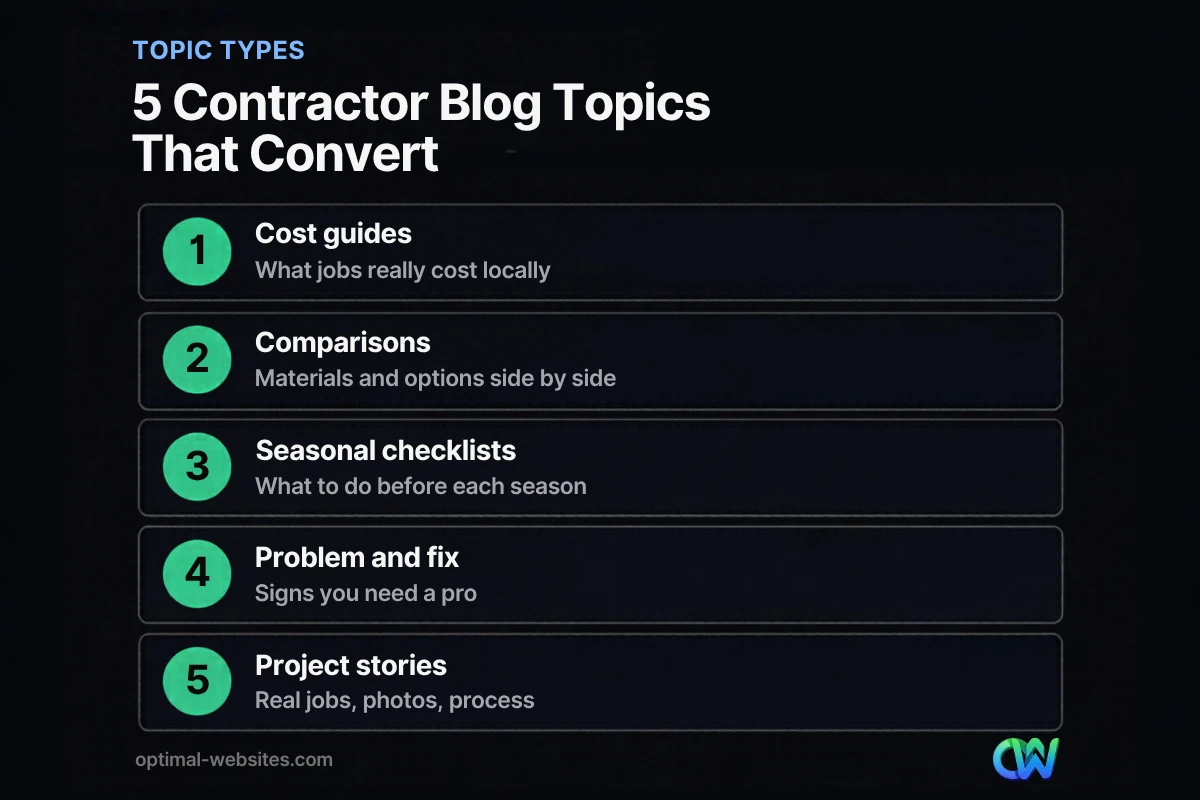
- Cost guides, comparisons, seasonal checklists, “signs you need” posts and project stories bring the most qualified readers.
- Every post should link to one service page and end with a clear next step.
- Local details (climate, permits, neighborhoods) make your posts more useful than generic national articles.
- Consistency beats volume: two strong posts a month are better than ten thin ones.
Why should contractors blog at all?
Contractors should blog because homeowners research before they call, and a helpful post puts your company in front of them at that moment. A blog also gives Google more reasons to show your site for the long, specific searches that service pages alone cannot cover.
A roofing service page can target “roof replacement in Dover.” It cannot also answer “how long does a roof last in Delaware,” “metal vs shingle roof cost” and “can you replace a roof in winter.” Blog posts can. Each one is a new entry point that leads back to the service page. For the bigger picture of how this fits your marketing, see our guide to content marketing for small business.
How do you come up with contractor blog topics?
You come up with contractor blog topics by writing down every question customers ask you, then turning each question into a post title. Keep a running list on your phone for two weeks and you will have more ideas than you can write.
Good sources for ideas:
- Questions from phone calls and estimate visits
- Objections that come up before customers sign
- Google autocomplete and “People also ask” for your services
- Questions your crew hears on site
- Comments and messages on your social profiles
- Mistakes you see from previous contractors or DIY attempts
Google’s guidance on helpful, people-first content asks whether content provides original information and a substantial, complete description of the topic. Contractors have a natural advantage here: you have first-hand experience that a generic content site does not.
40 blog ideas for contractors and home service pros
Here are 40 ideas organized by the five topic types that tend to bring in ready-to-hire readers. Swap in your own trade, city and region.
Cost and pricing posts
Cost posts attract people who are close to buying. Be honest about ranges and explain what moves the price up or down.
- How much does a roof replacement cost in [your city]?
- What affects the price of a kitchen remodel?
- Why HVAC replacement quotes vary so much
- Is a cheap estimate a red flag? What to compare
- How much does it cost to finish a basement?
- Repair or replace: when replacing saves money
- What is included in our estimate (and what is not)
- Do you need a permit, and who pays for it?
Comparison posts
Comparisons help homeowners choose, and they position you as the expert who explains trade-offs honestly.
- Metal roof vs asphalt shingles for [your region]
- Tankless vs tank water heaters: which fits your home?
- Vinyl vs fiber cement siding
- Heat pump vs furnace in a cold climate
- Quartz vs granite countertops for busy families
- Concrete vs pavers for a driveway
- Spray foam vs blown-in insulation
- Hiring a general contractor vs managing trades yourself
Seasonal checklists
Seasonal posts are easy to plan a year ahead and can be refreshed every year. They also give you timely updates to share.
- Fall roof checklist before winter storms
- Spring HVAC tune-up: what we check
- How to prepare your home for a hurricane or nor’easter
- Winter plumbing tips to prevent frozen pipes
- Best time of year to replace windows
- Summer deck maintenance checklist
- Gutter cleaning schedule for homes near trees
- Planning a spring remodel: start the conversation in winter
Problem and “signs you need” posts
These posts catch people at the moment something goes wrong, which is when they are most likely to call.
- 7 signs your roof needs replacing, not repairing
- Why is my AC running but not cooling?
- Water stains on the ceiling: what they mean
- Cracks in the foundation: which ones to worry about
- Why is my water bill suddenly higher?
- Signs of hail damage most homeowners miss
- What to do right after storm damage
- When a DIY fix makes the problem worse
Project stories and process posts
Project stories show real work and build trust. Use your own photos, explain the problem, the solution and the timeline, and only share customer details with permission.
- Before and after: a full roof replacement in [neighborhood]
- What to expect on day one of your remodel
- How we protect your home during a job
- A week-by-week timeline of a bathroom renovation
- How we handle surprises behind the walls
- Meet the crew: who shows up at your house
- Our warranty explained in plain English
- Questions to ask any contractor before you sign
Which blog topics should you write first?
Write first about the jobs you most want more of, starting with cost guides and “signs you need” posts. Those topics attract people closest to hiring, so they turn into calls fastest.
| Topic type | Buyer stage | Lead potential | Effort |
|---|---|---|---|
| Cost and pricing | Ready to compare quotes | High | Medium |
| Problem and “signs you need” | Something just went wrong | High | Low |
| Comparisons | Choosing an option | Medium to high | Medium |
| Seasonal checklists | Planning ahead | Medium | Low |
| Project stories | Checking credibility | Medium (builds trust) | Low with good photos |
A simple plan: pick your top three services, write one cost post and one problem post for each, and you have six strong posts. If you are unsure how many to publish, our guide on how often a business should blog covers realistic schedules.
How do you turn a blog post into leads?
You turn a blog post into leads by connecting it to a service page and making the next step obvious. A post that ranks but has no call to action is a missed opportunity.
Make each post do its job
- Answer the question early. Give the short answer in the first paragraph, then explain.
- Link to the matching service page. A post about roof leak signs should link to your roof repair page.
- Add a clear call to action. “Get a free roof inspection” beats “Contact us.”
- Use your own photos. Real job site photos build more trust than stock images.
- Add local details. Mention your climate, common home styles and the towns you serve.
- Include a short FAQ. Answer two or three related questions people ask next.
Reuse every post
One post can become several social updates, a short video and an email. You can also turn quick tips into posts on your Business Profile, which Google describes as a way to share announcements, offers and updates on Search and Maps. Our guide to social media for contractors shows how to share posts without spending hours every week.
What we see on contractor websites
When we build WordPress sites for roofing, construction and home service companies, the blog is often the most neglected part of the site. Posts were written years ago, link nowhere and have no call to action. A handful of focused posts that each point to a service page usually does more than dozens of generic articles about “home improvement trends.”
We also design blog templates in Elementor Pro with a built-in quote button and related service links, so every new post is set up to convert from day one. If your whole site needs that kind of structure, see our guide to contractor website design.
How Optimal Websites Can Help
If you have the expertise but not the time, our blog writing services turn your knowledge into search-friendly posts. We interview you briefly, research the questions customers search, and write posts in plain language that link to your services. Optimal Websites, a WordPress web design agency based in Delaware, can also build or refresh your site so the blog has a clean layout and clear calls to action. Check our pricing for website packages.
Frequently Asked Questions
What should a contractor write about on a blog?
A contractor should write about the questions customers ask before hiring: costs, material comparisons, seasonal maintenance, warning signs of problems and what the project process looks like. These blog ideas for contractors attract homeowners who are actively planning work, and each post can link directly to the matching service page with a clear way to request a quote.
How often should a contractor post on their blog?
Two well-researched posts a month is a realistic target for most contractors. Consistency matters more than volume, and one detailed cost guide will usually do more than several short generic posts. Busy seasons can slow things down, so batch-write a few posts in slower months and schedule them ahead.
Do blogs actually help contractors get leads?
Yes, when the posts answer real buying questions and link to service pages with a clear call to action. Blogs help contractors rank for specific searches that service pages cannot cover, such as cost questions or comparisons. Posts that are generic or have no next step tend to bring traffic without calls.
Should I write my own contractor blog posts or hire someone?
Write them yourself if you enjoy it and can stay consistent. Otherwise, hire a writer who interviews you and turns your expertise into posts, because your first-hand knowledge is what makes them valuable. A good blog writer handles research, structure and SEO while you review for accuracy.
How long should a contractor blog post be?
Long enough to fully answer the question. A simple “signs you need” post may need 800 to 1,200 words, while a detailed cost guide or comparison can run 1,500 words or more. Focus on completeness and clarity, add your own photos, and avoid padding just to hit a word count.
What are good home service blog ideas for slow seasons?
Slow seasons are perfect for planning content. Write seasonal checklists for the months ahead, cost guides for your most profitable services, and project stories from recent jobs. These home service blog ideas keep your site active and give customers useful reasons to call you before the busy season starts.
Ready to Get Started?
Want a contractor website and blog that turn questions into calls? Get a free quote or call (302) 554-9497 to talk with our team.


