
Quick answer: How long does it take to build a website? A small business website with 5 to 10 pages usually takes 2 to 6 weeks with an agency, a larger custom site 2 to 4 months, and an online store 6 to 12 weeks. The biggest factor is rarely the design itself: it is how quickly content, feedback and approvals come in.
You need a new website, and you need to know when it will be live. Maybe you are launching a business, running ads next month, or tired of sending people to a site you are embarrassed by. Agencies quote everything from “two weeks” to “six months,” which makes planning hard. This guide answers how long does it take to build a website with realistic ranges by site type, a phase-by-phase web design timeline, the delays that push launches back, and what you can do to keep your project on schedule.
Key Takeaways
- A typical small business website takes 2 to 6 weeks; most of our projects launch in 2 to 4 weeks.
- Larger custom sites, online stores and sites with complex integrations take months, not weeks.
- Content (text, photos, logins) is the most common cause of delays, not design or development.
- Fast feedback and one decision-maker shorten the timeline more than anything else.
- Launch is not the finish line: Google may take days to weeks to crawl and show new pages.
How long does it take to build a website, by type?
It depends mostly on the number of pages, custom features and how much content already exists. Here are realistic ranges for professionally built sites.
| Website type | Typical scope | Realistic timeline |
|---|---|---|
| One-page or landing page | 1 page, form, basic SEO | 1 to 2 weeks |
| Small business website | 5 to 10 pages, contact forms, mobile-first design | 2 to 6 weeks |
| Larger service business site | 15 to 40 pages, service and location pages, blog | 6 to 10 weeks |
| Online store | Product catalog, checkout, payments, shipping | 6 to 12 weeks |
| Custom web application or portal | Logins, custom functionality, integrations | 3 months or more |
These ranges assume an agency or experienced designer working on the project. A DIY site on a website builder can go live in a weekend, but most owners spend far longer than expected writing content, fixing layouts and learning the tool.
What are the phases of a website project?
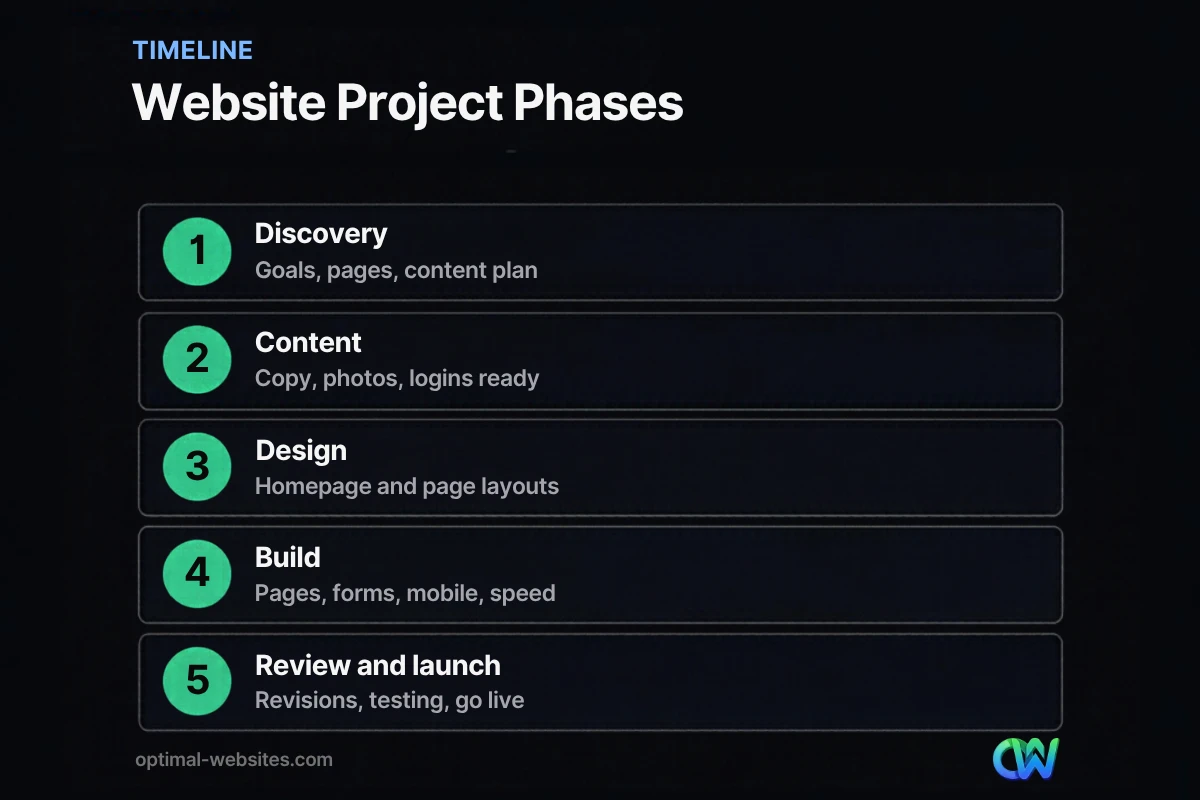
Most website projects move through five phases: discovery, content, design, build, and review and launch. Each phase has a clear output, and each one depends on approvals from the one before it.
1. Discovery and planning (2 to 5 days)
Discovery is the phase where you and your designer agree on goals, audience, pages and features. The output is a sitemap (the list of pages), a feature list and a schedule. Good discovery prevents the scope changes that blow up timelines later.
2. Content gathering (runs alongside design)
Content means the words, photos, logos, testimonials and logins the site needs. If you are writing your own copy, start immediately. If your agency writes it, expect a short questionnaire or interview.
3. Design (3 to 10 days)
The designer creates the homepage layout first, then templates for inner pages. Most agencies include a set number of revision rounds. Clear, consolidated feedback keeps this phase short.
4. Development and build (1 to 3 weeks)
The approved design is built into real, working pages. This includes responsive layouts for phones and tablets, contact forms, basic on-page SEO, speed optimization, analytics and any integrations such as booking tools or CRMs.
5. Review, testing and launch (3 to 7 days)
You review the full site on a staging link, request final changes, and the team tests forms, links and mobile layouts. Then the site goes live on your domain, with redirects in place if you are replacing an old site.
What slows down a website project?
The most common delays are missing content, slow feedback and scope changes. Development problems cause far fewer delays than most owners expect.
- Content is not ready. Pages cannot be finished without text and photos. This is the number one delay we see.
- Too many decision-makers. When three partners give conflicting feedback, each round takes longer.
- Scope creep. Adding a booking system, a second language or an online store mid-project resets part of the timeline.
- Missing logins. Domain registrar, hosting, Google Business Profile and analytics access often take days to track down.
- Migration from an old site. Moving dozens of pages and setting up redirects adds time, especially when nobody knows what the old site contains.
- Unclear goals. If nobody decides what the site should do (calls, quote requests, bookings), design revisions go in circles.
How can you speed up your website timeline?
Have your content and access ready before the project starts, name one decision-maker, and give consolidated feedback within a day or two. Those three habits can cut weeks from a typical web design timeline.
- Gather logins first: domain registrar, current hosting, email provider and any tools you want connected.
- Write or outline your services: a short paragraph for each service, the areas you serve, and the questions customers ask most.
- Collect real photos: your team, your work, your location. They beat stock photos every time.
- Pick three websites you like and note what you like about each.
- Name one decision-maker who collects feedback from everyone else.
- Block time for reviews so feedback comes back within 48 hours.
- Save extra features for phase two unless they are essential at launch.
Choosing the right partner also matters. Our guide to hiring a web design company covers what to ask before you sign, and our comparison of web designer vs agency explains how team size affects speed.
Does a template make a website faster to build?
Yes, starting from a template or a proven layout system usually shortens design time, but it does not remove the content and review phases. The real savings come from not designing every element from scratch.
The tradeoff is flexibility. A heavily customized design takes longer but can fit your brand and conversion goals more closely. Our post on custom website vs template breaks down when each option makes sense.
What happens after the website launches?
After launch, the site needs to be indexed by Google, monitored and kept up to date. Launch day is when your site becomes available, not when it starts ranking.
Google notes that crawling can take anywhere from a few days to a few weeks. You can help by verifying the site in Google Search Console and taking the time to submit an XML sitemap so Google can discover your pages. Plan for the first few weeks to include:
- Checking forms and phone links on real devices.
- Watching Search Console for crawl or indexing errors.
- Updating your Google Business Profile and social profiles with the new URL.
- Making small copy and layout tweaks based on how visitors use the site.
How we keep website projects on schedule
Most Optimal Websites projects launch in 2 to 4 weeks. That is possible because we build on WordPress with Elementor Pro, use a proven mobile-first layout system, and work in short review cycles instead of long design marathons.
We start with a free consultation to define pages and goals, then share a clear schedule. A 50% deposit starts the work, and the final 50% is due after you approve the finished site, so there is a clear incentive on both sides to keep things moving. Before launch, every client gets video tutorials so the team can update pages without waiting on a developer.
For contractors, roofers, law firms and other local service businesses, the fastest projects are the ones where the owner sends service descriptions and project photos in the first week. We have seen the same build take three weeks or three months depending almost entirely on that.
How Optimal Websites Can Help
Optimal Websites, a WordPress web design agency based in Delaware, builds fast, mobile-first websites for small businesses on a clear schedule. Our web design and development process covers planning, design, build and launch, and our packages and pricing start at $999 for the Starter package, with most projects live in 2 to 4 weeks.
If you have a launch date in mind, tell us during the consultation and we will tell you honestly whether it is realistic.
Frequently Asked Questions
How long does it take to build a website for a small business?
A small business website with 5 to 10 pages usually takes 2 to 6 weeks with an agency. Simple sites with ready content can launch in about two weeks, while sites that need copywriting, photography or migration from an old site take longer. Most Optimal Websites projects launch in 2 to 4 weeks.
What is the longest part of building a website?
For most small business projects, gathering content is the longest part. Writing service descriptions, collecting photos and finding logins often takes longer than design or development. Starting on content before the project kicks off, or having your agency write it, is the easiest way to shorten your website timeline.
Can a website be built in one week?
A one-page site or landing page can often be built in about a week if the content is ready and feedback is fast. A full multi-page business website in one week is possible but rushed, and it usually leaves little room for revisions, testing or SEO setup. Two to four weeks is more realistic.
How long does it take to build an ecommerce website?
An online store usually takes 6 to 12 weeks, depending on the number of products, payment and shipping setup, and integrations. Product photos and descriptions are often the biggest time cost. Stores with a small catalog and standard checkout can launch faster than stores with hundreds of products or custom features.
How long does a website redesign take?
A website redesign typically takes about as long as a new build of the same size, often 3 to 8 weeks for a small business. Redesigns add steps such as auditing old content, deciding what to keep, and setting up redirects so existing rankings and links are not lost.
How long after launch will my website show up on Google?
New pages can take a few days to a few weeks to be crawled and indexed. Verifying your site in Google Search Console and submitting a sitemap helps Google find your pages. Ranking well for competitive searches takes longer and depends on your content, local signals and competition, not just on launch.
Ready to Get Started?
Want a clear timeline for your new website? Request a free quote or call (302) 554-9497, and we will map out your project schedule during a free consultation.


