
Quick answer: Local SEO for small business means helping Google show your company to nearby customers in Maps and local results. Start by completing your Google Business Profile, building clear service and location pages on your website, keeping your name, address and phone consistent online, collecting genuine reviews and earning links from local organizations.
When someone searches “plumber near me” or “family lawyer in Wilmington,” Google shows a map with a handful of businesses before any regular results. Those few spots get a large share of the calls. If your business is not there, a competitor down the street is getting the work. Local SEO for small business is how you earn a place in those results, and most of it is within your control. This guide explains how local search ranking works, then gives you a practical starter plan: what to fix on your Google Business Profile, your website, your citations and your reviews, and how to track whether it is working.
Key Takeaways
- Google ranks local results mainly on relevance, distance and prominence. You cannot control distance, but you can improve the other two.
- Your Google Business Profile and your website work together. Both need accurate, consistent information.
- A dedicated page for each service, and for key locations, makes relevance obvious to Google.
- Reviews and local links build prominence. Ask real customers for reviews and never buy them.
- Track calls, form leads and direction requests, not just rankings.
What is local SEO for small business?
Local SEO for small business is the work of improving how often and how prominently a company appears when people nearby search for its products or services. It covers your Google Business Profile, your website, your listings on other sites, your reviews and the local links pointing to you.
It matters most for businesses that serve customers in a specific area: contractors, law firms, medical practices, restaurants, salons, home services and retailers. For these businesses, a top-three position in the local map results can matter more than ranking first in the regular results.
Local SEO is different from general SEO in one important way: location. Google tries to show the best nearby option, so signals that connect your business to a place carry extra weight. If you are new to SEO in general, our guide to SEO basics for small businesses covers the fundamentals.
How does local search ranking work?
Local search ranking works by weighing three main factors. Google says local results are based mainly on relevance, distance and prominence, and adds that there is no way to request or pay for a better local ranking.
| Factor | What it means | What you can do |
|---|---|---|
| Relevance | How well your profile matches the search | Accurate categories, complete services, detailed website pages |
| Distance | How far you are from the searcher or the location in the query | Set your service area accurately; create pages for areas you truly serve |
| Prominence | How well known your business is | Reviews, local links, mentions, an active and authoritative website |
Google notes that prominence draws on information such as how many websites link to your business and how many reviews you have, and that more reviews and positive ratings can help your local ranking. Your website’s overall strength in search also contributes.
How do near me searches work?
Near me searches work by combining what the person wants with where they are. When someone types or says “dentist near me,” Google uses the device location, or other location signals, to show nearby businesses that match the service.
You cannot optimize for “near me” by stuffing the phrase into your pages. Instead:
- Choose the most accurate primary category on your Google Business Profile.
- List every service you offer, in the words customers use.
- Mention the towns and neighborhoods you actually serve on your website.
- Keep your business hours accurate so searchers know when they can reach you.
What should your local SEO checklist include?
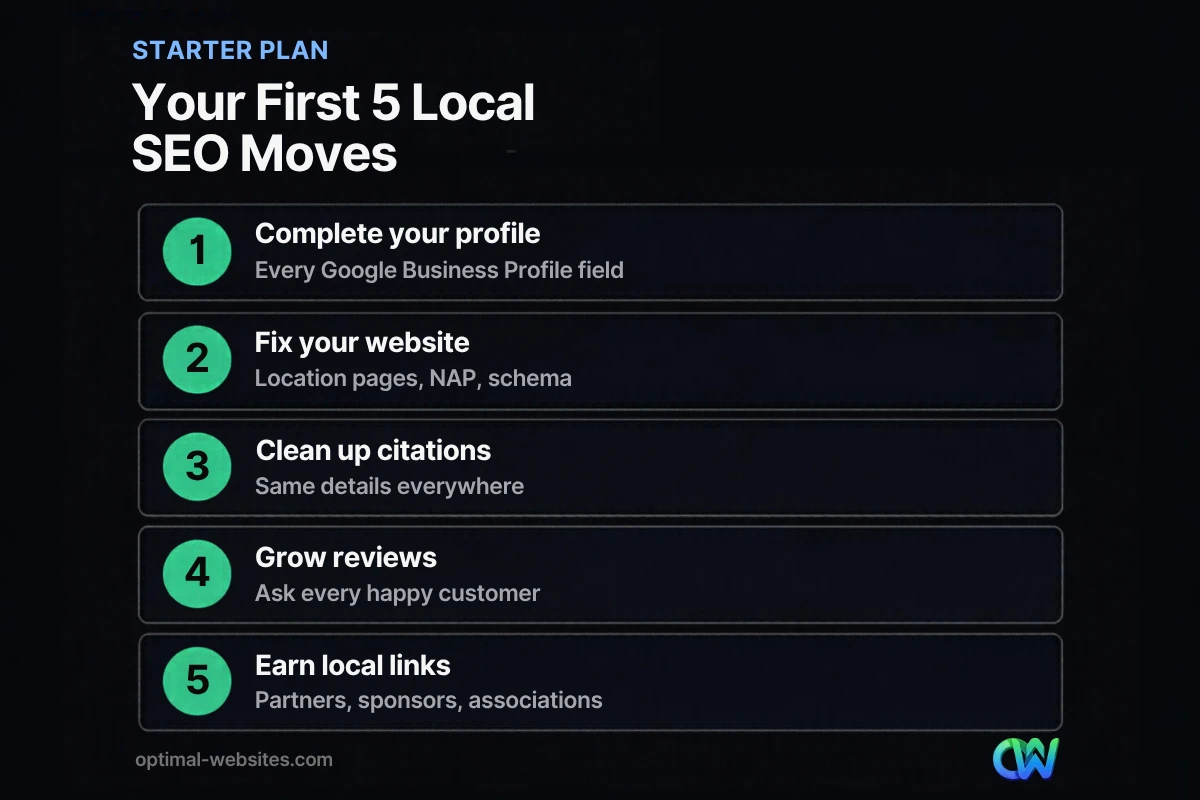
A local SEO checklist for a small business should cover five areas: your Google Business Profile, your website, citations, reviews and local links. Work through them in that order, because each one builds on the last.
1. Complete your Google Business Profile
Fill in every field: categories, services, hours, service area, description, photos and booking or quote links. Post updates when you have news or offers. Keep in mind that features change: Google removed the chat feature from Business Profiles in July 2024, so make sure phone and website links are your main contact paths. Our Google Business Profile optimization checklist walks through each field.
2. Make your website local
Your website should confirm everything your profile says, and add depth:
- Your business name, address and phone number (NAP) in the footer, matching your profile exactly.
- A dedicated page for each main service.
- Location or service area pages for the towns you serve, with genuinely local content.
- An embedded map and directions on the contact page if customers visit you.
- LocalBusiness structured data, which lets you tell Google details such as your hours and departments in a format it can read.
3. Clean up your local citations
Local citations are mentions of your business name, address and phone number on other websites, such as directories, industry associations, chambers of commerce and social profiles. Make sure the details match everywhere. Old addresses and outdated phone numbers confuse customers and can weaken trust in your listing.
4. Grow genuine reviews
Ask every satisfied customer for a review, ideally right after the job, with a direct link. Reply to reviews, positive and negative, promptly and professionally. Never buy reviews or post fake ones: in August 2024 the FTC announced a final rule banning fake reviews, including undisclosed reviews from company insiders.
5. Earn local links
Links from local websites signal that your business is part of the community. Good sources include local business associations, suppliers and partners, sponsorships of youth sports or charity events, local news coverage and professional directories in your industry.
Does your website matter for local SEO?
Yes, your website matters for local SEO because it supports both relevance and prominence. A strong site gives Google more detail about your services and locations, and it is where most local searchers go before calling.
A few website elements make the biggest difference:
- Service pages with real detail. Explain what you do, the process, typical timelines and common questions.
- Location pages that are actually local. Mention projects in that area, local conditions and nearby landmarks only where they are relevant.
- Fast, mobile-friendly pages. Many local searches happen on phones.
- Clear calls to action. A visible phone number, click-to-call and a short form on every page.
- Trust signals. Reviews, photos of your team and work, and credentials.
For an industry example, see how roofing websites win local calls, where the same principles are applied to contractors.
How long does local SEO take to work?
Local SEO usually takes a few weeks to show early movement and several months to build lasting results. Fixing a profile or correcting citations can help relatively quickly, while reviews and links grow over time.
Timelines depend on:
- How competitive your category and area are.
- How complete and accurate your current listings are.
- How many reviews and links your competitors already have.
- How consistently you keep working on it.
Treat local SEO as a habit, not a project. A little steady effort every month usually beats a burst of activity followed by silence.
How do you track local SEO results?
Track local SEO results by measuring actions, not only rankings. Rankings shift by location and device, while calls, leads and direction requests tell you whether the work is paying off.
- Google Business Profile performance: calls, website clicks and direction requests.
- Website analytics: visits from organic search and from your profile link, plus form submissions.
- Call tracking: which pages and sources lead to calls.
- Review count and rating: month over month.
- Spot-check rankings: search key phrases from different parts of your service area.
What we see when helping local businesses
Across contractors, construction firms, law practices and local service businesses, the same issues come up again and again: business details that do not match between the website and the profile, one generic services page instead of dedicated pages, few recent reviews and no tracking of calls. Fixing those four basics often matters more than any advanced tactic.
How Optimal Websites Can Help
Optimal Websites, a WordPress web design agency based in Delaware, builds websites designed to support local search, with service and location pages, matching business details, structured data, fast mobile layouts and clear calls to action. Our SEO services can help you put this starter plan into practice and keep it moving month after month.
Frequently Asked Questions
What is local SEO for small business?
Local SEO for small business is the process of improving how a company appears when nearby customers search for its services, especially in Google Maps and the local results. It includes optimizing your Google Business Profile, building local pages on your website, keeping citations consistent, growing genuine reviews and earning links from local organizations.
How do I improve my local search ranking?
Improve your local search ranking by strengthening relevance and prominence. Choose accurate categories and list all services on your Google Business Profile, create detailed service and location pages, keep your name, address and phone consistent across the web, collect genuine reviews and earn links from local organizations. Distance cannot be changed, so focus on the rest.
What are local citations?
Local citations are online mentions of your business name, address and phone number, usually on directories, industry associations, chambers of commerce and social profiles. Consistent citations help customers find accurate information and support trust in your business listing. Inconsistent or outdated details can confuse both customers and search engines, so audit them regularly.
Do I need a website for local SEO?
You can appear in local results with only a Google Business Profile, but a website makes local SEO much stronger. It gives Google detailed information about your services and service areas, supports prominence through links, and gives searchers a place to verify your credibility before calling. Most competitive local categories require a solid website.
How many reviews do I need for local SEO?
There is no magic number. Google says more reviews and positive ratings can help local ranking, so aim to keep pace with or exceed your top local competitors and to receive new reviews steadily. Recent, detailed reviews also persuade customers more than a large number of old ones. Ask every satisfied customer.
Can I do local SEO myself?
Yes, many small businesses can handle the basics of local SEO themselves: completing their Google Business Profile, asking for reviews and keeping listings consistent. Website work, such as service and location pages, structured data and speed improvements, often benefits from professional help. A local SEO checklist keeps either approach organized.
Ready to Get Started?
Want more calls from customers near you? Request a free quote or call (302) 554-9497 and we will review your local search setup.


