
Last updated: October 15, 2026
Quick answer: In the custom website vs template decision, a template (theme-based) site is the better choice when you need a professional site quickly on a tighter budget. A custom design is worth it when your brand, funnel, or features need to stand apart. Both can be fast and SEO-friendly when built correctly on a solid platform like WordPress.
Your website is often the first conversation a prospect has with your business. If it looks generic, loads slowly, or makes it hard to call or request a quote, that lead goes to a competitor. So choosing between a custom website vs template approach is really a revenue decision, not just a design preference.
Below you will find the pros and cons of each, a side-by-side comparison table, real price points, and a checklist to help you decide.
Key Takeaways
- A template or theme-based website costs less and launches faster, and it is the right fit for many local service businesses.
- A custom website gives you a unique brand experience, tailored user journeys, and more room to grow complex features.
- SEO depends on how the site is built (speed, structure, content), not on whether it started from a template.
- At Optimal Websites, theme-based packages start at $999 and fully custom design starts at $1,999.
What Is the Difference Between a Custom Website and a Template?
A template website starts from a pre-built design, and a custom website is designed from scratch around your brand and goals. Both can run on the same platform. The difference is where the design and structure come from.
A website template (in WordPress, usually called a theme) is a ready-made layout with set page designs, fonts, color schemes, and section styles. You swap in your logo, photos, and copy. A custom website begins with a blank canvas: a designer maps out your pages, user flows, and visual identity, then builds layouts that exist only for your business.
Many small businesses buy a middle ground: a professional builds on a quality theme, then customizes it with your branding, content, and calls to action.
Website Template Pros and Cons
Templates are fast and affordable, but they trade some originality and flexibility for that speed.
Pros of a template-based website
- Lower upfront cost. The design groundwork is done, so you pay for setup and customization.
- Faster launch. Page layouts already exist, which shortens the design phase.
- Proven layouts. Good themes follow common patterns visitors already understand.
- Easier to edit. Visual editors make updates simple for owners.
Cons of a template-based website
- Less distinctive. Other businesses, sometimes in your own industry, may use the same theme.
- Layout limits. If your sales process does not fit the theme’s structure, you end up working around it.
- Bloat risk. Some themes ship with features and scripts you will never use, which can slow the site down.
- Harder to scale complex features. Booking flows, calculators, portals, or unusual integrations can strain a theme’s design.
What about DIY builders like Wix or Squarespace?
DIY builders such as Wix and Squarespace let you assemble a template site yourself for a monthly subscription. They suit very simple sites or early testing. The tradeoff is your time: you handle design, copy, SEO setup, and updates yourself, within the features that platform offers.
Custom Web Design vs Template: Pros and Cons of Going Custom
A custom design costs more and takes longer, but it gives you a site built around how your customers actually buy from you.
Pros of a custom website
- A unique brand presence. Your site looks and feels like your business, not like a theme demo.
- Tailored user journeys. Pages are planned around your services and the actions you want visitors to take.
- Room to grow. Custom layouts and structure make it easier to add new services, locations, or features later.
- Leaner code. A design built for your needs only includes what you use, which helps with speed.
Cons of a custom website
- Higher investment. Original design and planning take more professional hours.
- Longer timeline. Discovery, design rounds, and approvals add time.
- More decisions. You will need to give input on structure, content, and design direction.
First impressions matter here. Nielsen Norman Group research on how long visitors stay found that the first 10 seconds of a page visit are critical to whether people stay or leave. A design that communicates your value right away, whether custom or theme-based, earns that attention.
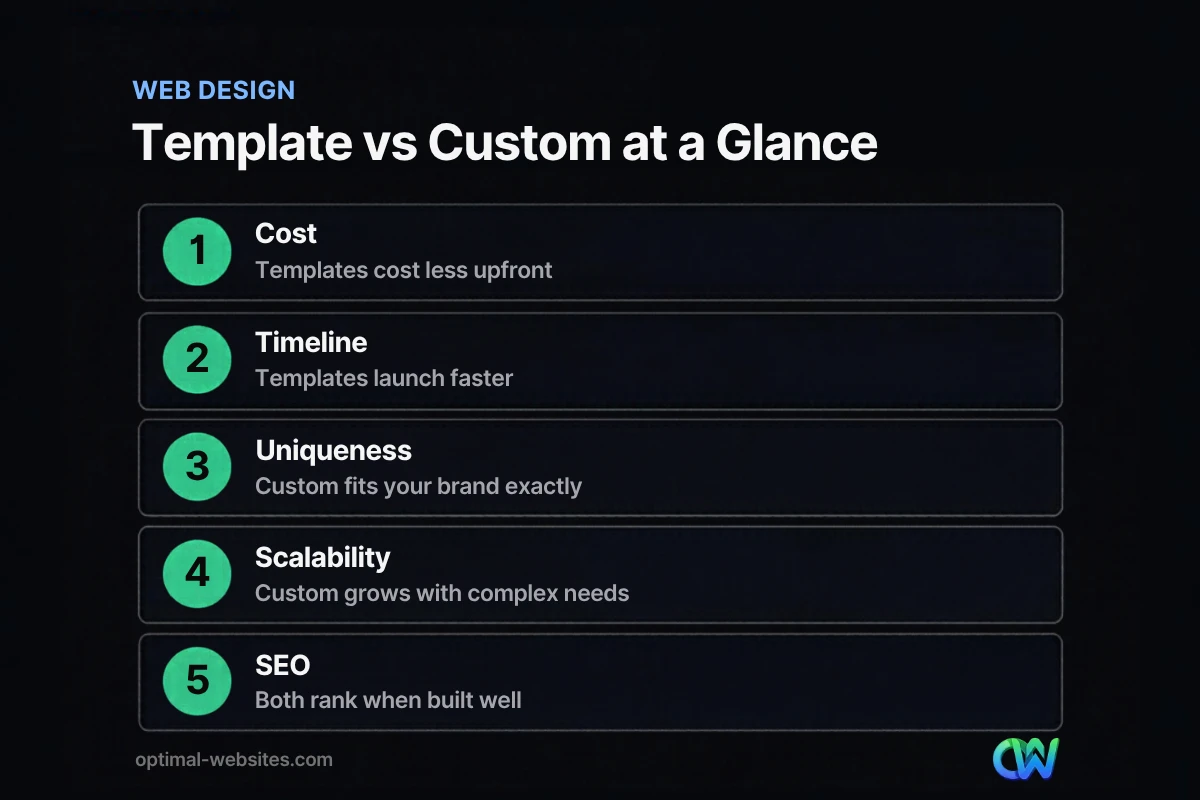
Custom Website vs Template: Side-by-Side Comparison
Here is how the three main options compare on the factors business owners ask about most.
| Factor | Theme-based (template) | Fully custom design | DIY builder (Wix, Squarespace) |
|---|---|---|---|
| Cost | Lower upfront; OW packages from $999–$1,499+ | Higher upfront; OW Advanced Custom from $1,999+ | Monthly subscription plus your own time |
| Timeline | Fastest professional option | Longer due to discovery and design rounds | Depends on your availability |
| Uniqueness | Branded, but built on a shared layout | One of a kind, built around your brand | Limited to platform templates |
| Scalability | Good for standard service sites | Best for complex features and growth | Limited to platform features |
| SEO | Strong when built and optimized well | Strong, with full control over structure | Basic tools; setup is on you |
| Maintenance | Theme, plugin, and core updates | Same updates, plus fewer unused features | Handled by platform; less control |
| Ownership | You own the site and content | You own the site and content | Tied to the platform’s subscription |
How Much Does a Custom Website Cost Compared to a Template?
Custom website cost is higher than a template-based build because more of the work is original design and planning. The exact gap depends on page count, features, and content.
Rather than talk in vague ranges, here is how the packages at Optimal Websites, a WordPress web design agency are structured. All three are built on WordPress with Elementor Pro, mobile-first and focused on turning visitors into leads.
| Package | Starting price | Design approach | Best for |
|---|---|---|---|
| Starter | $999+ | Theme-based design, customized to your brand | New or small businesses that need a credible site fast |
| Professional | $1,499+ | Theme-based design with more pages and customization | Established local businesses growing their online presence |
| Advanced Custom | $1,999+ | Fully custom design, dedicated project manager, 30-day quality guarantee | Brands that need to stand apart or have complex needs |
Most projects launch in 2–4 weeks. Projects start with a 50% deposit, and the final 50% is due after you approve the site. Every client also gets video tutorials so you can edit your own content without calling a developer. When you budget, look past the launch price. Factor in hosting, updates, and the cost of a site that does not convert.
Does a Custom Website Rank Better on Google Than a Template?
Not automatically. Google ranks pages based on content quality, relevance, and user experience, not on whether the design started from a template. As Google’s own SEO Starter Guide puts it, there are no secrets that will automatically rank your site first.
What does matter is how the site is built:
- Speed and Core Web Vitals. Google’s Core Web Vitals measure loading (LCP), responsiveness (INP), and visual stability (CLS). The Core Web Vitals thresholds on web.dev set “good” at an LCP within 2.5 seconds, an INP of 200 milliseconds or less, and a CLS of 0.1 or less. A bloated theme can miss these; a lean build of either kind can hit them. See our guide to practical ways to improve your page speed.
- Logical site structure. Clear service pages, descriptive URLs, and sensible internal links help both visitors and search engines.
- Mobile-first layout. Many customers find local businesses on their phones, so the mobile experience has to be strong.
- Real content. Pages that answer customer questions outperform thin pages, whatever the design.
The SEO advantage of custom design is control: it is easier to plan pages for each service and location you want to rank for.
Which One Fits You? A Decision Checklist
If most of your checks land in one list, that is likely your answer.
A theme-based (template) site is probably right if:
- [ ] You need a professional site live within a few weeks.
- [ ] Your budget is closer to $1,000–$1,500.
- [ ] You offer standard services (for example, a local contractor, roofer, or professional practice).
- [ ] Your main goal is calls and quote requests, without custom tools.
- [ ] You are replacing an outdated site or launching your first one.
A fully custom design is probably right if:
- [ ] Your brand needs to stand apart in a crowded market.
- [ ] You compete on reputation and premium positioning.
- [ ] You have unique user flows, such as multi-step forms or several audiences.
- [ ] You plan to add services, locations, or features over the next few years.
- [ ] You want a dedicated project manager guiding the build.
Still unsure? Focus on the basics first: clear services, easy contact options, fast loading, and trust signals. Those matter more than the design approach.
What We See Building Sites for Small Businesses
In our experience building WordPress sites with Elementor Pro, the right answer depends on how a business wins customers. Many contractors, construction firms, and local service businesses do very well with a well-customized theme, because their buyers mainly want proof of quality, clear services, and an easy way to request a quote. Law firms and companies competing on premium positioning often lean toward custom design, since trust is part of what they sell. Our portfolio spans roofing, construction, engineering, and legal clients such as PCS Roofs and F. J. Collins Law.
Either way, WordPress gives you a platform you own and can grow. Read more about why WordPress works so well for business sites.
How Optimal Websites Can Help
We start with a free consultation to understand your goals, budget, and timeline, then recommend the package that fits instead of the most expensive one. Whether you choose a theme-based Starter or Professional site or an Advanced Custom design, you get a fast, mobile-first WordPress site built with Elementor Pro and training to manage it yourself.
Learn more about our web design and development services, or see pricing for each package. If you are comparing providers, here is what to look for when hiring a web design company.
Frequently Asked Questions
Is a custom website better than a template?
A custom website is better when your brand, features, or sales process need something a template cannot handle. For many small businesses, a professionally customized template is the smarter choice because it launches faster and costs less. The best option in the custom website vs template debate is the one that matches your goals, budget, and growth plans.
How much does a custom website cost?
Custom website cost varies with page count, features, and content needs. At Optimal Websites, fully custom design through the Advanced Custom package starts at $1,999, which includes a dedicated project manager and a 30-day quality guarantee. Theme-based packages start at $999. A free quote is the best way to get a number for your exact project.
What are the main website template pros and cons?
The main website template pros are lower cost, faster launch, and proven layouts that visitors find familiar. The cons are less originality, layout limits, possible code bloat, and difficulty adding complex features. A professional who customizes and cleans up the theme can reduce most of those downsides.
Are template websites bad for SEO?
No. Template websites can rank well when they load fast, use a clear structure, work well on mobile, and include helpful content. Problems come from heavy themes with unused scripts or thin pages, not from the template itself. A custom build mainly gives you more control over structure and performance.
How long does it take to build a website?
Most Optimal Websites projects launch in 2–4 weeks. Theme-based sites are generally the quicker route because layouts already exist. A fully custom design involves more discovery and design rounds, so timing depends on scope and how quickly content and feedback come in.
Can I switch from a template to a custom design later?
Yes. Many businesses start with a theme-based site and move to a custom design as they grow. If your site runs on WordPress, you keep your platform, content, and much of your SEO groundwork, which makes the move smoother. Plan redirects carefully if any URLs change.
Ready to Get Started?
Not sure whether a template or custom design fits your business? Tell us about your goals and we will recommend the right package with no pressure. Request a free quote or call us at (302) 554-9497.


