
Last updated: October 15, 2026
Quick answer: An outdated website costs you money even when nobody complains. It loses leads to slow pages and weak mobile layouts, slips in search rankings, raises security and maintenance bills, and makes your business look smaller than it is. If your site is three or more years old, review it now.
“Our website doesn’t bring in business, so it doesn’t matter much.” We hear this from owners all the time, and it is usually wrong. An outdated website rarely fails loudly. It fails quietly: a referral checks you out and picks a competitor, a recruit decides you look stuck in the past, an ad sends paid clicks to a page that won’t load on a phone. None of that shows up as a line item, but it all hits revenue. This guide covers the hidden costs, the signs your website is outdated, how to decide between a refresh and a full redesign, and what a website redesign costs.
Key Takeaways
- An outdated website costs you in lost leads, weaker search visibility, higher security risk and wasted ad spend, even when it seems to “work.”
- Referrals and word-of-mouth prospects almost always look you up online before calling, so your site affects deals it never generated.
- Common warning signs include a poor mobile experience, slow load times, old information, no clear call to action and unpatched software.
- A refresh fixes surface problems; a redesign fixes structure, speed and conversion.
- Optimal Websites packages start at $999, and most projects launch in 2–4 weeks.
What are the hidden costs of an outdated website?
The hidden costs of an outdated website are the leads, sales, hires and search visibility you lose without ever seeing a bill for them. They are hard to measure, which is exactly why they get ignored. Here are the ones we see most often.
1. Your sales team works harder to close
Even if your website never generates a lead on its own, it influences almost every deal. A prospect gets your name from a referral, searches for you, and lands on your homepage. If that page lists services you dropped years ago, shows staff who left, or has no reviews, the prospect forms an opinion before your salesperson says a word.
Your company looks smaller than it is, and strong reviews on Google or Yelp never make it onto your own site. The last thing you want is a salesperson thinking, “I hope they don’t look at our website.”
2. Your marketing budget leaks
An outdated website limits what your marketing can do. If every landing page takes a developer and a week to build, you run fewer campaigns. Paid ads that land on a slow page buy traffic that bounces.
Your ads should point to focused landing pages and your forms should sit where people look for them. An old site often can’t support that without workarounds.
3. Recruiting gets harder
Job seekers research employers the same way customers research vendors. A site with broken pages, error messages and nothing about your team or culture tells candidates you aren’t investing in the business.
4. Search visibility slips
Google says it uses the mobile version of your content, crawled with its smartphone agent, for indexing and ranking. A desktop-first site can lose ground to competitors with cleaner mobile pages.
Speed and usability matter too. Google’s Core Web Vitals guidance sets “good” targets of Largest Contentful Paint (LCP) within 2.5 seconds, Interaction to Next Paint (INP) under 200 milliseconds, and Cumulative Layout Shift (CLS) below 0.1. Google says good results here align with what its core ranking systems seek to reward. INP replaced First Input Delay (FID) as a Core Web Vital in March 2024, so older audits may be measuring the wrong thing.
5. Security risk grows every month
Old software is an easy way into a website. The WordPress hardening documentation states that older versions of WordPress are not maintained with security updates, and that once a fix is released, details of the flaw are usually public, which makes old versions more open to attack. The same logic applies to abandoned themes and plugins.
A hacked site can mean downtime, injected spam, browser warnings and a cleanup bill bigger than routine maintenance.
6. Maintenance costs creep up
Outdated code is fragile. Updating one plugin can break a page, and a simple text change needs a developer. Over time you pay more to keep an old site alive than to replace it with one your team can edit.
7. Visitors leave before they learn anything
People decide fast. Nielsen Norman Group research on page visits found that users often leave web pages in 10–20 seconds, and that you need to communicate your value proposition within about 10 seconds to hold attention.
How much does an outdated website really cost?
There is no single dollar figure; it depends on your traffic, customer value and how many visitors leave. The table shows where the money goes.
| Cost area | What it looks like | How it hits revenue |
|---|---|---|
| Lost leads | No clear call to action, forms that don’t work on phones | Visitors who were ready to call contact a competitor instead |
| Slow speed | Heavy images, old code, failing Core Web Vitals | Higher bounce rates and wasted ad clicks |
| Weak search visibility | Desktop-first layout, thin or stale pages | Fewer people find you on Google in the first place |
| Security | Unpatched WordPress core, themes or plugins | Cleanup bills, downtime, browser warnings, lost trust |
| Maintenance | Every edit needs a developer, updates break pages | Ongoing developer hours for small changes |
| Sales and recruiting friction | Wrong services, old staff, no reviews | Longer sales cycles, fewer strong applicants |
To put a number on it, ask how many extra customers a better site would need to win each year to pay for itself. For most local service businesses, that number is small.
What are the signs your website is outdated?
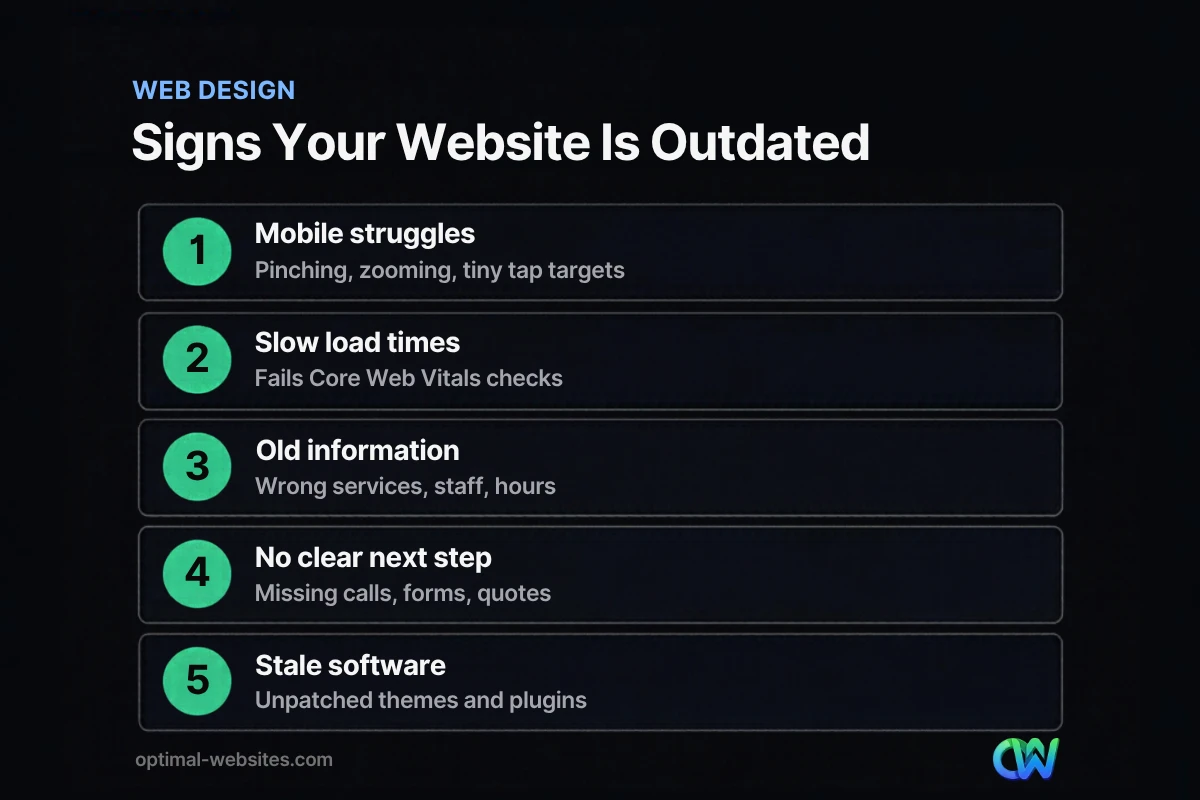
The clearest signs your website is outdated are a poor mobile experience, slow load times, old information, and no clear way for visitors to take the next step. If you check “yes” to two or more items below, it is time to act.
Outdated website checklist
- [ ] Visitors have to pinch and zoom to read your site on a phone
- [ ] Pages take more than a few seconds to load, or fail PageSpeed Insights
- [ ] Services, staff, hours or service areas are out of date
- [ ] There is no clear call to action (call, quote, booking) on key pages
- [ ] Your brand, logo or business model changed but the site didn’t
- [ ] You can’t edit text or photos without a developer
- [ ] WordPress core, themes or plugins haven’t been updated in months
- [ ] It still has dated elements like auto-playing music or visitor counters
Your business changed, but your website didn’t
If you added services, entered new markets or rebranded, every page should reflect it. A medical practice that launched a patient portal should link to it from the navigation and every booking prompt.
People struggle to use it
If your team spends hours answering questions the site should cover, treat that as free user testing. Confusing navigation sends people to competitors.
When should you redesign a website?
You should redesign a website when it no longer supports your business goals, usually every three years or so, or sooner if it fails on mobile, speed, security or conversion.
The old plan was to buy a domain, build a site and never touch it again. A healthier cycle looks like this:
- Understand your audience. Know what your best customers need to see before they call.
- Design for them. Answer their questions and make the next step obvious.
- Keep publishing. Fresh service pages, project photos and posts give people reasons to return.
- Connect your marketing. Point ads and social posts to focused landing pages.
- Measure and adjust. Review Google Search Console, PageSpeed Insights and your lead numbers regularly.
- Rebuild every few years. Plan a full redesign roughly every three years.
Should you refresh or fully redesign your website?
A refresh updates content and visuals on your existing site; a redesign rebuilds structure, code and user experience from the ground up. Refreshes work for newer sites with good bones. Redesigns are the right call when the problems are underneath the surface.
| Website refresh | Full website redesign | |
|---|---|---|
| Best for | Sites under about three years old that perform well | Older sites, slow sites, or sites that don’t fit the business anymore |
| What changes | Copy, photos, colors, a few pages | Structure, navigation, code, design, conversion paths |
| Fixes speed and mobile issues | Partially | Yes, when built mobile-first |
| Fixes security debt | Only if software is updated | Yes, with a clean, current build |
| Team can edit afterward | Depends on the old setup | Yes, with a visual editor and training |
| Typical timeline | Days to a couple of weeks | Most Optimal Websites projects launch in 2–4 weeks |
Not sure which you need? Our guide to custom design versus a template can help you think through how much you need to change.
How much does a website redesign cost?
Website redesign cost depends on the number of pages, features and how custom the design needs to be. At Optimal Websites, a WordPress web design agency packages start at $999 for Starter, $1,499 for Professional and $1,999 for Advanced Custom.
You can see what each tier includes on our website packages and pricing page. Payment is a 50% deposit to start and the final 50% after you approve the site.
When comparing quotes, ask whether the site is mobile-first, tuned for speed and editable by your team, and who handles updates after launch.
How do you keep a website from becoming outdated again?
You keep a website current by building it on a platform your team can edit, then maintaining it on a schedule. In our builds for contractors, roofers, law firms and local service businesses, these habits matter most:
- Use a visual editor. We build on WordPress with Elementor Pro and give every client video tutorials, so edits don’t need code.
- Design for phones first. Our guide to optimizing your site for mobile search covers the details.
- Stay fast. Start with these practical ways to improve page speed.
- Patch monthly, review quarterly. Update WordPress core, themes and plugins, and keep services, staff and reviews current.
How Optimal Websites Can Help
If your site shows several warning signs above, we can help you decide between a refresh and a rebuild. Our WordPress web design and development work focuses on fast, mobile-first sites built to turn visitors into calls and quote requests. We’ve built sites for businesses like PCS Roofs, F. J. Collins Law and E & S Construction Engineers.
If your current design is fine but the site is slow, our website speed optimization service can tackle performance on its own. Optimal Websites was named a Clutch Top Web Design Company in 2023 and is a DesignRush Accredited Agency.
Frequently Asked Questions
How do I know if my website is outdated?
Your website is outdated if it is hard to use on a phone, loads slowly, shows old information, or lacks a clear call to action. Other signs include unpatched plugins and a design older than three years. Run your homepage through PageSpeed Insights and view it on your own phone for a quick check.
How often should a business website be redesigned?
Most business websites benefit from a full redesign about every three years, with smaller content updates every few months. Redesign sooner if your services, branding or target market change, or if the site fails on mobile or speed. Regular updates in between keep the site from falling behind.
Does an outdated website hurt SEO?
Yes, an outdated website can hurt SEO. Google indexes and ranks pages using the mobile version of your content, so a desktop-first site can lose visibility. Slow pages that miss Core Web Vitals targets, stale content and broken links also weaken your chances.
What is the difference between a website refresh and a redesign?
A refresh updates the look and content of your current site, such as new copy, photos or colors. A redesign rebuilds the structure, navigation, code and conversion paths. A refresh suits a newer site that already performs well. A redesign is better when you know when to redesign a website: it is slow, hard to use on mobile, insecure or no longer fits the business.
How much does a website redesign cost for a small business?
Website redesign cost for a small business depends on page count, features and design complexity. At Optimal Websites, WordPress packages start at $999 for Starter, $1,499 for Professional and $1,999 for Advanced Custom. We offer a free consultation and free quote, require a 50% deposit to start, and collect the final 50% after you approve the finished site.
How long does it take to redesign a website?
Most Optimal Websites projects launch in 2–4 weeks, depending on the number of pages, the features you need and how quickly content and feedback come in. Larger builds, such as online stores, can take longer, and we give you a timeline with your free quote.
Can I update my website myself after a redesign?
Yes. We build on WordPress with Elementor Pro, a visual editor that lets you change text, images and pages without writing code. Every client receives video tutorials and training so your team can handle everyday edits. For software updates, backups and bigger changes, you can also choose our ongoing support and maintenance service.
Ready to Get Started?
An outdated website costs you something every day it stays live. Find out what yours is costing and what it would take to fix it. Request a free quote or call us at (302) 554-9497 for a free consultation.


