
Quick answer: How much does a website cost? For a small business, it depends on the route: DIY builders cost the least upfront but take your time, freelancers vary widely, and agencies charge more for strategy, design and support. Professional WordPress packages at Optimal Websites start at $999, plus ongoing domain, hosting and maintenance costs.
“How much does a website cost?” is usually the first question a small business owner asks, and the answers online are frustrating. You will see quotes that differ by thousands of dollars for what sounds like the same site. The gap exists because “a website” can mean a one-page template or a fully planned lead-generation tool. Getting the budget wrong in either direction costs you: too little and the site never brings in work, too much and you pay for features you do not need. This guide breaks down what you are actually paying for, the one-time and ongoing costs, and how to set a budget you will not regret.
Key Takeaways
- Website cost for a small business depends on scope: number of pages, custom features, content help and integrations.
- Separate one-time build costs from ongoing costs such as domain renewal, hosting, maintenance and marketing.
- The cheapest option often costs more over time if it does not produce leads or needs rebuilding.
- Fixed-price packages make budgeting easier. At Optimal Websites, packages start at $999, $1,499 and $1,999.
- Compare quotes line by line. Two proposals at the same price can include very different work.
How much does a website cost for a small business?
A small business website can cost very little or several thousand dollars, depending on who builds it and what it needs to do. The three main routes are DIY website builders, freelance designers and web design agencies, and each one trades money for time, expertise and accountability in a different way.
Here is how the routes compare in practice:
| Route | Upfront cost | Your time | Best for |
|---|---|---|---|
| DIY builder | Lowest | High: you plan, write and design | Very simple sites, tight budgets, owners who enjoy the work |
| Freelancer | Varies widely | Medium | Well-defined projects with clear content |
| Agency | Higher, often fixed-price | Low | Sites that must generate calls, quotes and sales |
The table hides an important cost: time. A DIY site might save money on paper, but an owner who spends 40 evenings fighting a template has spent real money too. And a site that looks fine but produces no calls has a cost that never shows up on an invoice.
What affects web design pricing?
Web design pricing is driven mostly by scope: how many pages you need, how custom the design is, who supplies the content, and which features the site must support. The platform and the level of support after launch also play a part.
Number of pages
A five-page brochure site and a 25-page site with individual service and location pages are very different projects. Each page needs planning, writing, layout and testing on phones and desktops.
Custom design versus templates
A pre-built theme lowers cost but limits how well the site fits your brand and goals. A custom layout takes longer but can be planned around how your customers actually decide. Our comparison of a custom website or a template explains when each makes sense.
Content and photos
Copywriting is one of the most underestimated costs. If you supply finished text and good photos, the project moves faster. If the designer writes service pages, the price rises, but so does quality in most cases.
Features and integrations
Online booking, payment forms, an online store, a members area, multilingual pages or connections to your CRM all add development and testing time.
Revisions and timeline
More rounds of revisions and rushed deadlines both increase cost. A clear plan at the start is the cheapest way to keep a project on budget.
What does a website design cost breakdown look like?
A website design cost breakdown splits the budget into planning, design and build, content, and the ongoing costs that start after launch. Seeing it this way helps you compare quotes and spot what a cheap proposal leaves out.
- Strategy and planning. Goals, audience, sitemap and the action you want visitors to take.
- Design and development. Layouts, page building, mobile responsiveness, forms and testing.
- Content. Headlines, service descriptions, about page, calls to action, photos and image optimization.
- Technical setup. SSL, analytics, basic on-page SEO, sitemap, speed optimization and security plugins.
- Launch and training. Moving the site live, checking forms and redirects, and showing you how to edit it.
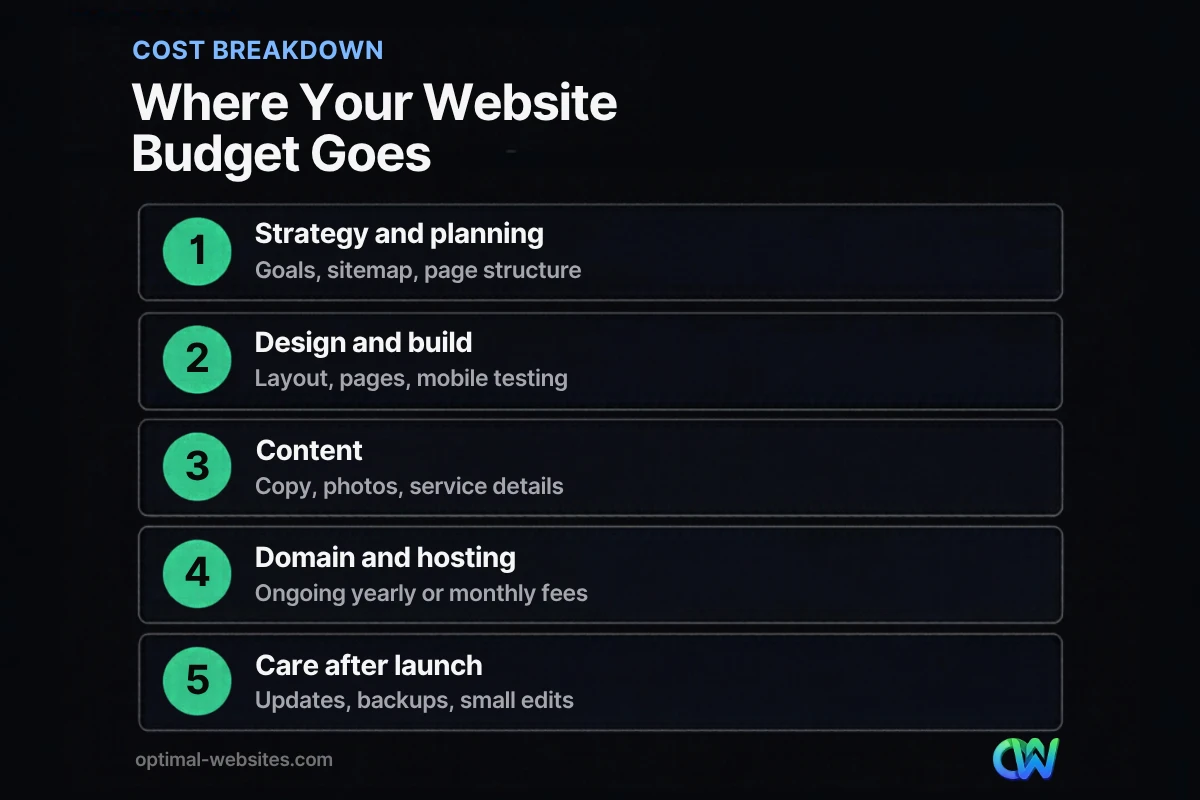
If a quote does not mention items 3 to 5, ask. Those are the pieces most often missing from low-cost proposals, and they are the ones that decide whether the site works.
What are the ongoing costs of a website?
The ongoing costs of a website are the expenses that continue after launch: domain renewal, hosting, maintenance, software licenses and any marketing you run. Budget for them from day one so the site does not slowly fall behind.
- Domain name. A yearly registration fee. The U.S. Small Business Administration recommends registering a domain to protect your brand online and notes that it must be renewed regularly.
- Hosting. A monthly or yearly fee for the server that runs your site. Quality hosting affects speed, uptime and security.
- Maintenance. Updates to WordPress, the theme and plugins, plus backups and security monitoring. You can do this yourself, pay hourly, or use a care plan.
- Premium tools. Some page builders, form tools and plugins have yearly licenses.
- Content and marketing. Blog posts, SEO, ads and social media are optional but are usually what grows traffic over time.
WordPress itself is open source software released under the GPL, so there is no license fee for the core platform. Your costs come from hosting, premium tools and the people who build and maintain the site.
How much does a professional small business website cost at Optimal Websites?
At Optimal Websites, a WordPress web design agency based in Delaware, professional websites are sold as fixed-price packages. Starter starts at $999, Professional starts at $1,499 and Advanced Custom starts at $1,999.
What that means in practice:
- Clear scope. Each package defines what is included, so you are not surprised by hourly overruns.
- Fast timeline. Most projects launch in 2–4 weeks once content is ready.
- Simple payment terms. A 50% deposit starts the project, and the final 50% is due after you approve the site.
- Training included. You get video tutorials so you can update text and images yourself.
We build on WordPress with Elementor Pro, which keeps sites flexible and easy to edit. You can compare tiers on our website packages and pricing page, and our guide to what a professional small business site includes explains the standards every package is built to.
How do you set a realistic website budget?
Set a realistic website budget by starting with what the site needs to achieve, then working backward to the pages and features required. Price comparisons only make sense once you know the scope.
Step 1: Define the job of the website
Is it to generate phone calls, quote requests, bookings or online sales? A site that must produce leads needs stronger content, clearer calls to action and better tracking than a digital business card.
Step 2: Estimate the value of a new customer
If one new client is worth $2,000 to your business, a site that brings in a few extra jobs a year pays for itself quickly. The SBA also recommends comparing marketing costs to the revenue they generate so you can measure return on investment.
Step 3: List must-have pages and features
Write down the services, locations and features you need now. Separate “nice to have” items you can add later.
Step 4: Add ongoing costs
Include hosting, domain renewal and maintenance for at least the first year.
Step 5: Collect two or three detailed quotes
Ask each provider to list deliverables, timeline, revisions, ownership and support. Our guide on what to look for when hiring a web design company includes a full list of questions.
Are cheap websites worth it?
Cheap websites are worth it only when the stakes are low. For a hobby, a placeholder or a business that gets all its work from referrals, a simple builder site can be enough.
For businesses that depend on online leads, a cheap site often ends up costing more. Common problems we see when owners come to us for a rebuild:
- The site looks dated or breaks on phones, so visitors leave quickly.
- There is no clear call to action, so traffic does not turn into calls.
- Pages load slowly because of oversized images and too many plugins.
- The owner does not have the login to the domain or hosting.
- Nobody has updated the plugins in years, which creates security risk.
Rebuilding a site twice costs more than building it properly once. That does not mean you need the most expensive option, only one that matches the job the site has to do.
How Optimal Websites Can Help
If you are comparing web design pricing and want a clear answer for your business, we can help. Our WordPress website design service starts with a free consultation to understand your goals, then recommends the package that fits. You get a fixed price, a 2–4 week typical launch and training to manage the site yourself.
Frequently Asked Questions
How much does a website cost for a small business?
How much a website costs for a small business depends on the route and scope. DIY builders have the lowest upfront cost but require your time. Freelancers vary widely. Agencies cost more but handle strategy, design and launch. At Optimal Websites, professional WordPress packages start at $999, $1,499 and $1,999, plus ongoing domain, hosting and maintenance.
What ongoing costs should I budget for after my website launches?
Plan for domain renewal, hosting, maintenance and any premium plugin or builder licenses. Maintenance covers WordPress, theme and plugin updates, backups and security checks. Many businesses also budget for content and SEO to grow traffic. Including these in your website budget from the start prevents the site from slowly becoming outdated or insecure.
Why do web design quotes vary so much?
Web design quotes vary because providers include very different work under the same label. One quote may cover only layout, while another includes strategy, copywriting, mobile testing, speed optimization, training and support. Compare deliverables line by line, not just the total, and ask what happens after launch before deciding.
Is it cheaper to build a website myself?
Building a website yourself is usually cheaper in cash but more expensive in time. You will handle planning, writing, design, mobile testing and technical setup. That can work for simple needs. If your site has to generate leads, a professional build often pays back faster because it is designed around conversions from the start.
How long does it take to build a small business website?
Most small business websites take a few weeks once content is ready. At Optimal Websites, most projects launch in 2–4 weeks. Larger sites, custom features and slow content delivery extend the timeline. Having your text, photos, logo and reviews ready before kickoff is the easiest way to keep the project on schedule and on budget.
Do I own my website after it is built?
You should. Before signing, confirm in writing that you will own the domain, hosting account, site files and admin login. WordPress is open source, so your site is not locked to one provider. Avoid any arrangement where the designer keeps control of your domain or refuses to hand over access after the final payment.
Ready to Get Started?
Want a clear number for your project? Get a free, fixed-price quote or call (302) 554-9497 to talk through your goals.


