
Quick answer: AI search visibility is how often AI tools like ChatGPT, Google AI Overviews and AI Mode mention or cite your business when people ask about your services. Measure it with a fixed list of real customer prompts, run monthly, logging whether you are named, cited or missing, plus AI referral visits in GA4.
Customers are asking AI tools which roofer to call, which law firm handles their kind of case, and what a new website should cost. If the answer names three competitors and not you, you lose the lead before it ever reaches Google’s blue links. The tricky part is that most small businesses have no idea whether AI tools mention them at all. This guide explains what AI search visibility means, why it matters for leads, and a simple, low-cost way to measure your AI brand mentions and citations every month, without buying an expensive platform on day one.
Key Takeaways
- AI search visibility covers two things: being mentioned by name and being cited as a source with a link.
- There is no official “AI rankings” report, so prompt tracking is the most practical way to measure it.
- Use a fixed list of 20–30 real customer questions and run them on the same tools each month.
- Track share of voice in AI by counting how often you appear compared with competitors.
- Connect visibility to results by watching AI referral traffic and leads in GA4.
What Is AI Search Visibility?
AI search visibility is the degree to which AI-powered search tools include your brand in their answers. That includes being named as a recommended business, being cited as a source with a link to your site, or being described accurately when someone asks about you directly.
It is related to, but different from, traditional rankings. In classic search, you rank in a list. In AI answers, the tool writes a summary and picks a handful of businesses or sources to mention. You are either in that short list or you are not.
If you are new to the strategy side, start with our guide to generative engine optimization. This post focuses on measurement.
Why Does AI Search Visibility Matter for Small Businesses?
It matters because AI answers increasingly sit between your customer and your website. When an AI summary appears, people click through to websites less often, so being named inside the answer carries more weight.
Pew Research Center found that Google users clicked a traditional search result on 8% of visits when an AI summary appeared, compared with 15% when no summary appeared. Clicks on links inside the summary itself happened on just 1% of visits. The study was based on browsing data from March 2025.
For a local business, the takeaway is simple. Some people will make a decision from the AI answer alone. If your name is not in it, you may never know you were considered.
What Should You Measure in AI Answers?
Measure four things: whether you are mentioned, whether you are cited with a link, how you are described, and how often competitors appear instead of you. Together they show your real presence in AI answers.
| Metric | What it tells you | How to record it |
|---|---|---|
| Mention rate | How often your brand is named | Percentage of prompts where you appear |
| Citation rate | How often your site is linked as a source | Count of answers linking to your domain |
| Accuracy | Whether facts about you are correct | Note wrong services, areas, prices or hours |
| Share of voice in AI | Your mentions versus competitors | Your mentions divided by all brand mentions |
| AI referral traffic | Visits and leads from AI tools | GA4 sessions from AI referrers |
AI brand mentions vs citations
An AI brand mention is your business named in the answer text. A citation is a linked source the tool shows next to or below the answer. You want both, but mentions influence the decision and citations drive the click.
How Do You Set Up Prompt Tracking?
Prompt tracking means running the same set of customer-style questions through AI tools on a regular schedule and recording the results. It is the most practical way to measure AI search visibility today, because no platform offers an official AI rankings report.
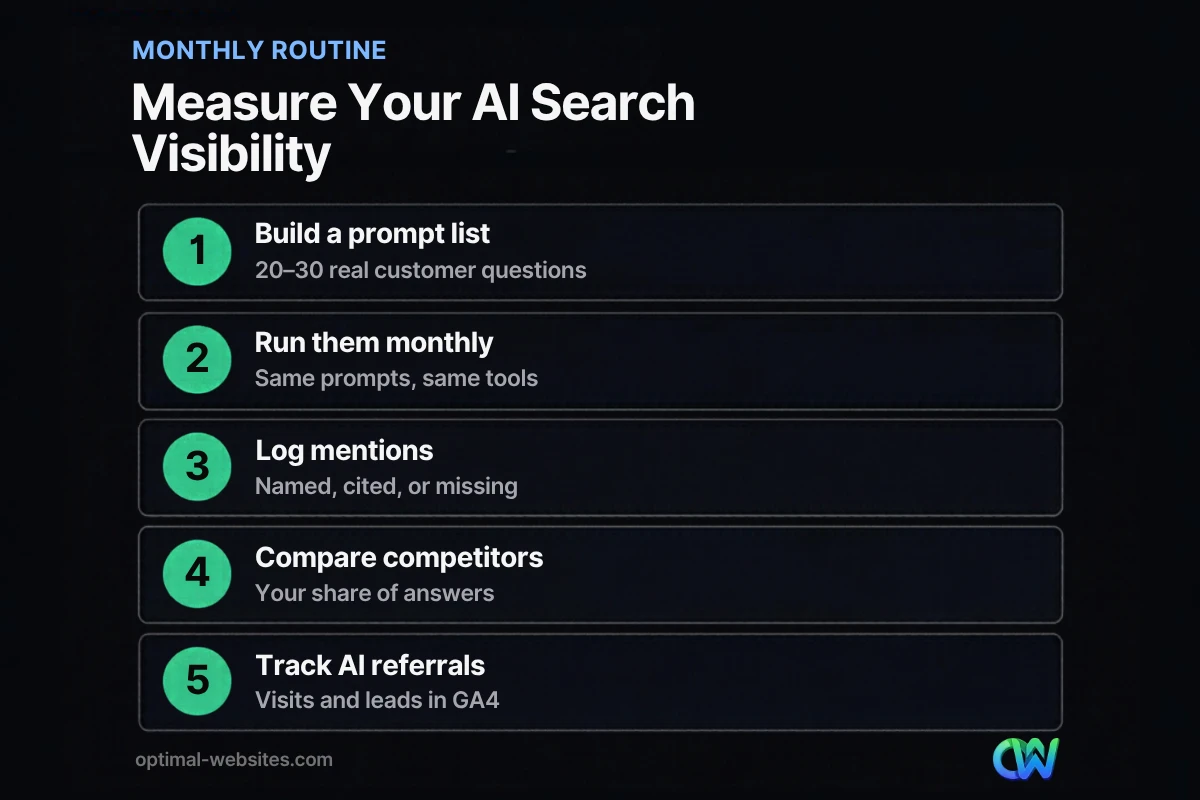
Step 1: Build your prompt list
Write 20–30 questions your customers really ask. Mix three types:
- Category prompts: “best roofing company in Wilmington, Delaware”
- Problem prompts: “how much does a roof replacement cost for a 2,000 square foot house”
- Brand prompts: “what services does [your business] offer”
Pull wording from sales calls, contact form messages and Google Search Console queries. Real language beats marketing language.
Step 2: Pick your tools
Choose the tools your customers are likely to use. For most US small businesses, that means ChatGPT, Google AI Overviews, Google AI Mode, and possibly Microsoft Copilot or Perplexity. Keep the list short enough to repeat every month.
Step 3: Run prompts the same way each time
AI answers vary between sessions, locations and accounts. Reduce noise by using a logged-out or fresh session where possible, setting your location to your service area, and running each prompt at least twice. Record what appears both times.
Step 4: Log results in a simple sheet
Columns: date, tool, prompt, mentioned (yes/no), cited (yes/no, which URL), competitors named, and notes on accuracy. A spreadsheet is enough to start.
How Do You Calculate Share of Voice in AI?
Share of voice in AI is the percentage of all brand mentions in your tracked answers that belong to you. Count every business named across your category prompts, then divide your mentions by the total.
Example: across 20 category prompts, AI tools name 60 businesses in total. Your business appears 9 times. Your share of voice is 9 ÷ 60 = 15%. Track that number monthly alongside your top three competitors to see who is gaining ground.
Use it as a trend, not a precise score. Small samples swing, so look for direction over three or more months.
How Do You Connect AI Visibility to Leads?
Connect visibility to leads by measuring visits and conversions from AI tools in Google Analytics 4. Mentions are a leading indicator; referral traffic and form submissions show whether they turn into business.
In GA4, AI tools that pass a referrer show up as traffic sources such as chatgpt.com or perplexity.ai. Create a custom channel group or an exploration filtered to those sources, then add your key events (form submissions, calls). Our step-by-step guide shows how to track AI referral traffic in detail.
Google’s own AI features work differently. According to Google’s guide on AI features and your website, traffic from AI Overviews and AI Mode is included in the overall search traffic in Search Console’s Performance report under the “Web” search type, so it is not broken out separately.
How Do You Improve AI Search Visibility Once You Measure It?
The same fundamentals that help SEO help AI answers. Google states there are no special optimizations required to appear in AI Overviews or AI Mode beyond being indexed and eligible to show with a snippet.
Practical improvements that tend to follow from tracking:
- Fix wrong facts. Update your website, Google Business Profile and directory listings so services, areas and hours match everywhere.
- Answer the prompts you miss. If you never appear for “cost” questions, publish a clear, honest pricing explainer.
- Strengthen service pages. One page per service, with specific detail about what you do and where.
- Earn mentions elsewhere. Reviews, local news, industry associations and partner pages give AI tools more sources that name you.
- Keep content current. Outdated pages are less useful as sources.
How Optimal Websites Approaches It
At Optimal Websites, a WordPress web design agency based in Delaware, we treat AI search visibility as an extension of good SEO, not a separate trick. We build clear, well-structured WordPress sites with Elementor Pro, write service pages that answer real questions, and help clients set up simple prompt tracking and GA4 reporting. For contractors, law firms and local service businesses, the biggest wins usually come from accurate facts and strong service pages rather than anything exotic.
How Optimal Websites Can Help
If you want to know whether AI tools mention your business and what to do about it, our SEO services include keyword strategy, on-page optimization, technical SEO and clear reporting. We can build your first prompt list, run a baseline check and show you where the gaps are.
Frequently Asked Questions
What is AI search visibility?
AI search visibility is how often and how accurately AI tools such as ChatGPT, Google AI Overviews and AI Mode mention or cite your business in their answers. It includes being named as a recommendation, being linked as a source, and being described correctly. You measure it by tracking a fixed set of prompts over time.
How do I check if ChatGPT mentions my business?
Write a list of questions customers would ask, such as “best plumber in [your city],” and run them in ChatGPT using a fresh session with your location set. Note whether your business is named or linked, and which competitors appear. Repeat monthly with the same prompts so you can see changes in your AI brand mentions over time.
What is prompt tracking?
Prompt tracking is the practice of running the same customer-style questions through AI tools on a regular schedule and recording which brands and sources appear in the answers. It is the most practical way to measure AI search visibility, because AI platforms do not provide an official rankings report for businesses.
Are there tools for AI citation tracking?
Yes, several paid platforms now offer AI citation tracking and share of voice reports across multiple AI tools. They save time at scale, but a simple spreadsheet and a monthly manual check work well for most small businesses. Start manually to learn which prompts matter, then decide whether a paid tool is worth it.
Does Google report AI Overviews traffic separately?
No. Google says traffic from AI Overviews and AI Mode is included in overall search traffic in Search Console’s Performance report under the Web search type. You cannot isolate it there. Track brand mentions with prompt tracking, and use GA4 to see referral traffic from other AI tools that pass a referrer.
How often should I measure AI search visibility?
Monthly is enough for most small businesses. AI answers vary from session to session, so very frequent checks mostly capture noise. Run the same prompts each month, compare share of voice in AI against your top competitors, and look for trends over at least three months before changing your strategy.
Ready to Get Started?
Curious whether AI tools recommend your business? Request a free quote or call (302) 554-9497 and we will run a baseline AI visibility check with you.


