

Quick answer: How often should a business blog? For most small businesses, two to four posts a month is a realistic target that builds search visibility without burning out the team. Consistency and quality matter more than volume: one genuinely useful post every week beats five thin ones. Pick a schedule you can keep for a full year.
Most business blogs follow the same pattern. A burst of enthusiasm produces five posts in the first month, then the schedule slips, and the newest article is from two years ago. Visitors notice, and so does your sales pipeline, because a stale blog does little to bring in search traffic or show expertise. So how often should a business blog to see results? This guide gives a realistic answer based on your goals and resources, explains what Google actually rewards, and lays out a simple posting schedule you can keep up with a small team.
Key Takeaways
- Two to four posts a month is a sustainable blogging frequency for most small businesses.
- Google does not reward publishing frequency by itself; it rewards helpful, people-first content.
- Consistency builds momentum. A steady schedule beats bursts followed by silence.
- Updating older posts counts as content work and often pays off faster than new posts.
- Plan topics around customer questions and your services so every post can lead to a lead.
How Often Should a Business Blog?
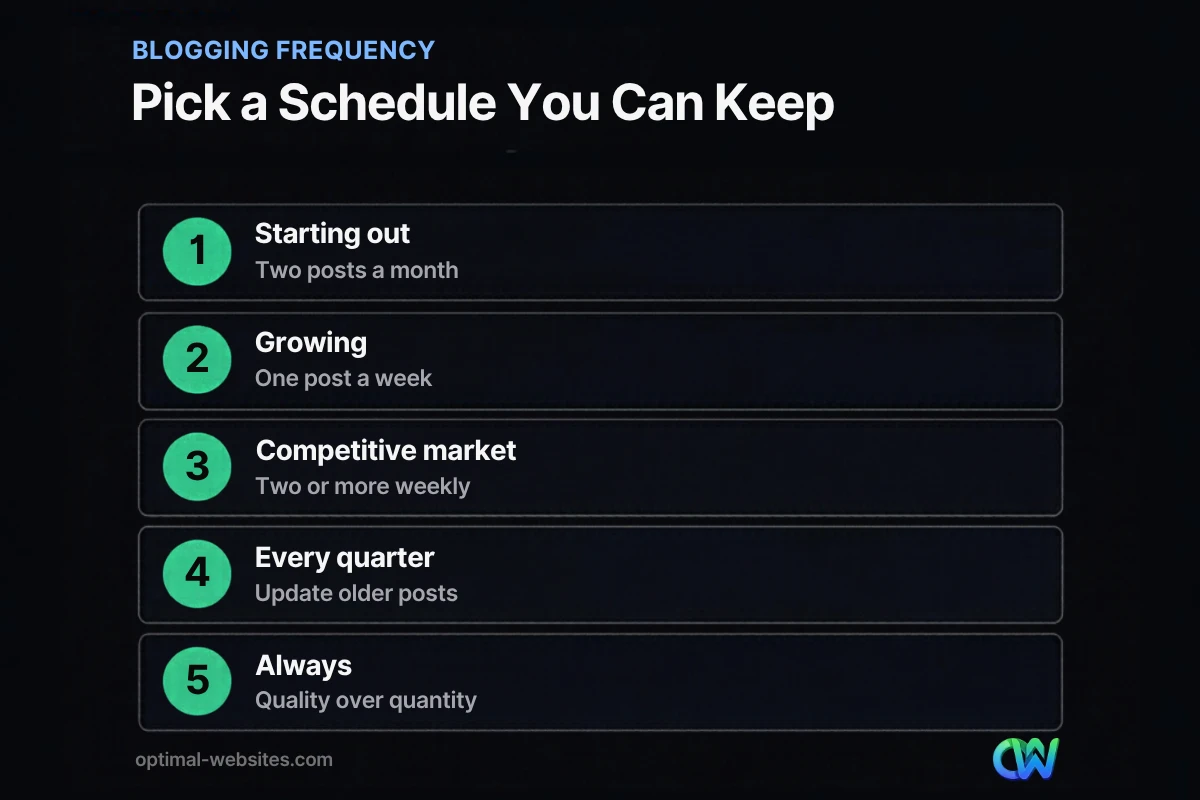
Most small businesses should publish two to four blog posts per month. That range is enough to build topical depth and steady search visibility, and it is achievable for an owner, a staff writer or a freelance partner.
The right number for you depends on three things: your goals, your competition and your capacity. A roofing company in a mid-sized town competes with a handful of local firms and can make real progress with two strong posts a month. A law firm in a large metro area competes with firms publishing weekly, so it may need more to keep pace. In every case, the deciding factor is whether you can sustain the schedule with quality.
Blogging frequency by goal
| Goal | Suggested frequency | What to focus on |
|---|---|---|
| Show you are active and credible | 1–2 posts per month | Project stories, FAQs, company updates |
| Build local search visibility | 2–4 posts per month | Customer questions, service and location topics |
| Compete in a crowded market | 1–2 posts per week | Topic clusters, comparisons, in-depth guides |
| Support paid ads and email | 2 posts per month plus updates | Content you can reuse in emails and social posts |
Does Posting More Often Help SEO?
Not by itself. Google’s guidance on creating helpful content asks whether you are producing lots of content on many topics just hoping some of it performs, and it warns that adding content only to make a site seem fresh will not help rankings.
Google describes people-first content as content created primarily for people, not to manipulate search rankings. Frequency helps indirectly: more helpful posts mean more questions answered, more pages that can rank, and more reasons for visitors to stay. But publishing for the sake of a quota usually produces thin, repetitive articles.
Google’s spam policies also define scaled content abuse as generating many pages primarily to manipulate rankings rather than help users, no matter how the content is produced. Google expanded that policy in March 2024, which makes mass-produced, low-value posts riskier than ever.
What Are the Business Blog Benefits Worth Chasing?
A business blog earns its keep when it answers the questions your customers ask before they buy. That builds search visibility, trust and a library of content you can reuse.
- Search visibility: each helpful post is another page that can appear for a real question.
- Trust: detailed answers show expertise before a prospect ever calls.
- Sales support: your team can send a post instead of writing the same explanation again.
- Internal links: posts can point readers to your service pages, where leads happen.
- Reusable content: one post can become social updates, an email and a FAQ answer.
For the bigger picture of how blogging fits with other channels, see our guide to content marketing for small business.
How Do You Build a Blog Posting Schedule You Can Keep?
Start with a schedule slightly below what you think you can manage, plan topics a quarter at a time, and batch the work. A blog posting schedule only works if it survives your busiest month.
- Choose your frequency. Pick a number you can sustain for twelve months, not just the first month.
- List customer questions. Ask your sales and service team what people ask before hiring you.
- Map topics to services. Make sure each post connects to a service page you want to promote.
- Plan a quarter at a time. Put titles, target keywords and publish dates in a simple calendar.
- Batch the writing. Write or review several posts in one session instead of one at a time.
- Publish on fixed days. Choose the same weekday each time so the routine sticks.
- Review every quarter. Check which posts bring traffic and leads, then adjust topics.
A sample monthly schedule for a small business blog
- Week 1: answer a common customer question in depth.
- Week 2: share a project story or case example, without invented numbers.
- Week 3: publish a comparison or cost explainer for one of your services.
- Week 4: update an older post with new information, photos and internal links.
That rhythm gives you three new posts and one refresh every month, which is a solid small business blog cadence.
Should You Update Old Posts or Write New Ones?
Do both. Refreshing older posts that already get impressions is often the fastest way to gain traffic, while new posts expand the topics you cover.
A practical split is roughly one refresh for every two or three new posts. Prioritize older posts that rank on page two, have outdated information, or no longer match what you offer. Our guide on how to update old blog posts for SEO explains how to choose which posts to refresh, merge or retire.
How Long Should Business Blog Posts Be?
As long as it takes to answer the question well. Google’s guidance says it has no preferred word count, so write for completeness and clarity rather than length.
In practice, quick answers to narrow questions might take 800 words, while buying guides and comparisons often need 1,500 words or more. Use headings, short paragraphs, lists and tables so readers can scan. A shorter post that fully answers one question beats a long post padded with filler.
Who Should Write Your Business Blog?
The best writer is someone who understands your customers and can explain your expertise clearly. That might be the owner, a team member, a freelance writer or an agency that interviews your team.
Owners often know the material best but have the least time. A common setup is for the owner or a team member to provide a short interview or bullet points, and a writer turns them into a polished post. If you are weighing options, our guide on how to hire a blog writer compares in-house, freelance and agency approaches.
At Optimal Websites, a WordPress web design agency based in Delaware, we see the same issue across contractor, roofing and law firm sites: the blog is the first thing to stall when work gets busy. Building the editorial calendar up front, and setting up WordPress so posts are easy to publish with consistent layouts, removes most of the friction.
How Optimal Websites Can Help
If keeping a steady blogging frequency is the hard part, our blog writing services handle topic planning, research, writing and on-page SEO, so your blog stays active without taking over your week. Every post is planned around the questions your customers ask and linked to the services you want to sell.
Frequently Asked Questions
How often should a small business post on its blog?
Most small businesses should aim for two to four blog posts a month. That frequency builds search visibility and trust while staying manageable for a small team. If you can only manage one great post a month, publish one great post a month. Consistency and usefulness matter far more than hitting a high number.
Is blogging once a month enough?
Blogging once a month is enough to keep your site active and gradually answer customer questions, especially in a less competitive local market. Results will build more slowly than with weekly posts. If once a month is your limit, make each post thorough, link it to a service page and update older posts regularly.
Does Google penalize you for not posting often?
No. Google does not penalize a site for publishing infrequently, and it does not reward frequency by itself. It rewards helpful, people-first content. A site with a few excellent, up-to-date articles can outperform one that posts daily. What hurts is mass-producing thin content or letting important information go out of date.
What is the best day to publish a blog post?
There is no single best day for every business. Choose a consistent weekday that fits your workflow and your audience, such as a weekday morning for B2B readers. A fixed blog posting schedule matters more than the specific day, because it keeps your team on track and gives readers a rhythm.
How long does it take for a business blog to bring traffic?
Most new posts take several months to reach their full search potential, and a newer website usually takes longer than an established one. Track impressions and clicks in Google Search Console to see early progress. Steady publishing plus refreshing older posts usually shows a clear upward trend within the first year.
Should I use AI to write my business blog?
AI tools can help with outlines, research and first drafts, but posts still need human expertise, fact-checking and your own examples. Google’s spam policies target mass-produced content made to manipulate rankings, however it is created. Use AI to speed up the process, and make sure every published post genuinely helps your readers.
Ready to Get Started?
Want a blog that stays active and brings in leads? Request a free quote for blog writing and content planning, or call (302) 554-9497 to talk about a schedule that fits your business.


