
Last updated: October 15, 2026
Quick answer: To hire a blog writer, start with clear goals, then compare four options: an in-house writer, a freelancer, an agency, or AI tools alone. Review published samples in your industry, ask how the writer handles SEO and fact-checking, run one paid test post, and put ownership, deadlines and revisions in writing.
Most small business owners know their website needs fresh, useful articles, but few have the hours to write them. The result is often a blog that went quiet years ago. When you hire a blog writer, you buy back that time and get a steady stream of content that answers customer questions, supports your search rankings and gives people a reason to contact you. This guide compares your hiring options, explains what drives the cost, and gives you a checklist for choosing someone who will write for your business, not just about it.
Key Takeaways
- Decide what you need the blog to do (traffic, leads, trust) before you look at writers.
- In-house, freelance, agency and AI-only content each fit a different budget and level of involvement.
- Industry knowledge, an SEO process and a fact-checking habit matter more than polished prose.
- A paid test post tells you more than any portfolio or interview.
- AI can speed up drafting, but Google expects every AI-assisted page to be reviewed and fact-checked by a person.
Why should a small business hire a blog writer?
A small business should hire a blog writer when consistent, expert content would bring in customers but nobody on the team has the time or skill to produce it. A good writer turns your knowledge into articles that rank, build trust and move readers toward a call or quote request.
Blog writing is the creation of helpful, search-optimized articles that answer the questions your customers ask before they buy. A roofing company might explain how to spot storm damage; a law firm might explain what happens after an injury claim is filed. The hard part is consistency, and a professional writer keeps a schedule so your site keeps earning visibility.
Google rewards this kind of work when it is done well. Its guidance on people-first content says content should be created primarily to help people, not to manipulate rankings. Hiring someone who understands that difference is the whole game. If you are new to search, our guide to SEO basics for small businesses explains how blog content fits into the bigger picture.
What type of writer do you need?
You need a writer whose specialty matches the content you want. Blog writers, copywriters, content writers and ghostwriters overlap, but each one is strongest at a different job.
- Blog and content writers focus on educational articles: how-to guides, comparisons, FAQs and explainers. For most small businesses, a content writer with strong blogging experience is the right fit.
- Copywriters write to persuade. They are best for ads, landing pages and emails, and can make educational articles sound too salesy.
- Ghostwriters write under your name, in your voice. They suit founder articles and thought leadership, and need more interview time.
Whatever the title, look for someone who already understands your field or learns it quickly. A writer who knows the difference between a general contractor and a construction manager, or between a retainer and a contingency fee, makes fewer mistakes that cost you credibility.
In-house vs freelance vs agency vs AI-only: which is best?
The best option depends on how much content you need, how involved you want to be and your budget. Freelancers suit occasional posts, agencies suit businesses that want strategy and publishing handled, in-house writers suit high-volume teams, and AI-only content is the riskiest choice for a business that depends on trust.
| Option | Best for | Strengths | Watch-outs | Your time each month |
|---|---|---|---|---|
| In-house writer | Companies publishing a lot of content across many channels | Deep product knowledge, always available, consistent voice | Salary, benefits and management; one person’s skills set the ceiling | Moderate (managing and reviewing) |
| Freelance writer | Occasional posts or a single content type | Flexible, pay per project, wide talent pool | Quality varies, availability changes, you handle strategy, SEO and publishing | High (briefing, editing, uploading) |
| Agency or blog writing service | Small businesses that want results without managing the process | Strategy, keyword research, editing, images and publishing in one team | Higher cost per post than a budget freelancer; needs your input to sound authentic | Low (approvals and expert input) |
| AI-only content | Internal drafts and brainstorming | Fast and cheap | Factual errors, generic advice, no real experience, possible spam policy risk at scale | Moderate to high (fact-checking everything) |
When a freelancer makes sense
The freelance vs agency blog writer decision often comes down to who handles everything around the writing. A freelancer is a good choice if you already have a content plan, someone to edit and someone to publish in WordPress. Look on professional networks such as LinkedIn, or ask colleagues for referrals, which tell you about reliability as well as talent. You can also contact the authors of articles you admire in your industry.
When an agency makes sense
An agency fits when you want topics, keyword research, writing, editing, images and publishing handled. You trade a higher price per post for far less of your own time.
When to develop someone on your team
Sometimes the best writer is already on your payroll. A project manager or technician who explains things clearly can draft posts from real field experience, which is exactly what readers and search engines value.
Where AI fits
AI tools can help with outlines and first drafts, but they should not be the final author. Google’s guidance on using generative AI content says it is critical to manually fact-check and review AI-generated content, and that producing many pages without adding value for users may violate its spam policy on scaled content abuse.
How much does a blog writer cost?
A blog writer’s cost depends on the hiring model, the writer’s experience, the length and research depth of each post, and how much is included beyond the writing itself. Rates for freelancers and agencies vary too widely to quote one reliable market range, so compare quotes based on exactly what each one includes.
For in-house hiring, there is a solid benchmark. According to the U.S. Bureau of Labor Statistics, the median annual pay for writers and authors was $76,910 in May 2025. That excludes benefits and management time. The same source reports that about 65% of writers and authors are self-employed, which is why most small businesses end up working with freelancers or agencies instead of hiring full time.
What drives the price
- Research depth: Interviews, data checks and technical review take time.
- Length and format: Long guides with tables and FAQs cost more than short updates.
- Industry expertise: Legal, medical and engineering topics need specialist accuracy.
- SEO work: Keyword research, search intent analysis, meta titles and internal linking add value and time.
- Extras: Images, WordPress publishing and promotion may or may not be included.
Compare quotes the right way
Ask each writer or agency to list what is included: topics, keyword research, revisions, images and publishing. The cheapest option is not cheap if you spend hours editing and uploading every post.
How do you hire a blog writer? A step-by-step checklist
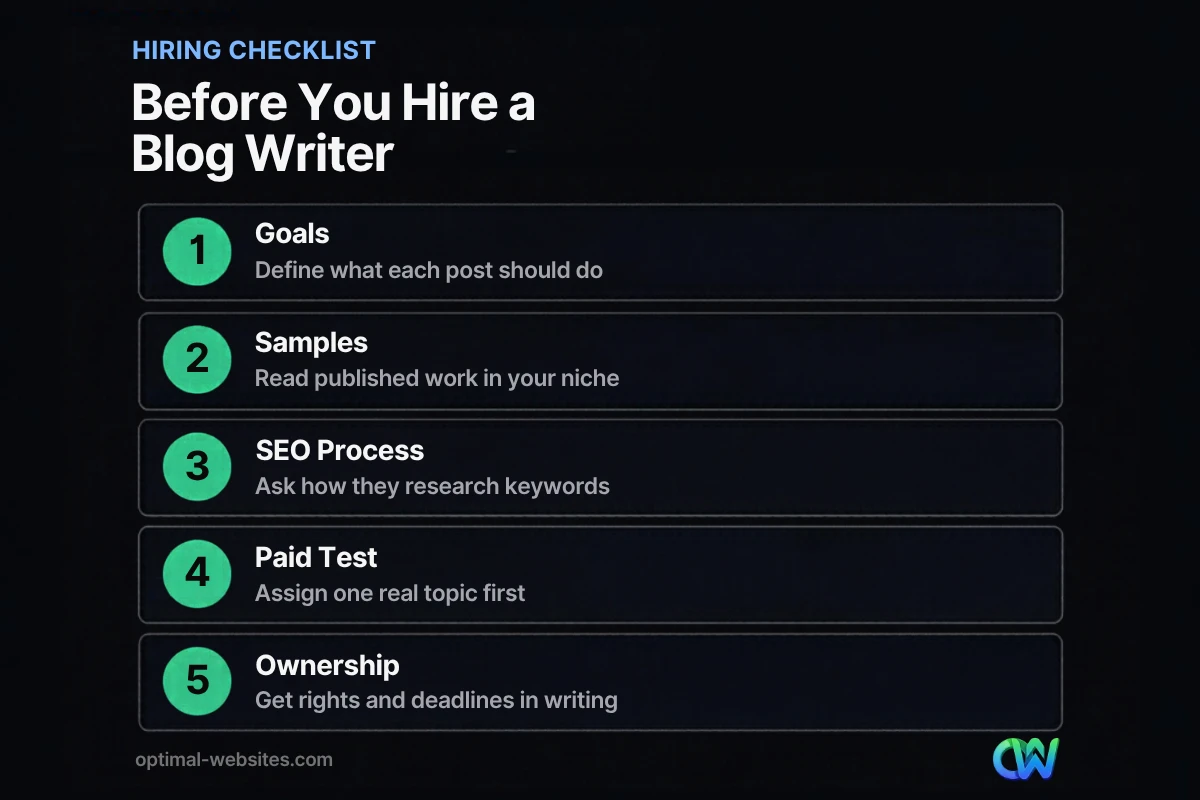
To hire a blog writer, define your goals, write a short brief, review relevant samples, ask about process, run a paid test and put the terms in writing. Following these steps in order filters out poor fits before you commit to a long-term arrangement.
- Define your goals. Search traffic, leads, sales support or authority: each goal changes the topics and calls to action.
- Write a one-page brief. List your services, ideal customers, service area, tone of voice and a few questions customers always ask.
- Review published samples in your niche. Read full articles and look for accurate detail and clear structure.
- Ask about their SEO process. A strong candidate can explain how they choose keywords, match search intent, structure headings and link to related pages on your site.
- Ask how they verify facts. Every statistic needs a real, current source. Ask how they use AI tools, if at all.
- Run one paid test post. Judge it on accuracy, voice and how much editing it needed.
- Agree on terms in writing. Cover deadlines, revisions, content ownership and payment terms.
- Set up a feedback loop. Review results monthly and plan the next topics together.
Red flags to watch for
- Guaranteed rankings or traffic numbers.
- No published samples, or samples that read like generic AI output.
- Statistics with no sources, or sources that do not say what the writer claims.
- Reluctance to sign an agreement that transfers content ownership to you.
What should a good blog post include?
A good blog post answers one main question clearly, is easy to scan, and points the reader to a useful next step. Your writer should deliver posts that are ready to publish, not rough drafts you have to rebuild.
At Optimal Websites, we build fast, mobile-first WordPress sites with Elementor Pro, and we see the same pattern across contractors, law firms and local service businesses: the posts that do the most work are the ones that answer real customer questions in plain language. A ready-to-publish post should include a title that matches real searches, a direct answer near the top, scannable headings, lists or tables where useful, links to related service pages and articles, compressed images with descriptive alt text, and a call to action that fits the topic.
Good posts also connect to the rest of your marketing. An article about seasonal roof inspections can be shared on social media, mentioned in your Google Business Profile updates, and used by your team in follow-up emails. Content that helps readers decide is also one of the most reliable ways to turn more website visitors into leads.
How Optimal Websites Can Help
Optimal Websites, a WordPress web design agency based in Delaware, offers blog writing services for small businesses that want consistent, expert content without managing the process. Our team handles topic and keyword research, writes original articles, adds images, headings and internal links, and publishes each post on your WordPress site with a distribution plan.
You stay involved where it counts: sharing expertise and approving posts. We pair blog writing with our SEO services for businesses that want the full picture, from technical fixes to content. If your site itself needs an upgrade before you start publishing, you can review our website packages and pricing.
Frequently Asked Questions
Where can I hire a blog writer?
You can hire a blog writer through referrals, professional networks such as LinkedIn, freelance marketplaces, or a blog writing service. Referrals usually give the most reliable results because someone you trust has already seen the writer’s work and deadlines. Agencies are easiest if you also want strategy and publishing handled.
How much does a blog writer cost?
The cost depends on the hiring model, the writer’s experience, post length, research depth and what is included beyond writing. For full-time hires, the U.S. Bureau of Labor Statistics reports a median annual pay of $76,910 for writers and authors as of May 2025. Freelance and agency pricing varies widely, so compare quotes based on what each includes.
Is it better to hire a freelancer or an agency to write blogs?
A freelancer is better if you already have a content strategy, an editor and someone to publish posts. An agency is better if you want one team to handle topics, SEO, writing, images and publishing. The freelance vs agency blog writer choice mostly comes down to how much of your own time you can give the process.
Can I just use AI to write my blog posts?
You can use AI to brainstorm and draft, but publishing AI-only posts is risky. Google says AI-generated content must be fact-checked and reviewed by people, and that mass-producing pages without added value can break its spam policies. A human writer adds real experience and your voice.
How do I hire a content writer for a small business?
To hire a content writer for a small business, define your goals, write a short brief, review samples in your industry and ask about their SEO and fact-checking process. Then run one paid test post on a real topic. If the draft needs little editing and sounds like you, agree on terms in writing.
How often should a small business publish blog posts?
Consistency matters more than volume. A steady schedule you can keep, such as two to four posts a month, usually beats bursts of activity followed by silence. Pick a pace that fits your budget and the customer questions you can answer well, then review results monthly.
What should I ask before I hire a blog writer?
Ask to see published samples in your field, how they research keywords, how they verify statistics, whether they use AI tools, how many revisions are included and who owns the finished content. Strong candidates also ask you questions about your customers, services and goals before they quote.
Ready to Get Started?
Want a blog that brings in customers? Request a free quote or call us at (302) 554-9497 to talk about your goals.


