
Quick answer: Law firm SEO is the work of helping your firm appear when people search for a lawyer in your area and practice area. It rests on dedicated practice area pages, a strong Google Business Profile with genuine reviews, clear attorney credentials, helpful content that answers client questions, and a fast website that makes contacting the firm easy.
Most people who need a lawyer start with a search: “car accident lawyer near me,” “divorce attorney in Dover,” “how much does an estate plan cost.” The firms that show up in the map pack and the first few results get the consultations. Legal search is also crowded, with national directories and large firms competing for the same terms, and every client decision involves money, family or freedom. This guide explains how law firm SEO works, which pages and signals matter most, how to show credibility, and what we see working on law firm websites.
Key Takeaways
- Law firm SEO has two targets: the local map pack and the organic results below it. Both depend on your website.
- Build one detailed page per practice area, and location pages only where you genuinely serve clients.
- Your Google Business Profile, reviews and consistent business details drive local visibility.
- Attorney bios, credentials and real experience help both search engines and potential clients trust the firm.
- Follow your state bar’s advertising rules on every page, especially for results, testimonials and claims.
What is law firm SEO?
Law firm SEO is search engine optimization tailored to legal practices: making your website and online presence the best answer when people search for legal help you provide. Because almost every legal search has local intent, it overlaps heavily with local SEO.
It covers four areas. On-page work makes each practice area page clear and complete. Local SEO builds your Google Business Profile, reviews and citations. Credibility work shows who your attorneys are and why they are qualified. Technical work keeps the site fast, secure and easy to use on a phone. For the fundamentals that apply to every business, see our guide to SEO for small business.
Why does SEO matter for law firms?
SEO matters because people search at the moment they need a lawyer, and legal matters are high value for the firm. A steady flow of organic inquiries reduces dependence on referrals, directories and paid ads.
Legal topics are also the kind of searches where people look closely at credibility. They compare firms, read reviews and look at attorney profiles before calling. Strong SEO puts you in that comparison set; a strong website wins the comparison.
How do you rank a law firm in local search?
Local rankings depend on relevance, distance and prominence. Google says local results are based on relevance, distance and prominence, and that more reviews and positive ratings can help local ranking.
For law firm local SEO, that means:
- Choose the most specific primary category for your main practice, such as “Personal injury attorney” or “Family law attorney,” and add secondary categories only for practices you actively handle.
- Complete your Google Business Profile: office hours, practice areas, description, photos of the office and attorneys, and appointment link.
- Keep name, address and phone consistent across your website, Google, Bing, Apple and legal directories.
- Ask satisfied clients for reviews where your state’s rules allow it, and reply professionally without revealing confidential details.
- Create a location page for each real office, with directions, parking, nearby courts and the attorneys who work there.
What pages does a law firm website need for SEO?
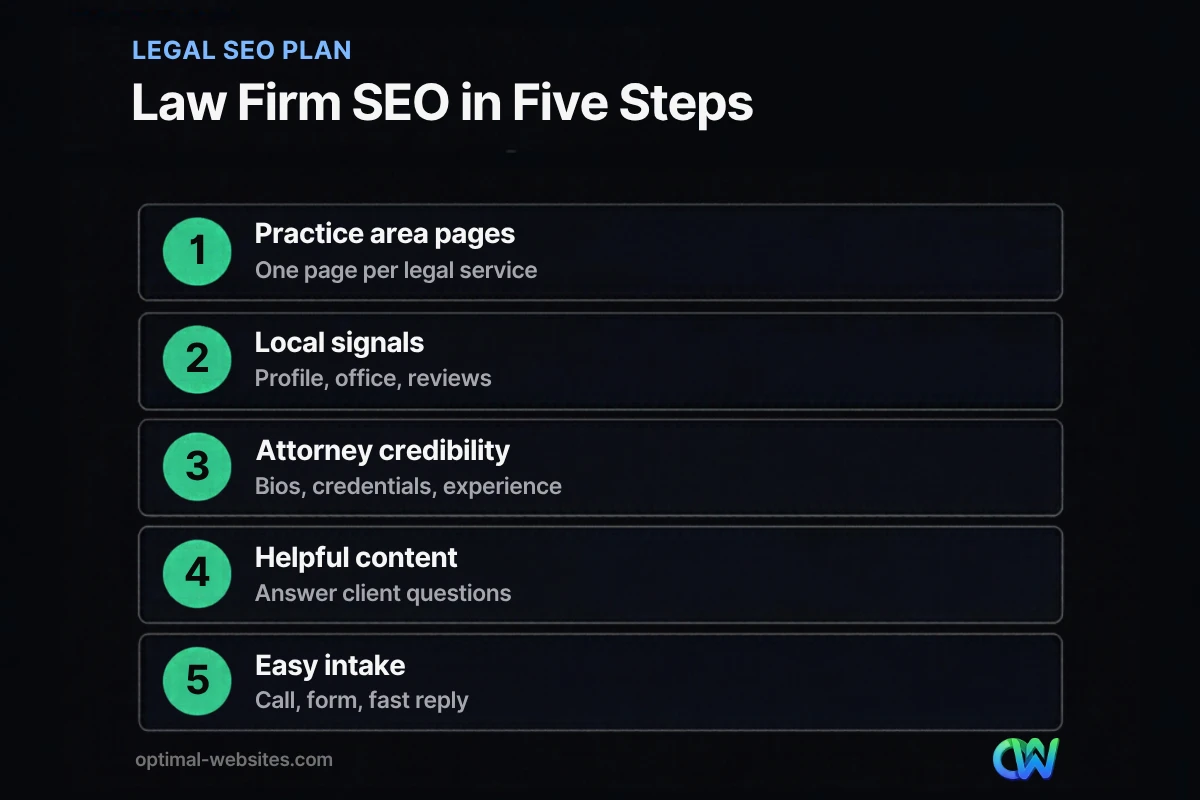
A law firm website needs a clear homepage, one detailed page per practice area, attorney bios, location pages for real offices, and helpful resources that answer client questions. Practice area pages do most of the ranking work.
Practice area pages
Practice area pages are the core of attorney SEO. Instead of one “Practice Areas” page listing everything, create a dedicated page for each service, such as car accidents, truck accidents, divorce, child custody, wills and trusts or DUI defense. Each page should explain:
- What the legal issue is and who it affects.
- How the process works and typical timelines.
- What clients should do next, and what to bring to a consultation.
- How fees work, described accurately.
- Answers to common questions.
If a practice area is large, add subpages for specific situations, such as motorcycle accidents under personal injury.
Attorney bios
Each attorney should have a real profile with education, bar admissions, practice focus, professional memberships and a photo. These pages help clients choose and help search engines connect expertise to your content.
Location pages
Create location pages only for offices where you actually meet clients. If you serve nearby towns from one office, mention them naturally on practice area pages rather than creating thin pages for each town.
Resources and FAQs
Articles that answer questions such as “What should I do after a car accident?” or “How long does probate take in Delaware?” attract early-stage searchers and show expertise. Link each article to the relevant practice area page.
How does E-E-A-T apply to law firm websites?
E-E-A-T stands for experience, expertise, authoritativeness and trustworthiness, and it describes the kind of content Google’s quality raters look for. In December 2022, Google added Experience to E-A-T in its search rater guidelines, noting that these guidelines do not directly influence ranking but help creators self-assess their content.
Legal content affects people’s money and lives, so credibility matters. Practical ways to show it:
- Put the author or reviewing attorney on every legal article, with a link to their bio.
- Show bar admissions, years of practice and relevant memberships accurately.
- Explain the firm’s real process and experience in each practice area.
- Keep content accurate and update it when laws change.
- Make contact details, office locations and the firm’s leadership easy to find.
What advertising rules affect law firm SEO?
State bar advertising rules apply to your website, profiles and reviews. Before publishing, check your state’s rules on case results, testimonials, specialization claims and comparisons with other firms.
Common areas to review with your firm’s ethics guidance:
- Case results: many states require disclaimers that past results do not guarantee future outcomes.
- Testimonials and reviews: rules vary on how they can be presented.
- “Specialist” or “expert” language: some states restrict these terms unless the attorney holds a recognized certification.
- Fee claims: describe contingency and fee arrangements accurately.
SEO copy should never trade compliance for keywords. Clear, accurate pages also tend to convert better.
What technical SEO do law firm websites need?
Law firm websites need fast, secure, mobile-friendly pages, clean structure and accurate structured data. Many legal searches happen on phones during stressful moments, so the site has to load quickly and make calling easy.
- Tap-to-call buttons and a short consultation form on every page.
- HTTPS everywhere, with no mixed-content warnings.
- LegalService or Attorney structured data where appropriate, matching your profile details.
- Fast page loads, especially on practice area pages with large images or videos.
- Clear navigation from every practice area to the relevant attorney bios and contact page.
- Search Console monitoring for indexing errors.
How long does law firm SEO take?
Expect early gains in a few months from profile fixes, practice area pages and technical cleanup, and steadier growth over six months to a year in competitive markets like personal injury in large metros. Smaller towns and niche practice areas usually move faster.
Budget and scope vary by market and practice area; our post on SEO pricing for small businesses explains how providers price this work and what to ask before signing.
What we see on law firm websites
We have built websites for law firms including Wright Ryon & Maher and F. J. Collins Law, and the SEO gaps on legal sites tend to repeat. The homepage tries to rank for every practice, practice area pages are a paragraph long, attorney bios are a name and a photo, and the contact form asks for case details the firm should collect privately.
When we build law firm websites with WordPress and Elementor Pro, we start with a structure of dedicated practice area pages, detailed attorney bios, location pages for real offices and a simple, secure consultation form. We make the phone number and consultation button visible on mobile and train the firm’s staff to publish new resources. You can see examples in our portfolio, and our guide to law firm website design covers the design side in depth.
How Optimal Websites Can Help
Optimal Websites, a WordPress web design agency based in Delaware, helps law firms build the foundation legal SEO depends on. Our SEO services for law firms include practice area page planning and writing, on-page optimization, Google Business Profile improvements, review processes and technical cleanup.
If your current site cannot support that structure, we can rebuild it as a fast, mobile-first law firm website designed to turn searches into consultations.
Frequently Asked Questions
What is law firm SEO?
Law firm SEO is the process of improving a law firm’s visibility in search results for the legal services it offers in its area. It includes practice area pages, local SEO through Google Business Profile and reviews, attorney credibility signals, helpful legal content and technical basics such as speed, security and mobile usability.
How do lawyers get more clients from Google?
Lawyers get more clients from Google by ranking in the map pack and organic results for practice area searches, then making it easy to call or book a consultation. That requires a complete Google Business Profile, genuine reviews, detailed practice area pages, strong attorney bios and a fast, mobile-friendly website with clear contact options.
What are practice area pages?
Practice area pages are dedicated website pages for each legal service a firm offers, such as car accidents, divorce or estate planning. They explain the issue, the process, fees and next steps, and answer common questions. They are usually the most important pages for attorney SEO because they match what clients actually search for.
How long does SEO take for a law firm?
Most law firms see early improvements within a few months from profile fixes, new practice area pages and technical cleanup. Competitive practice areas in large cities can take six months to a year or longer to reach the top results. Consistent work on content, reviews and links compounds over time.
Can law firms ask clients for Google reviews?
In many states, law firms can ask satisfied clients for honest reviews, but rules vary, so check your state bar’s guidance first. Never offer incentives or write reviews for clients. When replying to reviews, thank the reviewer without confirming the attorney-client relationship or revealing any confidential information about their matter.
Do law firms need a blog for legal SEO?
A blog or resource section helps legal SEO when it answers real client questions and links to practice area pages. Articles about processes, timelines and common mistakes attract people early in their search and show expertise. A few accurate, well-maintained resources are more valuable than many short, generic posts.
Ready to Get Started?
Want more consultations from local search? Request a free quote or call (302) 554-9497, and we will review your firm’s website and search presence together.


