
Quick answer: Construction SEO is the work of getting a builder or contractor found on Google by the property owners, developers and facility managers who hire them. It relies on clear pages for each project type and area, a strong project portfolio, an accurate Google Business Profile, reviews and links from trusted industry sources.
Construction companies have always won work through relationships, referrals and bid lists. Those still matter, but the people who award projects now check Google before they call. A facilities director looking for a design-build firm, a homeowner planning an addition or a developer comparing general contractors will search, scan a few websites and shortlist the firms that look capable. Construction SEO makes sure your company is on that list. This guide explains how search works for builders, which pages to build, how to show project proof, how local and B2B search differ and what results to expect.
Key Takeaways
- Construction search is a mix of local (residential, small commercial) and research-driven B2B searches. Plan for both.
- Build one detailed page per project type and per key market, not one page that lists everything.
- Project case studies with photos, scope and location are your strongest SEO and sales asset.
- An accurate Google Business Profile with service areas and reviews drives local visibility.
- Construction SEO is a long game: expect months, not weeks, and measure bid requests, not only rankings.
What is construction SEO?
Construction SEO is search engine optimization for builders, general contractors, specialty contractors and construction engineering firms. It improves how your website and Google Business Profile appear when potential clients search for the projects you build.
It follows the same fundamentals as SEO for small business, with a few differences. Project values are high and sales cycles are long, so a single new client can justify years of SEO work. Decision makers also research more before they reach out, which rewards websites with detailed proof.
Residential vs commercial construction marketing
Residential searches are mostly local and urgent (“kitchen remodeler near me”). Commercial construction marketing targets fewer, more specific searches (“medical office tenant improvement contractor”) from people who compare firms carefully. Most builders need content for both if they serve both markets.
How do people search for construction companies?
Prospects search by project type, location and qualification. They want to know whether you build what they need, where they need it and whether you can be trusted with the budget.
Typical search patterns include:
| Search type | Example | What the page needs |
|---|---|---|
| Service plus location | “commercial general contractor Wilmington” | Service page with local projects and service area |
| Project type | “assisted living facility construction” | Detailed page on that project type with case studies |
| Problem or method | “design-build vs design-bid-build” | Helpful article that explains your approach |
| Qualification | “bonded contractor Delaware” | Licensing, bonding and safety information |
| Brand | Your company name | Strong homepage, profile and reviews |
Which pages does a construction website need for SEO?
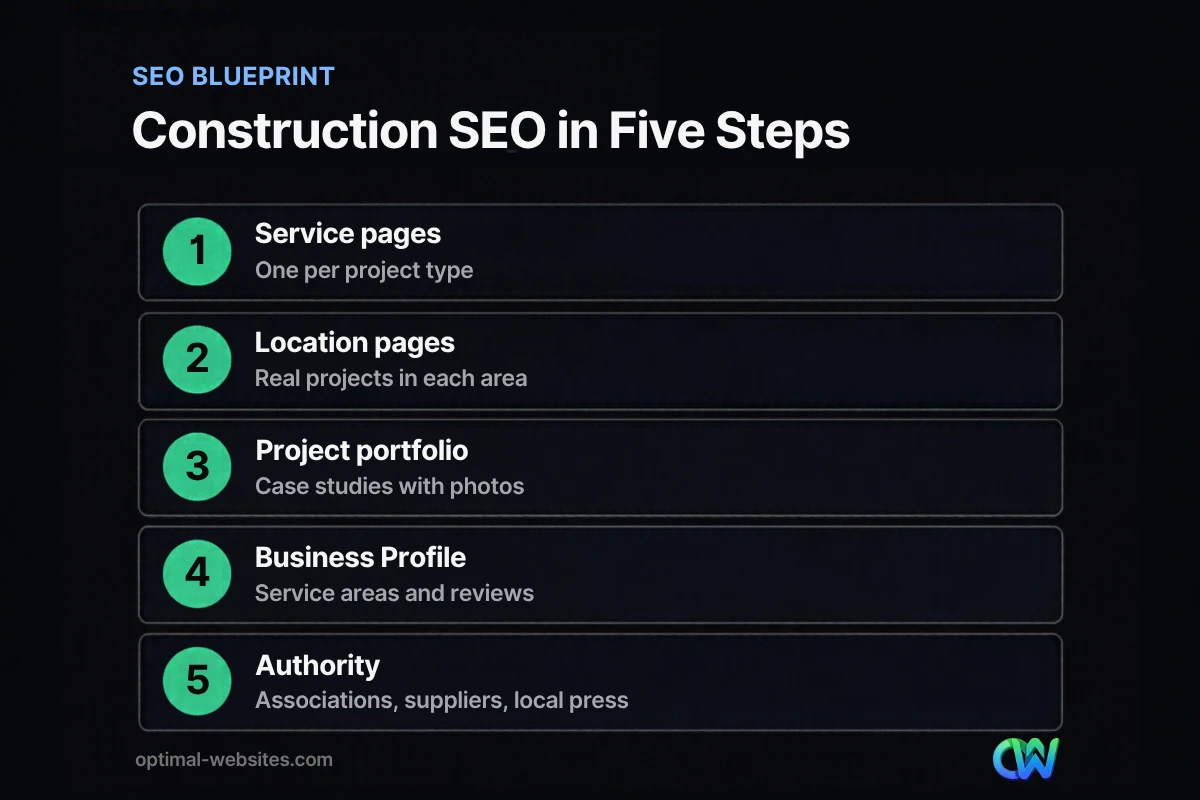
A construction website needs a page for each core service or project type, pages for the main markets you serve, a detailed project portfolio and clear company credentials. These pages give Google specific topics to rank and give prospects the proof they want.
Service and project type pages
Create one page per service you want to win: commercial build-outs, ground-up construction, renovations, design-build, site work or any specialty. Each page should explain scope, process, typical timelines, the clients you serve and examples of completed work. Avoid a single “Services” page that lists everything in one paragraph.
Location pages
If you work across several cities or counties, create pages for your main markets. Each one should include real projects in that area, local permitting knowledge and the team that serves it. Thin pages that only swap the city name rarely help.
Project case studies
Case studies are where builder SEO and sales overlap. For each featured project, include the client type, location, scope, square footage or size if you can share it, challenges, photos and the outcome. Only publish details your clients have approved.
Credentials and trust pages
Include licenses, bonding capacity if you publish it, safety programs, certifications, associations and key team bios. Commercial buyers look for these before inviting you to bid.
For layout and design guidance on these pages, see our guide to construction company website design.
How does local SEO work for contractors?
Local SEO for contractors centers on your Google Business Profile, your website’s location signals and your reviews. Google says local results are based mainly on relevance, distance and prominence, as explained in its page on how Google ranks local results.
Set up your Business Profile correctly
Most builders work at client sites, so they are service-area businesses. The Google Business Profile guidelines say service-area businesses should hide their address if they do not serve customers there and should keep their service area within about two hours of driving from their base. Choose the most specific primary category, add your services, post project photos and keep hours accurate.
Build reviews from real clients
Ask for a review at project closeout, when satisfaction is highest. Reviews from commercial clients and property managers carry weight with similar buyers. Reply to every review professionally.
Keep your contact details consistent
Your company name, phone number and address (if shown) should match across your website, Business Profile, industry directories and association listings.
How do construction companies build authority online?
Authority comes from mentions and links from trusted sources in your industry and region. For builders, that means associations, suppliers, partners, local media and community organizations.
Practical ways to earn links and mentions:
- Join and keep profiles current with trade associations and chambers of commerce.
- Ask suppliers and manufacturers to feature your projects.
- Share completed projects with local business journals.
- Partner with architects and engineers who list their collaborators.
- Sponsor community projects and events that publish sponsor lists.
Avoid buying links or joining link schemes. They can do more harm than good, and they do not build the kind of reputation that wins bids.
What technical basics matter for construction SEO?
Construction websites often carry heavy photo galleries and videos, which can slow pages down. Fast, mobile-friendly pages with clean structure help both rankings and user experience.
- Compress project photos and use modern image formats.
- Give every page a unique, descriptive title and meta description.
- Use clear headings and descriptive URLs, as Google’s SEO Starter Guide recommends.
- Add LocalBusiness or GeneralContractor structured data with accurate details.
- Connect Google Search Console to monitor indexing and search queries.
What we see on construction projects
We build WordPress sites with Elementor Pro for construction clients, including Care Facilities Construction and E & S Construction Engineers, both shown in our portfolio. On builder sites, the pages that matter most are consistent: detailed project type pages, a filterable project gallery and clear credentials. Building them as reusable templates means new projects can be added in minutes and each one strengthens the site.
How long does construction SEO take and what does it cost?
Most construction companies see early improvements in local visibility within a few months, while competitive commercial terms can take six months to a year. Speed depends on competition, your current site and how much proof you publish.
Cost depends on scope: a one-time technical and content setup, ongoing content such as case studies, and local SEO management. Our guide to SEO pricing for small business explains common pricing models and what each should include. Measure success by bid requests, qualified calls and projects won, not just rankings.
How Optimal Websites Can Help
Optimal Websites, a WordPress web design agency based in Delaware, builds fast, mobile-first websites for construction companies and sets them up to rank from launch, with service and location page templates, project portfolios and structured data. Learn more about our SEO services, or compare our website packages if your current site needs a rebuild first.
Frequently Asked Questions
What is construction SEO?
Construction SEO is search engine optimization for builders, general contractors and specialty contractors. It improves how your website and Google Business Profile appear when property owners, developers and facility managers search for the projects you build. It includes service and location pages, project case studies, local SEO, reviews and technical fixes.
Does SEO work for commercial construction companies?
Yes. Commercial buyers research contractors online before inviting them to bid, so construction company SEO helps you appear for specific project types and markets. Because commercial projects are high value, even one new client from search can justify the investment. Detailed case studies and credentials matter most for this audience.
How long does it take for contractor SEO to work?
Contractor SEO usually shows early local gains within a few months, while competitive commercial searches can take six months to a year. Results depend on competition in your market, the strength of your current website, how many case studies you publish and how consistently you collect reviews from completed projects.
What pages should a construction company website have?
A construction company website should have a page for each service or project type, pages for main markets, a project portfolio with case studies, an about page with credentials and safety information, and clear contact or bid request pages. Each page should include real project examples and photos, not generic text.
Should a contractor have a Google Business Profile?
Yes. A Google Business Profile helps contractors appear in local map results and branded searches. Most builders are service-area businesses, so Google’s guidelines say to hide the address if you do not serve clients there and to set a realistic service area. Keep categories, services, photos and reviews current.
How do builders get more reviews?
Builders get more reviews by asking at project closeout, sending a direct review link by email or text and making it easy for property managers and commercial clients to respond. Reply to every review professionally. Builder SEO benefits from a steady flow of genuine reviews rather than a burst followed by months of silence.
Ready to Get Started?
Ready to win more projects from search? Get a free quote or call (302) 554-9497 to talk about your website and SEO.


