
Quick answer: Ecommerce website cost is the one-time price of designing and building your store plus the recurring costs of hosting, platform fees, extensions, payment processing, maintenance and marketing. Product count, custom features and integrations drive the build cost. Payment fees grow with sales, so budget for them as a percentage of revenue.
Opening an online store is exciting until the quotes arrive and none of them look alike. One proposal covers design only, another bundles hosting, and a third leaves out shipping rules and taxes entirely. The real ecommerce website cost is not one number; it is a launch budget plus a monthly and per-sale budget that keeps the store running. Getting it wrong means either an unfinished store or surprise bills right when sales start. This guide breaks down every cost category, explains WooCommerce cost and payment processing fees, and gives you a simple worksheet to build your own budget.
Key Takeaways
- Split your budget into three parts: one-time build costs, fixed recurring costs and variable costs that grow with sales.
- Product count, product variations, custom features and integrations drive ecommerce development pricing more than page count.
- WooCommerce itself is free, but paid extensions, hosting and payment processing add up, so plan for them.
- Payment processing fees are usually a percentage plus a fixed fee per transaction. At scale, they can be one of your largest ongoing costs.
- Do not forget ongoing maintenance, security and marketing. A store with no traffic or broken checkout costs more than it earns.
What makes up ecommerce website cost?
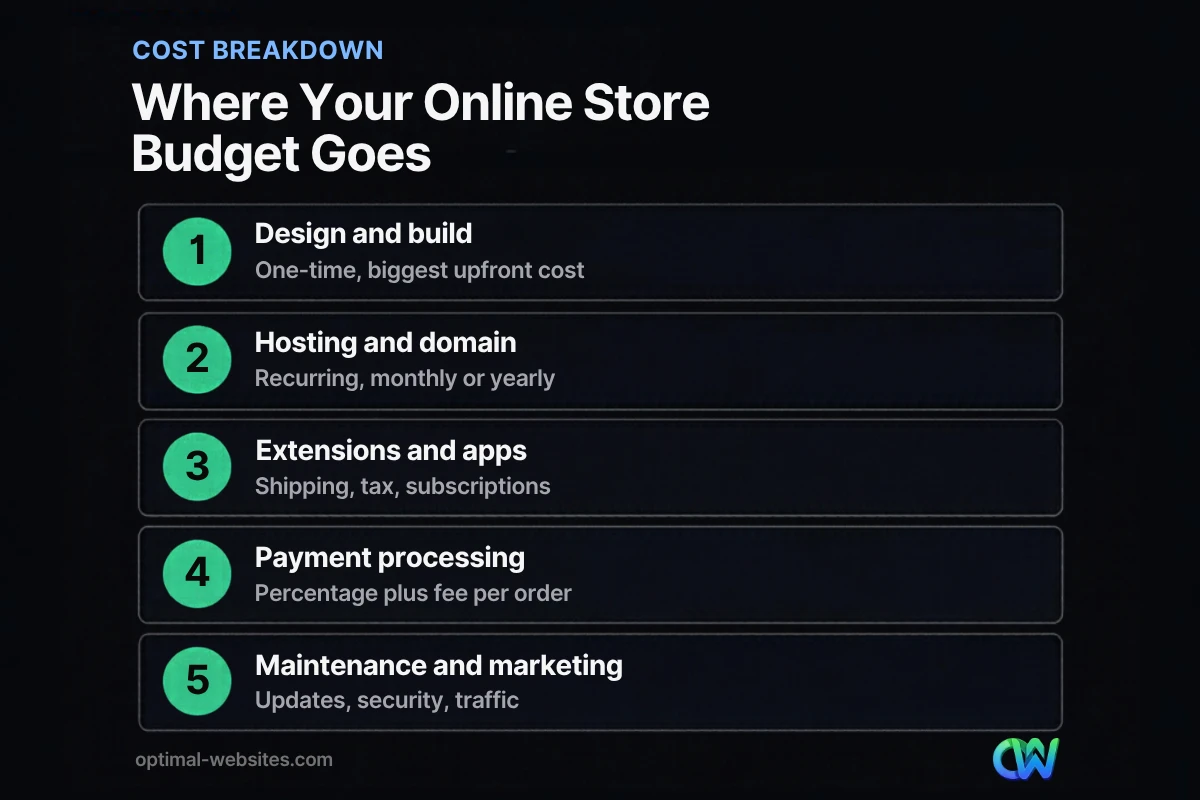
The cost of an ecommerce website comes from five areas: design and build, platform and hosting, extensions and apps, payment processing, and ongoing maintenance and marketing. Each one behaves differently, so budget for each separately.
| Cost area | Type | What drives it |
|---|---|---|
| Design and build | One-time | Custom vs theme-based design, number of templates, product setup, integrations |
| Platform and hosting | Recurring (monthly or yearly) | Hosted platform subscription or WordPress hosting plan, traffic, storage |
| Domain and SSL | Recurring (yearly) | Domain registrar; SSL is often included with hosting |
| Extensions and apps | Recurring or one-time | Shipping, tax, subscriptions, bookings, reviews, marketing tools |
| Payment processing | Variable (per sale) | Processor rates, card types, transaction volume |
| Maintenance and security | Recurring | Updates, backups, monitoring, fixes |
| Marketing | Recurring | SEO, ads, email, social media |
How much does it cost to design and build an online store?
The build is usually the largest upfront part of online store cost, and it depends mostly on how complex your catalog and features are, not on how many pages you have.
What raises ecommerce development pricing
- Product count and variations. Ten simple products are quick to set up. Hundreds of products with sizes, colors and bundles take far longer, especially if data must be cleaned and imported.
- Custom design. A fully custom store design costs more than customizing a proven theme.
- Custom features. Product configurators, quote requests, wholesale pricing, memberships or subscriptions add development time.
- Integrations. Connecting inventory, accounting, ERP, CRM or shipping systems often takes the most testing.
- Content. Product photography, descriptions and category copy are real costs if you do not create them yourself.
- Migration. Moving products, customers and orders from another platform requires careful mapping and testing.
What usually keeps costs lower
- A focused catalog at launch, with more products added later
- A theme-based design customized to your brand
- Standard shipping and tax rules
- Using proven extensions instead of custom code where possible
For the step-by-step build process, see our guide on how to build a WordPress ecommerce website.
What does WooCommerce cost?
The WooCommerce core plugin is free, but a working store on WooCommerce has other costs: hosting, a theme or builder, paid extensions and payment processing. Think of WooCommerce cost as “free to start, pay for what you need.”
Typical WooCommerce cost items:
- Hosting. A store needs reliable, fast hosting with good security and backups. Cheap shared hosting often struggles during traffic spikes.
- Theme or page builder. Many stores use a theme plus a builder like Elementor Pro, which includes WooCommerce templates for product, archive and checkout pages.
- Extensions. The WooCommerce Marketplace offers free and paid extensions. Common paid ones cover subscriptions, bookings, memberships, advanced shipping and product add-ons.
- Payment gateway fees. Charged per transaction by your processor.
- Maintenance. WordPress, WooCommerce and extensions need regular updates and testing.
The advantage is ownership and flexibility: you control your store, your data and your design, and you are not locked into one company’s app ecosystem. If you are still deciding on a platform, compare the trade-offs in our guide to WooCommerce vs Shopify and our roundup of the best ecommerce platform for small business.
How much are payment processing fees?
Payment processing fees are usually a percentage of each sale plus a small fixed fee per transaction. For example, Stripe’s standard US rate for online domestic card payments is 2.9% plus 30 cents per successful transaction.
Here is how that adds up at different sales levels, using that standard rate:
| Monthly sales | Orders | Percentage fee (2.9%) | Fixed fees ($0.30 each) | Total fees |
|---|---|---|---|---|
| $5,000 | 100 | $145 | $30 | $175 |
| $10,000 | 200 | $290 | $60 | $350 |
| $25,000 | 400 | $725 | $120 | $845 |
A few things to know:
- Small orders feel the fixed fee most. On a $10 order, 30 cents is 3% on its own.
- International cards and currency conversion often carry extra fees.
- Some hosted platforms add their own transaction fees if you use a third-party processor, so read the plan details.
- Rates can be negotiated at high volumes with some processors.
Include payment processing fees in your pricing and margin calculations from day one.
What are the ongoing costs of running an online store?
Ongoing costs keep a store secure, fast and visible. They are easy to underestimate because they arrive monthly in small amounts.
- Hosting and platform fees: monthly or yearly
- Extension and app renewals: many paid extensions renew yearly
- Maintenance: updates, backups, uptime and security monitoring, plus fixes when something breaks
- Performance: image optimization, caching and testing so pages stay fast. Slow product and checkout pages hurt sales, and Google measures real-user speed and stability through Core Web Vitals.
- Marketing: SEO, product content, email, social media and ads to bring buyers to the store
- Customer service tools: live chat, help desk or returns software if you need them
How do you build an ecommerce budget? A simple worksheet
Build your ecommerce budget in three columns: launch, fixed monthly and variable. Fill in real quotes for each line before you commit.
- List your launch costs. Design and build, product setup or import, photography, copywriting, premium theme or builder licenses, and any one-time extension purchases.
- List your fixed recurring costs. Hosting, domain, platform subscription, extension renewals, maintenance plan and baseline marketing.
- Estimate your variable costs. Payment processing fees as a percentage of projected sales, plus shipping and packaging if you absorb them.
- Add a contingency. Set aside a buffer for surprises such as a new integration or extra product data cleanup.
- Compare against your sales forecast. Work out how many orders you need each month to cover fixed and variable costs. That is your break-even point.
- Review after 90 days. Replace estimates with real numbers and cut tools you are not using.
How Optimal Websites Can Help
Optimal Websites, a WordPress web design agency based in Delaware, builds online stores on WordPress, WooCommerce and Elementor Pro, so you own your store and can manage products yourself after launch. We scope each store around your catalog, features and integrations, explain which costs are one-time and which are recurring, and include training videos so your team can update products and pages.
Our WordPress web design and development service covers stores as well as business sites. To compare our standard site packages, see our website packages, then ask us for a free quote on your store.
Frequently Asked Questions
How much does an ecommerce website cost for a small business?
Ecommerce website cost for a small business depends on product count, design approach, features and integrations. A small catalog on a customized theme costs far less than a large catalog with custom features and ERP integration. Budget for the build plus hosting, extensions, payment processing fees, maintenance and marketing to see the true first-year cost.
Is WooCommerce really free?
The WooCommerce core plugin is free to download and use. A live store still needs hosting, a domain, a theme or builder, and often paid extensions for features like subscriptions or advanced shipping. Payment gateways charge per transaction. So WooCommerce cost depends on which of those add-ons your store actually needs.
What are typical payment processing fees for an online store?
Many processors charge a percentage of each sale plus a fixed per-transaction fee. Stripe’s standard US online rate, for example, is 2.9% plus 30 cents for domestic cards. International cards and currency conversion may cost more, and some hosted platforms add their own transaction fees when you use an outside processor.
What is the biggest hidden cost of an online store?
The most commonly underestimated costs are product content and ongoing maintenance. Photographing products, writing descriptions and cleaning product data take real time. After launch, updates, security, backups and fixes are ongoing. Marketing is the other big one: without SEO, ads or email, even a well-built store gets little traffic.
Is it cheaper to use Shopify or WooCommerce?
It depends on your store. Hosted platforms bundle hosting and security into a monthly plan, while WooCommerce is free but needs separate hosting and maintenance. Paid apps or extensions add cost on both. Compare total yearly cost for your exact features, plus how much control and ownership you want over the store.
How long does it take to build an online store?
A simple online store with a small catalog can launch in a few weeks once products, photos and content are ready. Stores with large catalogs, custom features or integrations take longer because of setup and testing. Having product data, images and policies prepared before the build starts is the best way to keep the timeline short.
Ready to Get Started?
Planning an online store and want a clear budget before you commit? Request a free quote or call (302) 554-9497, and we will help you scope the build and the ongoing costs.


