
Quick answer: Good home service website design puts a click-to-call button on every screen, gives each service and service area its own page, shows licenses, reviews and warranties up front, and makes booking easy on a phone. HVAC, plumbing and electrical sites should be fast, mobile-first and built around urgent and planned jobs.
When a pipe bursts at 9 p.m. or the AC quits in July, homeowners grab their phones and search. They are stressed, in a hurry and ready to call the first company that looks trustworthy and available. That is why home service website design is different from a typical business website. Your site has to load fast, answer “can you help me right now?” in seconds and make calling effortless. It also has to win planned jobs like system replacements and panel upgrades, where buyers compare options for days. This guide covers the pages, features and design choices that help HVAC, plumbing and electrical companies turn searches into booked jobs.
Key Takeaways
- Design for the phone first. Most urgent home service searches happen on mobile, and Google indexes the mobile version of your site.
- Give every core service its own page, and every main town its own useful service area page.
- Show trust signals early: license numbers, insurance, reviews, warranties and real photos of your techs and trucks.
- Separate emergency and planned work. Emergency visitors need a phone number; replacement shoppers need details, financing and proof.
- Make booking easy with click-to-call, a short form and, if it fits your operation, online scheduling.
What makes home service website design different?
Home service website design has to serve two very different buyers at once: the homeowner with an emergency and the homeowner planning a big purchase. A general business template rarely handles both well.
| Visitor | What they need | What the site should show |
|---|---|---|
| Emergency (no heat, burst pipe, power out) | Fast help, now | Big click-to-call button, “24/7” or hours, service area, response promise you can keep |
| Repair (noisy unit, slow drain, flickering lights) | Someone reliable soon | Service page, pricing approach, reviews, easy booking |
| Planned project (new AC, water heater, panel upgrade) | Confidence and value | Options, brands you install, financing, warranties, project photos |
| Maintenance (tune-ups, inspections) | Convenience and savings | Maintenance plan details, seasonal reminders, online booking |
Many home service companies get most of their revenue from planned replacements and maintenance plans, but most of their first contacts from urgent repairs. A good site welcomes the emergency caller and earns the bigger job later.
What pages does a home service website need?
A home service website needs a clear homepage, one page per core service, service area pages, an about page with credentials, reviews, and a contact or booking page. Each page should have one obvious next step.
Core pages
- Homepage: what you do, where you work, how fast you respond, and a call button.
- Service pages: one for each major service, such as AC repair, furnace installation, water heater replacement, drain cleaning, panel upgrades or EV charger installation.
- Service area pages: one for each main town or region, with local details, not copied text.
- About and credentials: license numbers, insurance, certifications, years in business, team photos.
- Reviews: real customer reviews, ideally connected to your Google reviews.
- Maintenance plan page: what is included, how often you visit, and the benefits for the customer.
- Financing page: if you offer financing, explain how it works.
- Contact or booking page: phone, form, hours and service area map.
Trade-specific examples
- HVAC website design: separate pages for AC repair, AC installation, heating repair, furnace installation, heat pumps, indoor air quality and maintenance plans. Seasonal banners help: cooling in summer, heating in fall.
- Plumber website: pages for emergency plumbing, drain cleaning, water heaters, leak detection, sewer line repair, repiping and fixture installation.
- Electrician website: pages for panel upgrades, rewiring, lighting, generator installation, EV charger installation, inspections and emergency electrical service.
What features help a home service website book more jobs?
The features that book jobs are the ones that remove friction between “I need help” and “I called.” On a phone, every extra tap costs you calls.
Click-to-call everywhere
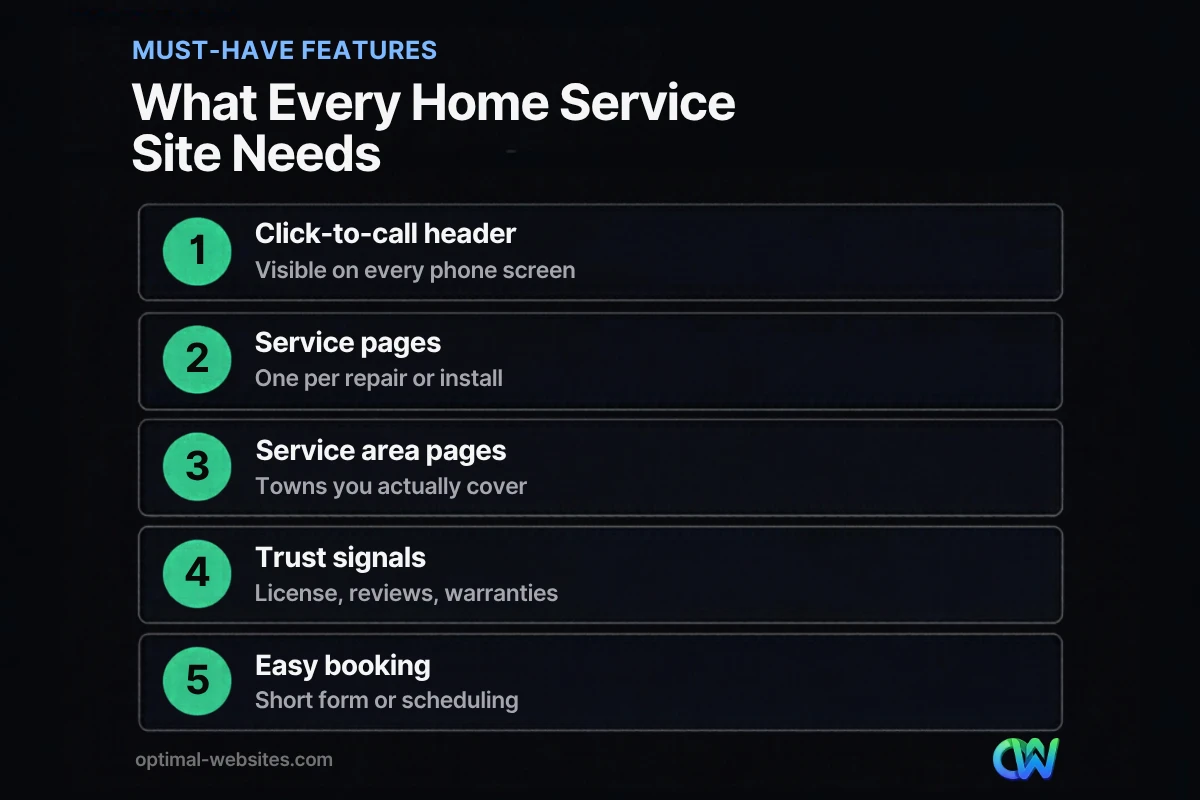
Put your phone number in the header as a tap-to-call button on every page, and consider a sticky call bar at the bottom of mobile screens. Track taps as conversions in your analytics so you know which pages produce calls.
Short forms and online booking
Ask for name, phone, ZIP code and the problem, nothing more. If your dispatch process allows it, online scheduling lets customers pick a time window after hours, when you cannot answer the phone.
Trust signals near the top
- License and insurance details
- Star rating and recent reviews
- Warranties and guarantees you actually offer
- Photos of your real technicians, trucks and completed work
- Manufacturer or trade certifications you hold
Clear service area information
List the towns you serve and link to service area pages. Homeowners want to know immediately whether you come to them.
Pricing approach
You do not need to publish a full price list, but explain how you price: flat-rate vs hourly, diagnostic fees, free estimates for replacements. Transparency reduces “just checking prices” calls and builds trust.
Why is mobile-first design critical for home service companies?
Mobile-first design matters because the people who need a plumber, electrician or HVAC tech fast are usually searching on their phones, and because Google uses the mobile version of a site’s content for indexing and ranking.
What mobile-first means in practice:
- Pages load quickly on a cellular connection, with compressed images and minimal scripts.
- The phone number and main button are visible without scrolling.
- Text is readable without zooming, and buttons are big enough to tap.
- Forms use the right keyboard types (numbers for phone and ZIP).
- No popups that cover the call button.
Our guide to building a mobile-friendly website covers testing and common fixes in more detail.
How does a home service website help local SEO?
Your website supports local SEO by giving Google clear, specific information about what you do and where you do it. Google says local results are mainly based on relevance, distance and prominence, and your site helps with relevance and prominence directly.
- Service pages tell Google exactly which services you offer.
- Service area pages connect those services to the towns you cover.
- Consistent name, address and phone across your site and Google Business Profile reduce confusion.
- Structured data using Schema.org’s LocalBusiness types, such as HomeAndConstructionBusiness and its more specific subtypes for trades like plumbers and electricians, labels your business details for search engines.
- Reviews and mentions across the web build prominence over time.
For a full plan that connects your website, profile, reviews and ads, read our guide to lead generation for contractors.
What does home service web design look like in practice?
At Optimal Websites, a WordPress web design agency based in Delaware, we build home service and contractor sites on WordPress and Elementor Pro, using the same structure we have refined for roofing, construction and local service clients. A typical build includes a Theme Builder header with a click-to-call button, a service page template that keeps every service consistent, service area pages with real local details, review sections, and short estimate forms that send leads straight to the office.
Owners get video tutorials so they can add seasonal promotions, new services and project photos without waiting on a developer. Because trades share many needs with general contractors, our guide to contractor website design is a useful companion if you also handle remodeling or construction work.
How Optimal Websites Can Help
If your current site is slow on phones, hides your phone number or lumps every service onto one page, we can fix that. Our WordPress web design service builds fast, mobile-first home service websites with dedicated service and service area pages, click-to-call headers and lead forms. Packages start at $999, most projects launch in 2–4 weeks, and you pay 50% to start and 50% after you approve the finished site. See our packages for details.
Frequently Asked Questions
What should a home service website include?
A home service website should include a click-to-call header, one page per core service, service area pages, license and insurance details, reviews, warranties, real photos, a maintenance plan page if you offer one, and a short contact or booking form. Everything should load quickly and work easily on a phone.
How much does home service website design cost?
Home service website design cost depends on the number of service and service area pages, custom features like online booking, and whether you need content written. Our WordPress packages start at $999 for Starter, $1,499 for Professional and $1,999 for Advanced Custom, with every project quoted on its needs. Ask for a free quote for an exact price.
Should HVAC companies have separate pages for each service?
Yes. HVAC website design works best with separate pages for AC repair, AC installation, heating repair, furnace installation, heat pumps, indoor air quality and maintenance plans. Separate pages match what homeowners search for, let you answer service-specific questions and give each page a clear call to action, which helps both rankings and conversions.
What makes a good plumber website?
A good plumber website makes emergency calls effortless with a prominent click-to-call button, lists services like drain cleaning, water heaters and leak detection on their own pages, shows the towns you serve, and displays licenses, reviews and guarantees. It should load quickly on a phone, since many plumbing searches happen during an urgent problem.
Do electricians need a website if they have a Google Business Profile?
Yes. A Google Business Profile helps people find you in Maps, but an electrician website gives you space to explain services like panel upgrades and EV charger installation, show credentials and project photos, and capture estimate requests. Your website also supports your profile’s local rankings by reinforcing what you do and where.
Should a home service website offer online booking?
Online booking is worth it if your scheduling and dispatch process can handle it, because it captures customers after hours and those who prefer not to call. If your jobs need a phone conversation first, use a short request form with a promised callback time instead, and keep click-to-call as the main action.
Ready to Get Started?
Ready for a website that turns urgent searches into booked jobs? Request a free quote or call (302) 554-9497 to talk about your HVAC, plumbing or electrical business.


