
Last updated: October 15, 2026
Quick answer: To learn how to drive traffic to your website, start with the channels your buyers already use: search (organic and local), social media, email, referrals and paid ads. Fix your site’s speed and tracking first, publish helpful answer-first content, optimize your Google Business Profile, then promote every page and measure what converts.
A website with no visitors is a brochure sitting in a drawer. You paid for it, it looks good, and nobody sees it. For a contractor, law firm or local service business, that means missed calls, missed quote requests and revenue going to the competitor who shows up first. This guide explains how to drive traffic to your website in a way that brings the right people, not just more people. You will get a side-by-side comparison of six traffic channels by cost, time and fit, practical steps for each one, and a simple 30-day plan you can start this week without hiring a big agency.
Key Takeaways
- Quality traffic beats raw traffic. Aim for visitors who match your service area and buying intent.
- Organic and local search are slow to build but compound over time; paid ads are fast but stop when spending stops.
- Your Google Business Profile is often the quickest win for local service businesses.
- One great article promoted through email, social and partners beats five average posts nobody sees.
- Measure in Google Search Console and your analytics tool, then double down on what converts.
What Counts as Quality Website Traffic?
Quality website traffic is visitors who are likely to become customers: people in your service area, searching for what you sell, at a stage where they are ready to call, book or buy. A thousand visits from the wrong country are worth less than ten visits from homeowners in your county looking for a roof repair.
So “how do I get more traffic” is really two questions: how do I get found by the right people, and what do they see when they arrive? A fast, mobile-friendly page with a clear offer and an obvious next step is what turns a visit into a lead.
Signs your traffic is the right traffic
- Visitors come from your city, state or target market.
- They land on service pages, not only the homepage.
- They call, fill out forms or request quotes at a steady rate.
- Search queries in Google Search Console match the services you actually offer.
How to Drive Traffic to Your Website: The 6 Main Channels
You drive traffic to your website through six main channels: organic search, local search, social media, email, referrals and paid ads. Most small businesses do best by mastering two or three of them instead of dabbling in all six.
Here is how they compare. Costs are relative because budgets vary widely by industry and market.
| Channel | Cash cost | Time to results | Best fit for |
|---|---|---|---|
| Organic search (SEO) | Low to medium | Months, then compounds | Businesses with services people research online |
| Local search (Google Business Profile) | Low | Weeks | Contractors, law firms, clinics, any local service |
| Social media | Low (organic) to medium (boosted) | Weeks, needs consistency | Visual work, community brands, B2C |
| Low | Days, once you have a list | Repeat customers, referrals, long sales cycles | |
| Referral (partners, directories, guest posts) | Low, time heavy | Weeks to months | B2B, professional services, trade networks |
| Paid ads (search and social) | Medium to high | Same day | Launches, seasonal offers, testing new services |
Organic search
Organic search traffic is visitors who find you through unpaid Google results. It is the channel that keeps working while you sleep, but it takes patience. Google’s SEO Starter Guide notes that some changes can take effect within hours while others take several months, so plan for the long game.
The foundation is simple: one page per service, clear titles and headings that match how customers search, fast load times and content that answers real questions. Google’s guidance on people-first content defines it as content made primarily for people, not to manipulate rankings. If you want the full playbook, our guide to SEO for small business walks through it step by step.
Local search
Local search traffic comes from the Google map pack and “near me” searches. Google explains that local results are mainly based on relevance, distance and prominence (how well known a business is, including reviews and references around the web).
You cannot change distance, but you can improve the other two. Complete every field on your Google Business Profile, pick accurate categories, add real photos, and ask happy customers for reviews. Our walkthrough on optimizing your Google Business Profile covers each setting.
Social media
Social media drives traffic when you share useful posts consistently on the platforms your customers already use. According to Pew Research Center, 84% of U.S. adults say they use YouTube and 71% say they use Facebook (survey conducted February to June 2025).
A tactic worth keeping from our older blog advice: reshare your best older posts. A helpful article from last year is still helpful today, and a WordPress scheduling plugin or a social scheduler can rotate evergreen posts automatically so they keep sending visitors.
Email traffic is visitors who click through from your newsletter or follow-up messages. It is the one channel you own outright, since no algorithm decides who sees it. Even a list of past customers and leads can bring steady visits when you send a short note each time you publish something useful.
Grow the list with a simple offer: a checklist, a cost guide or a seasonal maintenance reminder. Giveaways can work too if the prize is genuinely relevant to your buyers. A free gutter cleaning attracts homeowners; a generic gadget attracts people who will never hire you.
Referral traffic
Referral traffic is visitors who click a link to your site from another website. Good sources include industry associations, local chambers of commerce, supplier and partner sites, and directories your customers actually use.
Guest posting still works when done right. Write for sites that are more established than yours and serve your audience, and give them your best work, not leftovers. Answering questions in industry forums and online communities builds the same trust, as long as you lead with expertise and only link when it truly helps. Skip the old trick of dropping links in blog comments; it looks like spam and brings little value.
Paid ads
Paid traffic is visitors you pay for per click or impression through Google Ads, Meta or similar platforms. It is the fastest way to get visitors and the fastest way to waste money if the landing page is weak.
Use paid ads to test a new service or promote a seasonal offer while SEO builds, and send clicks to a focused landing page, not your homepage.
What Should You Fix Before Driving More Traffic?
Fix speed, mobile layout and tracking before you push more traffic, because every visitor you send to a slow or confusing page is money lost. More traffic multiplies whatever your site already does, good or bad.
Use this quick checklist:
- [ ] Run your key pages through PageSpeed Insights and check Core Web Vitals (LCP, INP and CLS).
- [ ] Test every page on a phone. Buttons should be easy to tap and forms short.
- [ ] Confirm Google Search Console is verified and your sitemap is submitted.
- [ ] Make sure your analytics tool tracks calls, form submissions and quote requests as conversions.
- [ ] Put a clear call to action and your phone number above the fold on service pages.
When we build mobile-first WordPress sites with Elementor Pro for contractors and law firms, this checklist is part of launch, not an afterthought. It is much cheaper to get the foundation right than to pay for traffic that bounces.
What Content Brings the Most Traffic?
Content that answers the exact questions your customers type into Google brings the most qualified traffic. For a service business, that usually means cost guides, “how long does it take” articles, comparison posts and clear explanations of your process.
Write answer-first
Start every article with a direct answer in the first two sentences, then expand. This helps readers, and it helps search engines and AI answer tools understand and quote your page.
Pick topics from real conversations
Your best topic list is already in your inbox and call log: the questions customers ask before they hire you. A roofing company might answer “how long does a roof replacement take,” while a law firm might explain “what happens at a first consultation.”
Consistency over volume
Nothing builds traffic like great content, published consistently. One well-researched article a month that you promote properly will outperform weekly filler.
A 30-Day Plan to Drive Traffic to Your Website
A 30-day plan works by fixing the foundation first, claiming the fastest local wins, then publishing and promoting one strong piece of content. Here is a schedule you can follow.
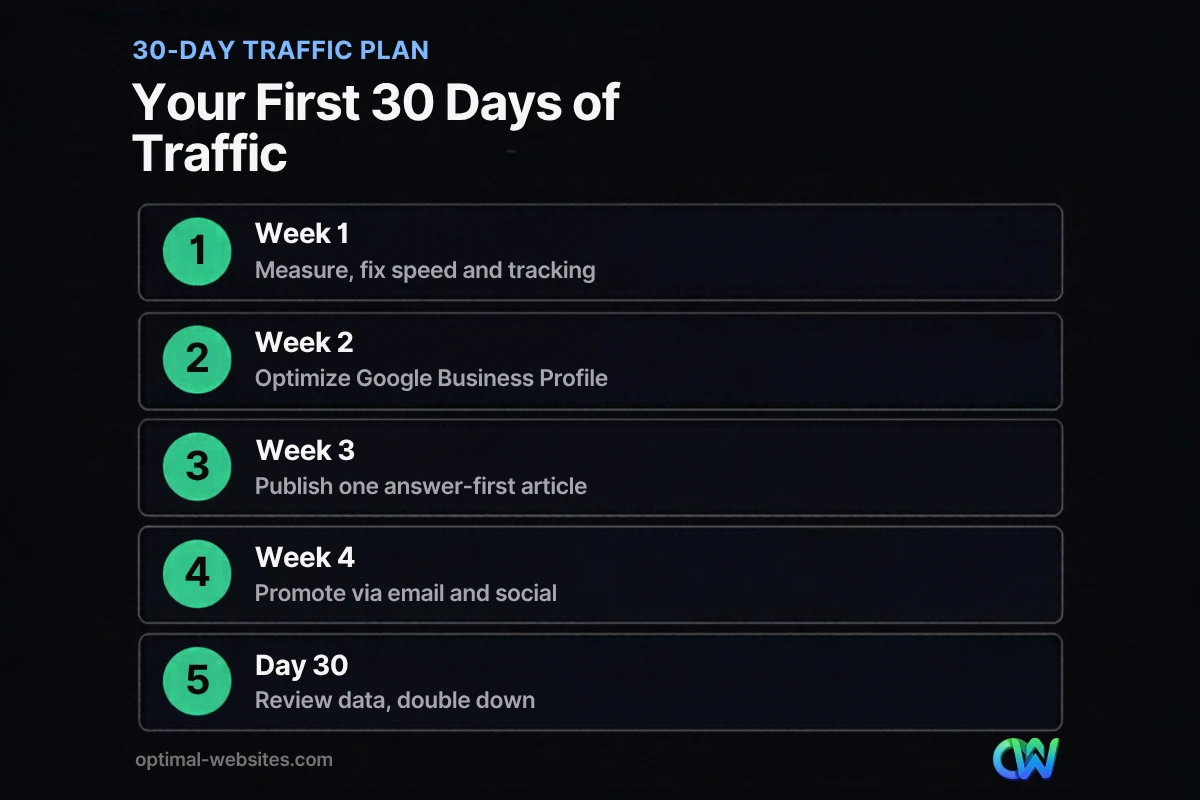
- Week 1: Measure and fix. Set up or check Google Search Console and analytics. Note your current monthly visits, top pages and leads. Run PageSpeed Insights on your homepage and top service pages, and fix the biggest problems.
- Week 2: Claim local visibility. Complete your Google Business Profile, add photos and services, and send review requests to five to ten recent happy customers. Check that your name, address and phone match everywhere they appear online.
- Week 3: Publish one answer-first article. Pick the most common customer question and write the best answer on the internet for your area. Link it to the matching service page.
- Week 4: Promote it everywhere. Email it to your list, share it on your main social platforms, send it to a partner or association that might link to it, and consider a small paid boost aimed at your service area.
- Day 30: Review and double down. Compare visits, search queries and leads to Week 1. Keep the channels that produced calls and forms, and repeat the cycle next month with a new topic.
Once traffic starts to climb, the next job is to turn more of those visitors into leads with better calls to action and shorter forms.
How Do You Measure Website Traffic Growth?
You measure traffic growth by tracking visits, sources and conversions month over month in Google Search Console and your analytics tool. Visits alone can mislead; leads and revenue are the numbers that matter.
Watch these metrics each month:
- Search clicks and impressions in Google Search Console, plus the queries that drive them.
- Traffic by channel (organic, direct, social, email, referral, paid) in your analytics tool.
- Conversions such as calls, form fills and quote requests, by channel.
- Top landing pages, so you know which content earns its keep.
If a channel brings visits but no leads, check the landing page before dropping the channel.
How Optimal Websites Can Help
Driving traffic is easier when the website underneath it is built to rank and convert. Optimal Websites, a WordPress web design agency based in Delaware, builds fast, mobile-first sites with Elementor Pro for contractors, construction firms, roofers, law firms, healthcare providers and local service businesses, with portfolio work for clients like PCS Roofs and F. J. Collins Law.
Our SEO services cover on-page optimization, local search and content, and our social media marketing team can keep your best pages in front of your audience. You can review our website packages and pricing, which start at $999, with most projects launching in 2–4 weeks.
Frequently Asked Questions
How long does it take to drive traffic to your website?
It depends on the channel. Paid ads can send visitors the same day, and a well-optimized Google Business Profile can show results within weeks. Organic SEO usually takes several months to build, according to Google’s own guidance, but it keeps compounding once your pages rank. Most businesses combine a fast channel with a slow one while they wait.
What is the cheapest way to increase website traffic?
The cheapest ways to increase website traffic are local SEO, organic content and email. A complete Google Business Profile costs nothing but time, and helpful articles that answer customer questions can bring visitors for years. Email to your existing customers and leads is nearly free and reliably brings people back to your site whenever you publish something new.
Is paid advertising worth it for small businesses?
Paid advertising is worth it when you have a clear offer, a focused landing page and a way to track leads. It is ideal for testing new services or seasonal promotions. Without tracking and a strong page, ads can burn budget quickly. Treat paid ads as a supplement to organic and local search, not a replacement for them.
Does social media help SEO?
Social media does not directly raise your Google rankings, but it helps indirectly. Sharing your content puts it in front of people who may link to it, search for your brand later or become customers. It is a strong channel for getting new articles seen quickly while organic search traffic builds over time.
How do I get local customers to find my website?
To get local customers to find your website, optimize your Google Business Profile, create a page for each service and service area, and collect reviews from real customers. Google bases local results on relevance, distance and prominence, so complete and accurate information plus a steady stream of reviews is how to drive traffic to your website locally.
How often should I publish blog posts to grow blog traffic?
Publish as often as you can do it well and promote it. For most small businesses, one or two strong, answer-first posts per month beats weekly filler. Consistency matters more than volume, and every post should target a real customer question and link to the related service page so readers can take the next step.
What is the difference between website traffic and quality traffic?
Website traffic is any visit to your site. Quality traffic is visits from people likely to become customers, such as local searchers looking for your exact service. A smaller number of qualified visitors who call or request quotes is worth far more than a large number of visitors who leave without acting.
Ready to Get Started?
If you want a website that attracts the right visitors and turns them into calls, we can help. Request a free quote or call us at (302) 554-9497 to talk through your goals.


