
Last updated: October 15, 2026
Quick answer: Hiring a web design company makes sense when your website needs to bring in leads or sales and you lack the time or skills to build it well. Define your goals, compare 3–4 proposals, review portfolios in your industry, call references, ask about process and ownership, and avoid anyone who promises guaranteed rankings.
Your website is often the first place a customer decides whether to call you or your competitor. A slow, dated, or confusing site quietly costs you leads every week, and a bad hire can cost you months and thousands of dollars before you notice. Hiring a web design company is one of the bigger marketing decisions a small business makes, yet most owners do it only once every few years. This guide gives you a practical way to compare your options, a vetting checklist, the questions to ask a web designer before you sign, the red flags to walk away from, and what a professional build typically costs.
Key Takeaways
- An agency is the right fit when your site has to generate revenue, not just exist. DIY builders work for very simple needs; freelancers work for well-defined, smaller projects.
- Get 3–4 detailed proposals. Comparing them shows you fair pricing, response times, and approaches you had not considered.
- Judge the process, not just the portfolio. A good firm can explain every step, the timeline, and what happens after launch.
- Always own your domain, hosting account, and site admin login. Walk away from anyone who will not put that in writing.
- Be wary of guaranteed rankings, vague proposals, and firms that claim they do everything.
When does hiring a web design company make sense?
Hiring a web design company makes sense when your website needs to win customers and you cannot build, maintain, and improve it yourself without pulling time away from running the business. If the site only needs to show your hours and phone number, a simpler route may be enough.
Many owners fall somewhere in the middle. They tried a DIY builder, or a friend built something years ago, and now the site looks dated on phones, loads slowly, and rarely produces a call or form submission.
Signs you have outgrown DIY
- You spend evenings fighting a template instead of serving customers.
- The site looks broken or cramped on a phone.
- You get traffic but very few calls, quotes, or bookings.
- You want features the builder cannot handle well, such as an online store, booking, or a growing blog.
The real cost of doing it yourself
Time is the hidden price. Every hour spent there is an hour not spent on sales calls, estimates, or client work. Mobile matters more than many owners realize, too: Google uses the mobile version of your content for indexing and ranking, so a site that only looks good on a desktop is working against you in search.
Web designer vs agency vs DIY builder: which is right for you?
A DIY website builder is a hosted platform that lets you assemble a site from prebuilt templates without code. A freelance web designer is one person who designs and often builds your site. A web design agency is a team that handles strategy, design, development, content, and support under one roof. The right choice depends on your goals, budget, and how much you want to manage yourself.
| Factor | DIY builder | Freelancer | Web design agency |
|---|---|---|---|
| Upfront cost | Lowest (monthly subscription) | Varies widely | Higher, usually fixed packages |
| Your time required | High | Medium | Low |
| Design quality | Template-based | Depends on the individual | Consistent, team-reviewed |
| Strategy and conversion focus | Up to you | Sometimes | Usually built into the process |
| Speed and SEO foundations | Limited by platform | Varies | Typically included |
| Scalability (store, blog, new pages) | Limited to platform features | Depends on skills | Planned from the start |
| Ownership and portability | Often locked to the platform | Usually yours | Usually yours (confirm in writing) |
| Support after launch | Help docs and tickets | Depends on availability | Support and maintenance plans |
| Risk if someone disappears | Low | Higher (single point of failure) | Lower (team coverage) |
When a DIY builder is enough
A builder can work for a brand-new side business, an event page, or a simple online business card. The trade-offs are limits on design, features, and portability. On many builders, moving your site to another platform means rebuilding it. If you are weighing this route, our breakdown of template vs. custom design covers the trade-offs in more detail.
When a freelancer fits
A skilled freelancer can be a great choice for a clear, contained project with a firm scope. The main risks are capacity and continuity. If that one person gets busy, sick, or moves on, updates and fixes can stall.
When an agency is the better bet
An agency fits when the site is a core sales tool, you want one partner for design, speed, SEO foundations, and ongoing support, and you need someone accountable after launch.
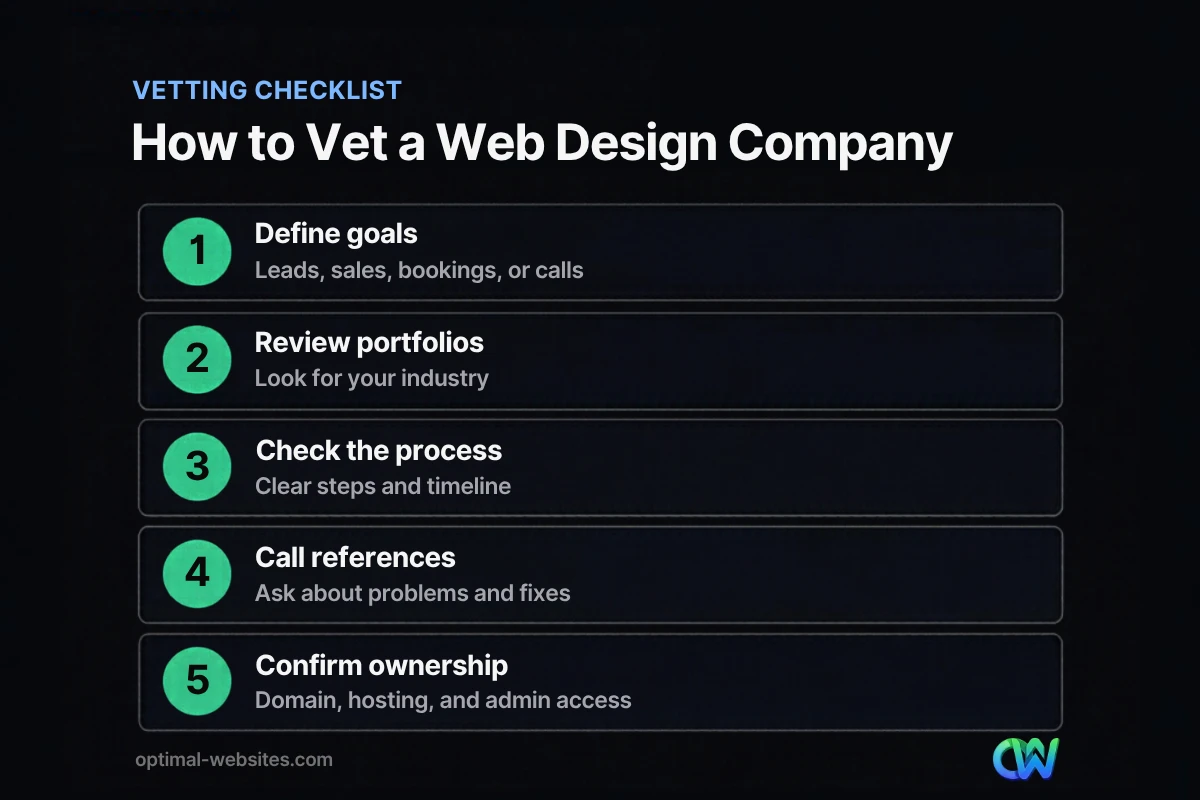
How to choose a web design company: a 7-step vetting checklist
The best way to choose a web design company is to define what success looks like first, then compare several firms against the same criteria. Use these steps in order.
- Define your goals. Decide what the site must produce: phone calls, quote requests, bookings, or online sales. Review what a business website needs to do its job before you talk to anyone.
- Shortlist 3–4 firms and get proposals. One quote tells you nothing. Several quotes let you benchmark price and scope and spot anyone who is far too high or suspiciously low.
- Watch response time. Note how quickly each firm replies after your first inquiry and throughout the sales process. Slow replies before you sign rarely improve after.
- Review portfolios for your industry. Look for live sites, not just mockups. Check that they load fast and make it easy to call or request a quote.
- Study the process. Ask them to walk you through discovery, design, development, revisions, launch, and training.
- Call references. Ask for clients similar to you, and if possible pick from their portfolio yourself rather than accepting only the list they hand you.
- Read the proposal and contract carefully. It should spell out scope, number of pages, revision rounds, timeline, payment schedule, who owns what, and what support looks like after launch.
Compare proposals on more than price
Price matters, but a detailed proposal at a fair price beats a cheap one with three vague lines.
Look for focus, not “we do everything”
Firms that claim to do everything for everyone rarely build deep expertise. A focused agency knows its platform, its project types, and often the industries it serves. A useful question: “What kind of projects do you not take on?” A confident, specific answer is a good sign.
What questions should you ask a web designer before hiring?
Ask questions that reveal how the firm works, who owns the result, and what happens after launch. Vague answers to any of these are a warning sign.
About process and timeline
- What is your process from kickoff to launch, step by step?
- How long will my project take, and what could delay it?
- How many revision rounds are included?
- Who will be my main point of contact, and how will we communicate?
About the build
- What platform do you build on, and why is it right for my business?
- Will the site be designed mobile-first?
- How do you handle page speed? Do you test against Core Web Vitals thresholds such as LCP, INP, and CLS?
- What SEO foundations are included (page titles, meta descriptions, headings, site structure, Google Search Console setup)?
- Who writes the content, and is copywriting included?
About ownership and support
- Will I own the domain, hosting account, design, and content?
- Will I get full admin access to the site?
- Will you train me to edit pages myself?
- What do support, maintenance, and future changes cost?
Questions for their references
- What went well working with this company?
- What could they have done better?
- Tell me about a problem during the project and how they handled it.
- Would you hire them again, and are you still working with them?
What are the red flags when hiring a web design company?
The biggest red flags are guaranteed rankings, unclear ownership, and vague proposals. Any one of these is reason enough to keep looking.
- Guaranteed #1 rankings on Google. No one can promise that. Google’s own advice on hiring an SEO warns against exactly this kind of promise and against anyone claiming a “special relationship” with Google.
- They register your domain in their name. Your domain is a business asset. As the U.S. Small Business Administration explains, owning your domain means no one else can use it while you keep it renewed. Make sure that owner is you.
- No admin access for you. If you cannot log in to your own site, you cannot leave without starting over.
- A big price with few details. Reputable firms put scope in writing because it protects both sides and prevents scope creep.
- No clear process or timeline. If they cannot describe how the project runs, it probably will not run smoothly.
- Pressure to sign today. A good partner gives you time to compare.
- No live portfolio or references. Screenshots alone are not proof of work.
How much does it cost to hire a web design company?
The cost of hiring a web design company depends on the number of pages, custom features, content needs, and integrations such as online stores or booking. Fixed packages make budgeting easier than open-ended hourly billing.
To give you a concrete reference point, here are Optimal Websites’ published package starting prices:
| Package | Starting price | Typical fit |
|---|---|---|
| Starter | Starting at $999 | Small businesses that need a professional, mobile-first site |
| Professional | Starting at $1,499 | Growing businesses that need more pages and features |
| Advanced Custom | Starting at $1,999 | Projects with custom layouts or functionality |
Final pricing depends on scope, which is why a free consultation and written quote come first. Most of our projects launch in 2–4 weeks, with a 50% deposit to start and the final 50% after you approve the site. You can see what each tier includes on our package pricing page.
Costs to plan for beyond the build
- Domain renewal. Usually billed yearly.
- Hosting. Fast, reliable hosting affects speed and uptime; our guide to choosing small business hosting explains what to look for.
- Maintenance and updates. Plugins, themes, and the platform itself need regular updates for security and stability.
- Marketing. SEO, lead generation, and social media are usually separate services.
What should happen after your website launches?
After launch, a good web design company trains you to make simple edits, stays available for fixes, and offers support so the site stays secure, fast, and current. A website is not a one-time project; it needs care like any other business asset.
Expect a handoff that includes your logins, a walkthrough of the editor, and a clear way to request changes. Periodic website speed optimization helps keep load times and Core Web Vitals in good shape as you add images and features.
How Optimal Websites Can Help
Optimal Websites, a WordPress web design agency builds fast, mobile-first, conversion-focused websites with Elementor Pro. We work with contractors, construction and roofing companies, law firms, healthcare providers, local service businesses, and startups. Our portfolio includes sites for businesses such as PCS Roofs, Care Facilities Construction, and F. J. Collins Law.
Projects start with a free consultation and quote, then move through design, build, your review and approval, and launch. We include video tutorials and training so you can edit it yourself. We also offer hosting, support and maintenance, online stores, landing pages, and web content. See our WordPress web design and development service for details. Clutch named us a Top Company in 2022 and a Top Web Design Company in 2023, and we are a DesignRush Accredited Agency.
Frequently Asked Questions
To choose a web design company, start with your goals, then compare 3–4 firms on portfolio, process, response time, references, and the detail in their proposals. Favor firms with experience in your industry and a clear process. Confirm you will own your domain, hosting, and site, and that training and support are included or clearly priced.
The web designer vs agency choice depends on scope and risk. A freelancer can be cost-effective for a small, clearly defined project. An agency is usually better when your site drives revenue, because a team covers design, development, speed, SEO foundations, and support, and your project does not stall if one person becomes unavailable.
Key questions to ask a web designer include: What is your process and timeline? How many revisions are included? What platform do you use and why? Is the site mobile-first and optimized for speed? Who owns the domain and site? Will I get admin access and training? What does support cost after launch?
Timelines depend on scope, content readiness, and how quickly feedback comes back. At Optimal Websites, most projects launch in 2–4 weeks. Larger sites with custom features or many pages take longer, and having your logo, photos, and service details ready keeps things on schedule.
Prices vary with pages, features, and content. As one reference point, Optimal Websites’ packages start at $999 for Starter, $1,499 for Professional, and $1,999 for Advanced Custom. Also budget for domain renewal, hosting, maintenance, and any content or marketing services. A written quote based on your actual scope is the most reliable number.
Common red flags when hiring a web design company include guaranteed first-page rankings, registering your domain in their name, refusing you admin access, vague proposals with large price tags, no clear process, pressure to sign quickly, and no live portfolio or references. Any of these suggests you should keep looking.
You should, but confirm it in writing before you sign. Your contract should state that you own the domain, the content, and the finished site, and that you get full admin access. Avoid proprietary systems you cannot move. With WordPress, your site can be moved to another host or developer if your needs change.
How do I choose a web design company for my small business?
To choose a web design company, start with your goals, then compare 3–4 firms on portfolio, process, response time, references, and the detail in their proposals. Favor firms with experience in your industry and a clear process. Confirm you will own your domain, hosting, and site, and that training and support are included or clearly priced.
Is it better to hire a freelance web designer or an agency?
The web designer vs agency choice depends on scope and risk. A freelancer can be cost-effective for a small, clearly defined project. An agency is usually better when your site drives revenue, because a team covers design, development, speed, SEO foundations, and support, and your project does not stall if one person becomes unavailable.
What questions should I ask a web designer?
Key questions to ask a web designer include: What is your process and timeline? How many revisions are included? What platform do you use and why? Is the site mobile-first and optimized for speed? Who owns the domain and site? Will I get admin access and training? What does support cost after launch?
How long does it take a web design company to build a website?
Timelines depend on scope, content readiness, and how quickly feedback comes back. At Optimal Websites, most projects launch in 2–4 weeks. Larger sites with custom features or many pages take longer, and having your logo, photos, and service details ready keeps things on schedule.
How much should a small business pay for a website?
Prices vary with pages, features, and content. As one reference point, Optimal Websites’ packages start at $999 for Starter, $1,499 for Professional, and $1,999 for Advanced Custom. Also budget for domain renewal, hosting, maintenance, and any content or marketing services. A written quote based on your actual scope is the most reliable number.
What are red flags when hiring a web design company?
Common red flags when hiring a web design company include guaranteed first-page rankings, registering your domain in their name, refusing you admin access, vague proposals with large price tags, no clear process, pressure to sign quickly, and no live portfolio or references. Any of these suggests you should keep looking.
Do I own my website if a web design company builds it?
You should, but confirm it in writing before you sign. Your contract should state that you own the domain, the content, and the finished site, and that you get full admin access. Avoid proprietary systems you cannot move. With WordPress, your site can be moved to another host or developer if your needs change.
Ready to Get Started?
If you are ready to compare options or just want a second opinion on a proposal, we are happy to help. Request a free quote or call us at (302) 554-9497 for a free consultation.


