

Quick answer: Small law firm marketing works best when it focuses on a few channels that compound: a fast website with clear practice-area pages, a strong Google Business Profile and local SEO, a steady flow of ethical client reviews, referral relationships, and tracking that shows which efforts bring real cases.
Most small firms do not lose clients because they are worse lawyers. They lose them because a prospective client searched at 9 p.m., found a competitor first, and booked a consultation before your office opened. Small law firm marketing is about being the obvious, trustworthy choice at that moment, without a big-firm budget or a marketing department. This guide lays out a practical law firm marketing plan built on the channels that work for solo attorneys and small practices: your website, local search, reviews, referrals and simple tracking. It also covers what to avoid, because legal marketing carries ethics rules that other industries do not face.
Key Takeaways
- Focus on a few compounding channels instead of trying every marketing tactic at once.
- Your website is the hub: clear practice-area pages and easy intake turn searches into consultations.
- Local SEO and your Google Business Profile drive most “lawyer near me” visibility.
- Reviews matter, but must be genuine; incentives and fake reviews create real legal and ethical risk.
- Track calls and forms by source so you invest in what brings signed clients.
What Is Small Law Firm Marketing?
Small law firm marketing is the set of activities a solo or small practice uses to attract, convert and keep clients, typically with a limited budget and limited time. It favors channels that build on themselves, like search visibility and reputation, over expensive one-off campaigns.
The goal is not to be everywhere. It is to be easy to find, easy to trust and easy to contact for the specific cases you want. For most small firms, that means:
- A website that explains your practice areas and makes intake simple
- Local search visibility, especially in Google Maps results
- A reputation that shows up in reviews
- Relationships that produce referrals
- Tracking that tells you which of these is working
Why Does Your Website Matter Most?
Your website matters most because nearly every other channel sends people there to decide. A referral, a review or a Google result all lead to the same question: does this firm handle my problem, and how do I reach them?
A strong small-firm website includes:
- One page per practice area, written in plain language about the problems you solve and where you practice
- Attorney bios with credentials, bar admissions and a real photo
- Clear contact options: click-to-call, a short intake form and office hours
- Fast mobile performance, since many legal searches happen on phones under stress
- Appropriate disclaimers required in your jurisdiction
Legal topics fall into what Google calls “Your Money or Your Life” content, where trust carries extra weight. Clear authorship, real credentials and accurate, carefully written pages are not optional extras. Our guide on what a law firm website needs goes deeper on structure and design.
At Optimal Websites we have built law firm sites such as Wright Ryon & Maher and F. J. Collins Law, and the pattern is consistent: practice-area pages and an easy path to a consultation do more work than any homepage animation.
How Do Small Law Firms Win Local Search?
Small law firms win local search by keeping a complete, accurate Google Business Profile, building consistent listings, earning reviews and publishing location-relevant practice pages. Local results are often where small firms compete best against larger ones.
Start with your Google Business Profile. Follow the Google Business Profile guidelines on naming: use your firm’s real-world name without added keywords or taglines, and list a real office address rather than a virtual office. Then:
- Choose accurate primary and secondary categories
- Add hours, practice areas, photos of your office and team
- Keep your name, address and phone number identical on your website and legal directories
- Post updates occasionally and answer common questions in your profile
On your website, make sure each practice-area page mentions the city, county or region you serve, and that your contact page includes your full address and a map. Our law firm SEO guide covers keyword research and on-page work in more detail.
How Should Small Law Firms Handle Reviews?
Ask every satisfied client for a review, make it easy with a direct link, and reply professionally to every review without revealing confidential information. Never pay for reviews, offer incentives or write them yourself.
Law firm reviews are powerful because prospects read them as proof that you are responsive, clear and effective. But the rules are strict. Google’s tips for asking for reviews prohibit offering incentives in exchange for reviews. The FTC final rule banning fake reviews and testimonials also prohibits fake reviews, undisclosed insider reviews and review suppression.
Lawyers also have professional conduct rules on advertising and client confidentiality. Your state bar’s version of the rules governs what you can say, so check it before quoting results or replying in detail.
A simple, ethical review process:
- Identify the right moment, such as after a matter closes successfully.
- Ask in person or by phone first, then send a short email with your review link.
- Do not ask clients to mention specific outcomes or amounts.
- Reply to every review with a brief, professional thank-you that confirms nothing about the matter.
- Respond to negative reviews calmly and offline where possible, without disclosing client details.
What Are the Best Legal Marketing Ideas on a Small Budget?
The best legal marketing ideas on a small budget are the ones that build lasting assets: helpful content, referral relationships and community visibility. These cost more time than money and keep paying off.
Practical ideas for solo attorney marketing:
- Answer real client questions in short articles on your website, such as what to expect at a first consultation
- Build referral relationships with accountants, financial advisors, real estate agents and other attorneys who do not compete with you
- Speak locally at chamber events, libraries or community groups
- Keep in touch with past clients through an occasional, useful email update
- Use LinkedIn to share practical insights rather than sales messages
- Track intake calls and ask every new client how they found you
Paid search can work for some practice areas, but costs vary widely and it pays to have your website and intake process solid first. Our law firm lead generation guide explains when paid channels make sense.
How Do You Build a Law Firm Marketing Plan?
Build a law firm marketing plan by choosing your target cases, fixing your foundation, picking two or three channels and reviewing results every quarter. Keep it to one page so it actually gets used.
| Step | What to do | Time to set up |
|---|---|---|
| 1. Define target cases | List the matters and clients you want more of | One afternoon |
| 2. Fix the foundation | Website, practice pages, intake form, call tracking | A few weeks |
| 3. Claim local search | Google Business Profile and key directories | A few days |
| 4. Start reviews | Add a review request to your closing process | One hour |
| 5. Pick two channels | For example, content plus referrals | Ongoing |
| 6. Review quarterly | Consultations and signed clients by source | One hour per quarter |
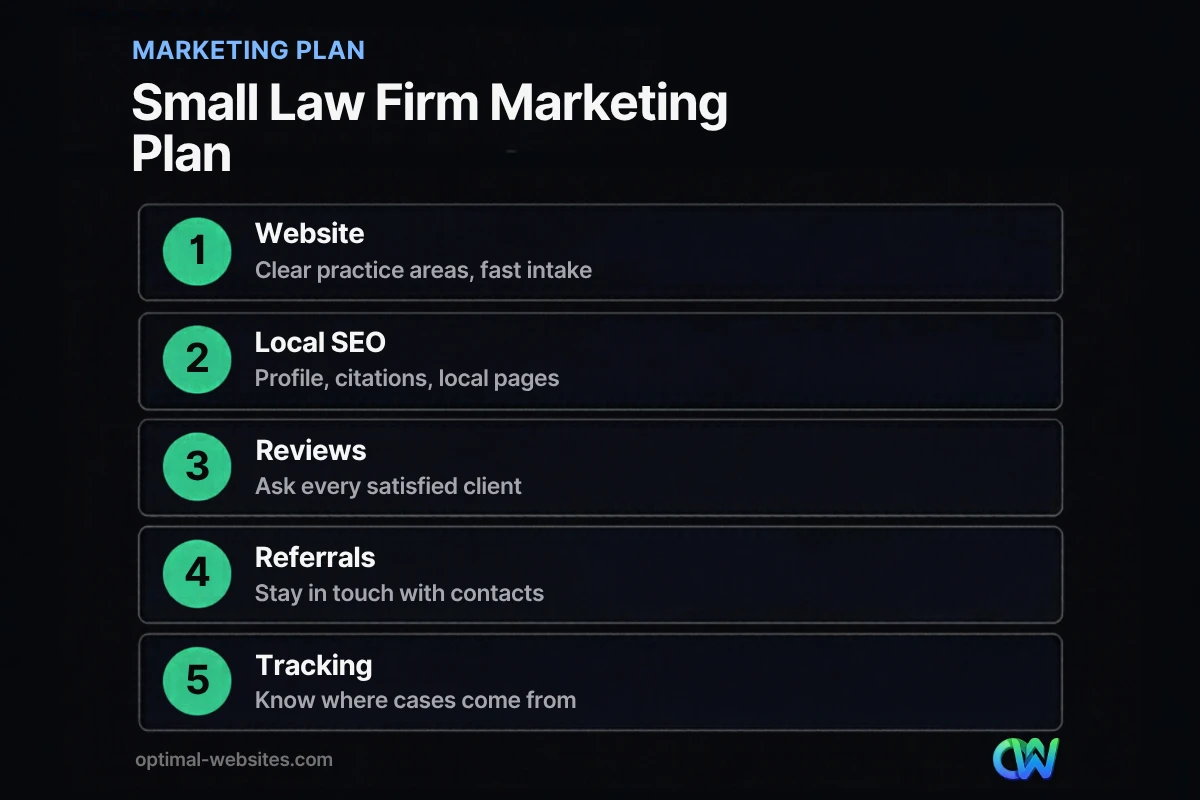
For a wider view of planning across channels, see our guide to digital marketing strategy for small business.
How Do You Measure Small Law Firm Marketing Results?
Measure small law firm marketing by tracking consultations and signed clients by source, not just website traffic or rankings. A channel that brings fewer leads but more signed cases is often the better investment.
Track at least:
- Phone calls and form submissions from the website, using call tracking and analytics key events
- Google Business Profile calls, direction requests and website clicks
- The source of every new client, recorded at intake
- Cost per consultation and cost per signed client for any paid channel
Review these numbers each quarter and shift time and budget toward what produces signed matters.
How Optimal Websites Can Help
Optimal Websites, a WordPress web design agency based in Delaware, builds fast, mobile-first law firm websites with Elementor Pro, with clear practice-area pages, simple intake forms and the tracking you need to see which channels bring clients. Our lead generation services help small firms turn website visits into consultations. Browse our portfolio of law firm websites to see examples of our work.
Frequently Asked Questions
What is the best marketing for a small law firm?
The best marketing for a small law firm combines a clear, fast website, a complete Google Business Profile, steady client reviews and referral relationships. These channels compound over time and cost less than constant advertising. Add paid search only after your website and intake process convert well, and track which channels produce signed clients.
How much should a small law firm spend on marketing?
There is no single right number. Base your budget on your growth goals, the value of a typical case and what you can sustain for at least a year. Start by funding the foundation, a strong website and local search, then add channels gradually and measure cost per signed client before increasing spend.
How can a solo attorney get more clients?
Solo attorney marketing works best when it is focused: pick one or two practice areas, build helpful pages for them, claim your Google Business Profile, ask every satisfied client for a review and build referral relationships with professionals who serve the same clients. Consistency matters more than trying every channel at once.
Can lawyers ask clients for reviews?
Yes, lawyers can generally ask clients for reviews, as long as they follow platform rules and their state’s professional conduct rules. Do not offer incentives, write reviews for clients or ask them to mention specific results. Reply to law firm reviews without revealing confidential information, and check your state bar’s guidance.
What should a law firm marketing plan include?
A law firm marketing plan should include your target cases, the channels you will use, who handles each task, a budget and how you will measure results. Keep it to one page. Review consultations and signed clients by source each quarter, and adjust your time and spending based on what works.
Is SEO worth it for a small law firm?
SEO is usually worth it for a small law firm because people search for legal help when they need it. Local SEO and well-written practice-area pages can bring steady consultations without paying for every click. Results build over months, so pair SEO with reviews and referrals while it grows.
Ready to Get Started?
Ready to make your firm easier to find and easier to hire? Request a free quote or call (302) 554-9497 to talk about your website, local search and intake.


