
Last updated: October 15, 2026
Quick answer: Our web design process has eight steps: free quote, discovery questions, a 50% deposit, content planning, design and build on WordPress with Elementor Pro, review and testing, launch after your approval, and training so you can edit the site yourself. Most projects launch in 2–4 weeks, and you give feedback at every stage.
Most business owners have heard a horror story about a website project: months of delays, a budget that kept growing and a final site nobody on the team could update. A clear web design process prevents that. When you know what happens at each step, who is responsible for what and when you pay, you can plan your launch, your marketing and your cash flow with confidence. This guide walks through the exact process Optimal Websites, a WordPress web design agency based in Delaware, uses on client projects, why we borrow ideas from agile development, and what you can do to keep your own project on schedule.
Key Takeaways
- Our web design process runs from a free quote to launch and training, and most projects launch in 2–4 weeks.
- You pay a 50% deposit to start and the final 50% only after you approve the finished website.
- We build on WordPress with Elementor Pro, so you can edit pages visually after launch.
- We work in a collaborative, agile-inspired way: core pages first, frequent feedback and room to adjust as ideas change.
- The biggest factors in your timeline are how quickly content and feedback are ready.
What is a web design process?
A web design process is the set of steps an agency follows to plan, design, build, test and launch a website. A good one makes scope, timing and responsibilities clear before any design work begins.
Without a defined process, projects drift. Requirements change halfway through, feedback arrives all at once at the end and nobody is sure what “done” means. With one, every stage has a goal, a deliverable and a decision point where you say yes, change this or move forward.
Processes vary from agency to agency. Some run long, fixed phases with sign-offs months apart. Others work in short cycles with frequent check-ins. Ours sits closer to the second model, which is why this post started life in 2020 as a note about our agile approach.
Why do we use an agile approach to web design?
We use an agile-inspired approach because websites rarely go exactly to plan, and a process that welcomes feedback early produces a better site than one that saves every change for the end.
The idea comes from software development. The Manifesto for Agile Software Development values customer collaboration over contract negotiation and responding to change over following a plan. Those two ideas fit web design well. You know your business, your customers and your competitors. We know WordPress, layout, speed and how visitors move through a page. The best results come from combining both, continuously, rather than handing over a list of requirements and waiting.
In practice, an agile approach to web design means a few things for you:
- Be realistic about change. New ideas come up once you see a page in a browser. That is normal, and a flexible process makes room for it without throwing out work.
- Treat brainstorming as ongoing. The first conversation sets direction, but the best ideas often appear after you see real layouts with your real content.
- Start with the core. Software teams call it a minimum viable product. For a website, that means getting the pages that drive calls and quote requests right first, then adding enhancements.
- Break the project into pieces. Prioritizing what matters most, and in what order, keeps decisions small and progress visible.
To be clear about our limits: we do not run formal sprints or charge by the sprint. We use agile principles to keep the collaboration tight and the project moving inside a clear scope, timeline and price.
What are the steps in our web design process?
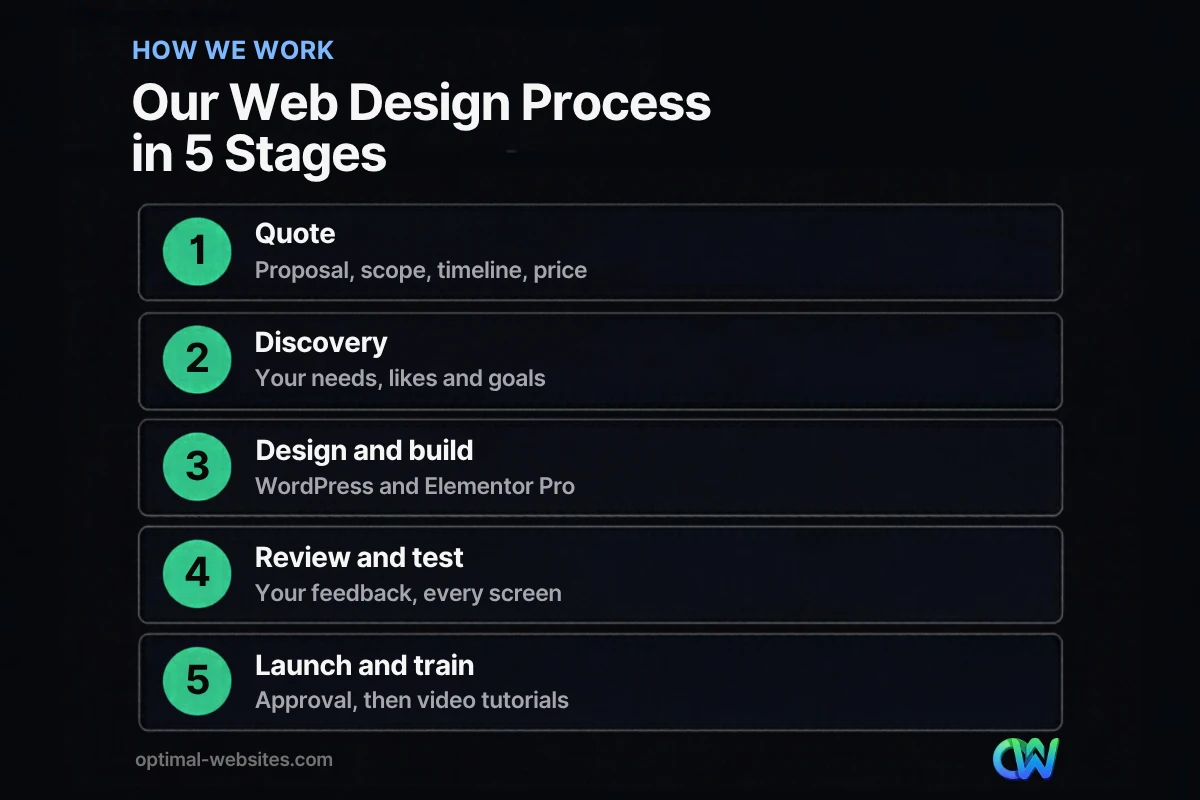
Our web design process has eight steps, from the first conversation to the day you edit your own site. Here is what happens at each one.
1. Free consultation and quote
Every project starts with a free conversation about your goals. You tell us about your business, the type of project (new website, redesign, online store, landing page) and your budget range. We reply with a clear proposal covering scope, timeline and price, with no obligation.
2. Discovery questions
Your input shapes the whole project, so we start with plenty of questions about your needs, likes and goals. Who are your best customers? Which services matter most? Which sites do you like, and why? What should a visitor do after landing on your homepage? These answers guide structure, design direction and calls to action.
3. Deposit and kickoff
We require a 50% deposit to get started. Once it is in, the project is scheduled and work begins. The second 50% comes later, only after you approve the completed website.
4. Content planning
Content is usually the step that sets the pace. In most projects, you write the content because you are the expert on your business. If you need help, our copywriter can polish your text or write original content for an additional cost. On redesigns, the Professional and Advanced Custom packages include content migration from your old site.
5. Design and build on WordPress and Elementor Pro
We build every site on WordPress with Elementor Pro. That combination is flexible, widely supported and easy for clients to manage. Depending on your package, the design is theme-based (Starter and Professional) or fully custom (Advanced Custom).
Every build is mobile-friendly and fully responsive on phones, tablets and desktops. We set up on-page SEO, fast-loading pages, contact forms, Google Maps and social integration as part of the build. If you want to compare approaches before you decide, read our guide on a custom website vs. a template.
6. Review, feedback and testing
This is where the agile idea pays off. You review the site as it takes shape and tell us what works and what does not. We adjust, and you review again. Your feedback is crucial, and the faster it arrives, the faster we launch.
Before launch, we check that the site works across screen sizes, and the Professional and Advanced Custom packages include multi-browser testing. We also look at loading speed. As general guidance, Google’s Core Web Vitals thresholds on web.dev recommend a Largest Contentful Paint within 2.5 seconds and an Interaction to Next Paint of 200 milliseconds or less for a good user experience.
7. Approval and launch
When you are fully satisfied with the completed website, you approve it and pay the final 50%. Then the site goes live.
8. Training and ongoing support
We love it when clients take control of their website. After launch, you get comprehensive video tutorials and a training session so you can update pages yourself. If you prefer to hand it off, we provide ongoing support and maintenance for many of our clients, and the Advanced Custom package includes a dedicated project manager and developer plus a 30-day quality guarantee.
How long does the web design process take?
Most of our projects launch in 2–4 weeks. Each client sets the pace, because your input in the early stages, your availability for feedback and how soon content is ready all affect the timeline.
More complex functionality, such as an online store or custom integrations, can take longer. Here is how responsibilities split across the project:
| Stage | What we do | What you do |
|---|---|---|
| Quote | Send proposal, scope, timeline and price | Share goals, project type and budget |
| Discovery | Ask about needs, likes and goals | Answer questions, share sites you like |
| Content | Migrate old content (Professional and up), optional copywriting | Write or approve page content |
| Design and build | Build on WordPress and Elementor Pro, mobile-first | Review progress |
| Review and test | Apply feedback, test screens and browsers | Give clear, consolidated feedback |
| Launch and train | Go live, deliver video tutorials and training | Approve the site, pay the final 50% |
How can you keep your web design project on track?
You keep a web design project on track by preparing content early, giving one consolidated round of feedback at a time and trusting the team with the technical decisions. These general tips apply to any agency, not only to us.
- Get to know your designer first. Look at their portfolio, read their reviews and understand how they work. Our guide on what to look for when hiring a web design company covers the questions worth asking.
- Name one decision maker. Feedback from five people with five opinions slows every round. Collect input internally, then send one clear list.
- Start content now. Draft your service descriptions, about page and contact details before kickoff. Use our checklist of the pages and features every business website needs as a starting point.
- Prioritize the money pages. Decide which pages bring in calls and quote requests, and get those right first. Extras can follow after launch.
- Trust the professionals, stay involved. You are paying for skills, so leave room for expert recommendations on layout and technology, while staying close enough to steer the result.
- Plan for search from day one. Page titles, headings and clear service pages matter. Google’s SEO Starter Guide is a plain-language primer worth reading before launch.
Is an agile web design process right for every project?
An agile, feedback-driven process suits most small business websites, but it is not ideal for every situation. It works best when you can give feedback quickly and when priorities may shift as you see the site come together.
It is a weaker fit when the scope is fixed by outside rules, such as a regulated industry with legal sign-offs at every step, or when the launch must be perfect on the first impression because customers may not return. In those cases, more upfront planning and fewer public iterations make sense. We talk through this during the free consultation and adjust the process to your situation.
Across the industries we serve, from roofing and construction companies to law firms and local service businesses, the pattern is consistent: the projects that launch fastest are the ones where content is ready early and feedback arrives in clear, single rounds.
How Optimal Websites Can Help
If you are planning a new website or a redesign, our team handles the full process, from the first conversation to training your staff. We build fast, mobile-first sites with WordPress and Elementor Pro that you can update yourself. See what is included in our WordPress web design and development service, then compare our website packages and pricing: Starter starts at $999, Professional at $1,499 and Advanced Custom at $1,999.
Frequently Asked Questions
What are the main steps of the web design process?
The main steps of the web design process are discovery, planning, content, design and build, review and testing, launch and training. At Optimal Websites, that becomes eight steps: free quote, discovery questions, deposit, content planning, building on WordPress and Elementor Pro, review and testing, launch after your approval, and training with video tutorials.
How long does it take to design a website for a small business?
Most small business websites we build launch in 2–4 weeks. The timeline depends on how quickly your content and feedback are ready and on the features you need. A simple brochure site moves faster, while an online store or custom integrations can take longer. We give you a timeline with your free quote.
How much input do I have in the web design process?
You have a lot of input. We start with questions about your needs, likes and goals, then you review the site as it takes shape and tell us what to change. Your feedback guides every stage of the web design process, and nothing goes live until you approve the completed website.
When do I pay for my website?
You pay a 50% deposit to get started and the final 50% after you approve the completed website and are fully satisfied. We accept all major credit cards through our online processing system, wire transfers and PayPal. Package prices start at $999 for Starter, $1,499 for Professional and $1,999 for Advanced Custom.
Who writes the content for my website?
Usually you do, because you are the expert on your business and your customers. If writing is not your strength, our copywriter can polish your text or write original content for an additional cost. On redesigns, the Professional and Advanced Custom packages include migrating content from your old website.
What does agile web design mean?
Agile web design means building a website in a collaborative, flexible way, with frequent feedback instead of one big reveal at the end. It borrows from agile software development, which values customer collaboration and responding to change. For you, it means core pages first, regular reviews and room to adjust ideas as the site takes shape.
Can I update my website myself after launch?
Yes. We build on WordPress with Elementor Pro, which lets you edit pages visually without code. After launch, you receive comprehensive video tutorials and a training session so you can manage text, images and pages on your own. If you prefer, we also offer ongoing support and maintenance.
Ready to Get Started?
Tell us about your goals and we will reply with a clear proposal, scope, timeline and price. Request a free quote or call us at (302) 554-9497.


