
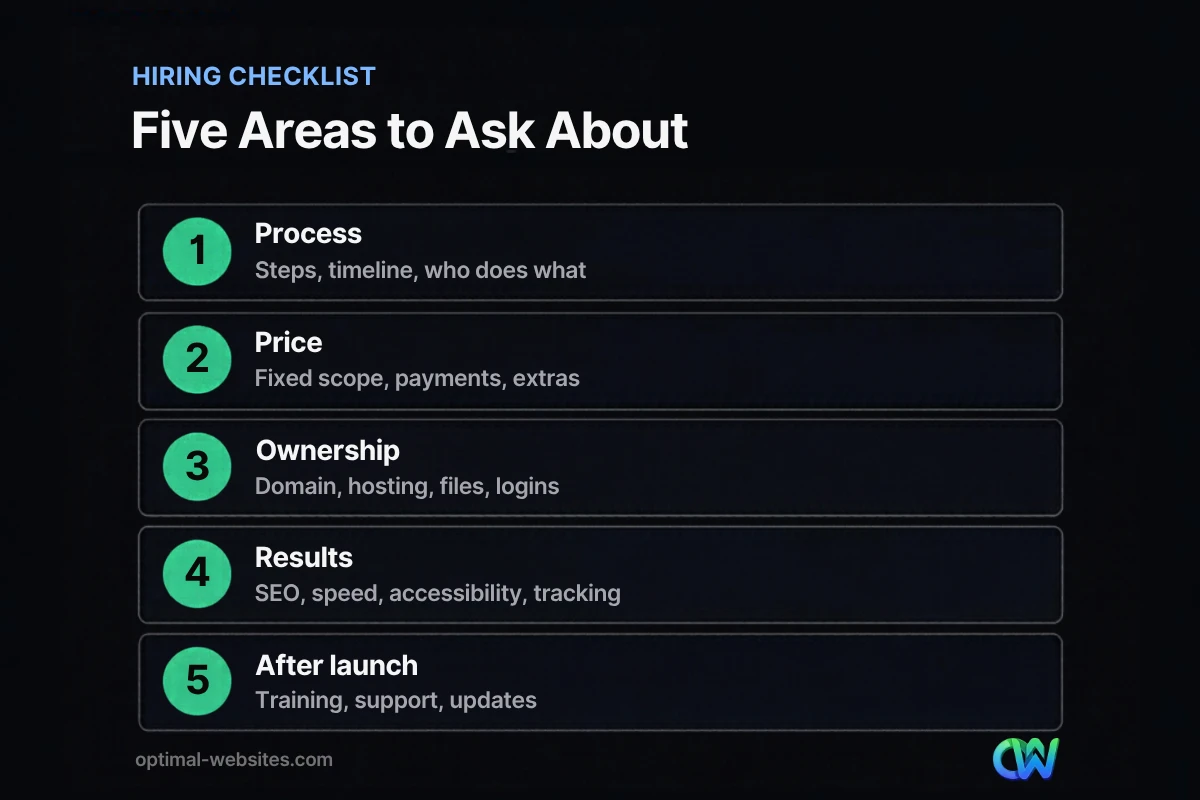
Quick answer: The most important questions to ask a web designer cover five areas: their process and timeline, exactly what the price includes, who owns the domain, hosting, files and logins, how they handle SEO, speed and accessibility, and what support and training you get after launch. Clear, written answers to each are the best sign of a good hire.
A new website is a big investment, and most business owners only hire a web designer once every few years. That makes it easy to focus on the portfolio and the price and forget to ask the questions that decide how the project actually goes. Who owns the site when it is done? What happens if the project runs late? Will the site load fast and show up on Google? This guide gives you the questions to ask a web designer, grouped by topic, with what a good answer sounds like, the contract terms to check and the red flags that should end the conversation.
Key Takeaways
- Ask about process, price, ownership, results and post-launch support, not only design style.
- Get the scope, timeline, payment schedule and deliverables in writing before you pay a deposit.
- Make sure you own your domain, hosting account, site files and admin logins.
- Ask how the site will handle mobile speed, basic SEO, accessibility and conversion tracking.
- Walk away from guaranteed rankings, vague quotes and anyone who will not give you admin access.
Why do the right questions matter when hiring a web designer?
The right questions reveal how a designer works before you are committed. A good portfolio shows what someone can make; good answers show whether they can deliver it on time, on budget and in a way that serves your business.
Our broader guide to hiring a web design company covers how to shortlist and compare providers. If you are still deciding between a freelancer and a firm, see web designer vs agency. This post goes deeper on the interview itself.
What are the questions to ask a web designer about process?
Process questions tell you whether the designer has a repeatable way of working or is improvising. Listen for clear steps, named responsibilities and realistic timing.
- What are the steps from kickoff to launch? A good answer lists discovery, sitemap and content planning, design, development, review, testing and launch.
- How long will my project take, and what could delay it? Expect a range and an honest note that content and feedback are the usual delays. Our guide on how long it takes to build a website explains typical timelines.
- Who will I work with day to day? You should know who designs, who builds and who answers your emails.
- How many rounds of revisions are included? Get a number, and ask what happens beyond it.
- What do you need from me, and when? Content, photos, logins and approvals all have deadlines.
What should you ask about price and the web design contract?
Price questions should uncover exactly what is included, what costs extra and how payments are tied to progress. Your web design contract should answer all of them in writing.
| Question | What a good answer includes |
|---|---|
| What exactly does the price include? | Page count, features, content work, SEO setup, training, launch support |
| What is not included? | Copywriting, photography, premium plugins, hosting, ongoing support (if extra) |
| How are payments scheduled? | A deposit to start and the balance tied to milestones or approval |
| What happens if the scope changes? | A written change request with a price before work starts |
| Are there recurring costs? | Hosting, domain, licenses and maintenance, with estimates |
| What if we need to end the project early? | Clear terms for work completed and files delivered |
Contract terms worth checking
- Scope and deliverables listed page by page or feature by feature.
- Timeline with milestones and what happens if either side causes a delay.
- Ownership and transfer of the design, code and content on final payment.
- Third-party licenses for themes, plugins, fonts and stock images.
- Warranty or bug-fix period after launch.
On ownership, it helps to know the basics. The U.S. Copyright Office’s guide to works made for hire explains that work by an outside contractor is only “made for hire” in certain cases with an express written agreement. If you want to own the design and content outright, make sure the contract assigns those rights to you. Ask a lawyer if anything is unclear.
What questions should you ask about ownership and access?
Ownership questions protect you if you ever change providers. The answers should be simple: you own and control your domain, hosting account, website files and admin logins.
- Will the domain be registered in my name and account?
- Whose account will the hosting be in, and can I get access?
- Will I get full administrator access to the website?
- Can I get a complete backup of the site at any time?
- What happens to my site if I stop paying for your services?
If a designer hesitates on any of these, treat it as a warning sign. Losing access to your own domain or site is one of the most expensive problems a small business can face.
What should you ask about SEO, speed and accessibility?
These questions show whether the designer builds sites that perform, not just sites that look good. A beautiful site that loads slowly, cannot be found or excludes visitors costs you leads.
- How do you make sites fast on mobile? Look for image optimization, caching, lean plugins and testing against Core Web Vitals.
- What SEO setup is included? Page titles, meta descriptions, headings, clean URLs, sitemap, schema, Google Search Console setup and redirects from old URLs.
- How do you approach accessibility? A good answer mentions WCAG 2.2 basics such as color contrast, labeled forms, keyboard navigation and alt text.
- How will we track leads? Form and call tracking in Google Analytics 4, set up before launch.
- Will the site be easy for my team to update? Ask to see the editor and whether training is included.
What we answer when clients ask us
At Optimal Websites, a WordPress web design agency based in Delaware, we build on WordPress with Elementor Pro, mobile-first, with on-page SEO basics and tracking set up before launch. Clients own their domain and get admin access, and every site comes with video tutorials so their team can edit pages. Our packages start at $999, most projects launch in 2–4 weeks, and we take 50% to start and the final 50% after client approval. We share this not as a pitch but as an example of the kind of specific answers you should expect from any provider.
What should you ask about support after launch?
Post-launch questions reveal whether the relationship ends at launch or continues. Websites need updates, backups and small changes over time.
- How long do you fix bugs for free after launch?
- Do you offer hosting, maintenance or support plans, and what do they include?
- How quickly do you respond to problems, such as a broken form or site outage?
- How are small content changes priced?
- Will you train my team, and is there documentation or video help?
What are the biggest web design red flags?
The biggest web design red flags are promises no one can keep, vague quotes and anything that limits your control of your own website. Any one of these is a reason to keep looking.
- Guaranteed first-page or number one rankings
- A price with no written scope or deliverables
- Refusing to register the domain in your name or share admin access
- Pressure to sign or pay immediately
- No portfolio or references from businesses like yours
- Unclear answers about who actually does the work
- Large upfront payment with no milestones
How Optimal Websites Can Help
If you are comparing providers, we are happy to answer every question on this list in writing. Learn more about our WordPress web design services, or review our fixed-price packages to see what is included at each level.
Frequently Asked Questions
What questions should I ask a web designer before hiring?
Ask about their process and timeline, exactly what the price includes, who owns the domain, hosting, files and logins, how they handle SEO, speed and accessibility, and what support you get after launch. These questions to ask a web designer reveal how the project will run, not just how the finished site will look.
What should be in a web design contract?
A web design contract should list the scope and deliverables, timeline and milestones, payment schedule, revision rounds, change request process, ownership and transfer of rights, third-party licenses, post-launch bug-fix period and what happens if the project ends early. Everything you discussed verbally should appear in writing before you pay a deposit.
Who should own my website domain and hosting?
You should own your domain and, ideally, your hosting account, registered in your business’s name with your own login. Your designer can be added as a user. This protects you if you change providers and prevents disputes over access, renewals or transfers later. Ask for this in writing during hiring.
What are common web design red flags?
Common web design red flags include guaranteed rankings, quotes with no written scope, refusal to give you admin access or register the domain in your name, pressure to pay immediately, no relevant portfolio or references, and unclear answers about who does the work. Any of these is a reason to keep looking.
How many web designers should I interview?
Most small businesses should interview three or four web designers or agencies. That is enough to compare process, pricing and communication styles without spending weeks on the search. Use the same list of web designer interview questions with each one so you can compare their answers side by side.
Should I ask a web designer for references?
Yes. Ask for two or three references from businesses similar to yours and call them. Ask whether the project stayed on schedule and budget, how problems were handled, how easy the site is to update and whether they would hire the designer again. References often reveal more than a portfolio does.
Ready to Get Started?
Have your questions ready? Ask us. Request a free quote or call (302) 554-9497 and we will walk you through our process, pricing and ownership terms.


