
Quick answer: Effective construction company website design helps owners, developers and general contractors decide you are qualified before they call. That means a detailed project portfolio, clear capabilities and sectors served, safety and credential information, an introduction to your leadership team, and an easy way to request a bid or send plans. Speed and mobile usability matter too.
In construction, the website rarely closes the deal by itself, but it often decides whether you get invited to bid. Owners, facility managers, architects and general contractors check your site to see what you have built, how big a job you can handle and whether you look established and safe. A dated site with a few stock photos can quietly take you off a shortlist. This guide covers what construction company website design should include, how to build a project portfolio page that sells, and the details that help commercial clients trust you before the first meeting.
Key Takeaways
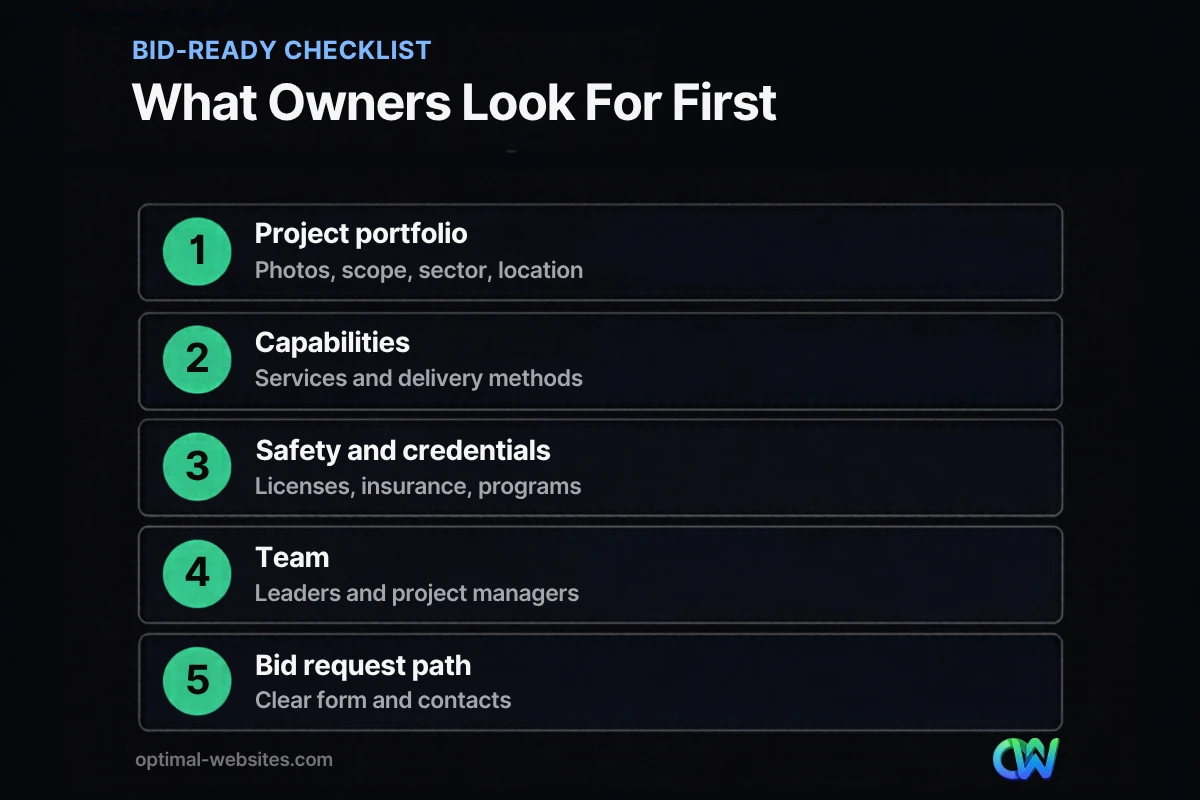
- Your project portfolio is the most important part of a construction website, so give each project real detail.
- Show capabilities clearly: services, sectors, delivery methods and service area.
- Safety records, licenses, insurance and certifications help with prequalification.
- Make the bid request path obvious, with a form that accepts plans or a clear contact for estimating.
- Fast, mobile-friendly pages matter, because many visitors check your site from job sites and phones.
Who Visits a Construction Website?
Construction sites serve several audiences at once: property owners and developers, facility managers, architects and engineers, general contractors looking for subcontractors, and job seekers. Each wants different information, so the navigation should make each path obvious.
Commercial buyers are usually doing due diligence. They want proof of similar work, capacity and reliability. Residential clients want to see quality and feel comfortable with the people. Recruits want to know whether you are a good place to work. A strong builder website addresses all three without burying the bid request under general marketing copy.
What Pages Does a Construction Company Website Need?
Most construction companies need a homepage, services or capabilities pages, a project portfolio with individual project pages, sector or market pages, an about and team page, safety and credentials, careers, and a contact or bid request page.
| Page | What it should include |
|---|---|
| Homepage | What you build, sectors served, service area, featured projects, bid request button |
| Services or capabilities | General contracting, design-build, construction management, preconstruction, self-perform trades |
| Projects | Filterable portfolio with a page per project |
| Sectors | Healthcare, education, industrial, retail, multifamily, or whatever you build most |
| About and team | Company history, leadership, project managers and superintendents |
| Safety | Safety program overview, training, certifications you hold |
| Careers | Open roles, culture, benefits, application path |
| Contact and bids | Estimating contact, bid request form, plan upload, office locations |
Many trade contractors need a simpler structure. If that sounds closer to your business, our guide to contractor website design focuses on residential and service-based contractors.
How Do You Build a Project Portfolio Page That Wins Work?
A project portfolio page wins work when it shows similar projects with enough detail for a buyer to judge fit. Each project should have its own page, not just a photo in a grid.
What to include on each project page
- Project name, location and sector, such as a medical office or warehouse.
- Scope and your role: general contractor, construction manager, design-build or a specific trade.
- Size and type of work, in the terms your clients use, if you can share them.
- Challenges and how you solved them, such as phased work in an occupied building or a tight schedule.
- Quality photos of the finished work and, where useful, progress photos.
- Team and partners, with permission, such as the architect or owner.
How to organize the portfolio
Let visitors filter by sector, service and location. Feature your best and most recent projects at the top, and keep older or less relevant work lower down. A filterable portfolio turns a long list of jobs into quick answers: “Have they built a school like ours?”
Photos deserve care. Google’s image SEO guidance recommends short, descriptive file names, informative alt text and placing images near relevant text. A file named `medical-office-renovation-wilmington.jpg` with a clear caption helps both search engines and visitors more than `IMG_4821.jpg`.
How Should Construction Company Website Design Support Prequalification?
Construction company website design should make prequalification easier by putting the information buyers ask for in one place. Many owners and general contractors screen firms before sending bid invitations.
- Licenses and insurance: list license types and states, and note that certificates are available on request.
- Safety program: describe your training, meetings and certifications you actually hold.
- Bonding capacity: share it if you are comfortable doing so, or invite qualified buyers to ask.
- Certifications: small business, minority-owned or other certifications you hold.
- Capabilities statement: a downloadable one-page PDF for public and commercial buyers.
Only publish credentials, awards and figures you can document. Overstated claims can disqualify you faster than missing ones.
What Makes a Commercial Construction Web Design Different?
Commercial construction web design prioritizes proof, capacity and process over emotional appeal. Buyers want to see that you can deliver on schedule and budget, communicate well and manage risk.
- Explain your process: preconstruction, estimating, scheduling, communication and closeout.
- Show your people: leadership bios and project managers build confidence in who will run the job.
- Highlight relationships: repeat clients and long-term partners, with permission.
- Make estimating easy to reach: a direct estimating email or a form that accepts plan uploads.
Residential builders can lean more on lifestyle photography, design galleries and testimonials, but the same rule applies: show real work, real people and a clear next step.
Which Technical Details Matter for a Builder Website?
Speed, mobile layout and local search setup matter as much as design. Many visitors check a builder website on a phone from a job site or between meetings.
- Compress project photos and use modern formats so galleries load quickly.
- Keep navigation simple on mobile, with the bid request button always visible.
- Use LocalBusiness structured data to describe your business details, such as hours and locations, to Google.
- Create location pages if you have several offices or serve distinct regions.
- Keep forms short, and route bid requests to the right estimator automatically.
Should You Use a Template or a Custom Design?
A template can work for a small firm with a handful of projects, but most growing construction companies benefit from a custom structure built around their portfolio and sectors. The portfolio filtering, project pages and prequalification content rarely fit a generic template well.
Our comparison of whether to choose a custom website or a template explains the trade-offs in more detail.
How Optimal Websites Can Help
At Optimal Websites, a WordPress web design agency based in Delaware, construction and engineering firms are among the industries we serve, including Care Facilities Construction and E & S Construction Engineers, which you can see in our portfolio. Our web design services cover project portfolio structures, capability and sector pages, bid request forms and fast, mobile-first builds on WordPress with Elementor Pro, plus video training so your team can add new projects themselves. Read more about our approach to small business website design.
Frequently Asked Questions
What should a construction company website include?
A construction company website should include a detailed project portfolio, services and capabilities, sectors served, an about and team page, safety and credentials, careers, and a clear contact or bid request page. Each project should have its own page with scope, sector, location and quality photos, so buyers can quickly judge whether you fit their job.
How do I make a construction website that wins bids?
Make it easy for buyers to prequalify you. Show similar past projects with real detail, list licenses, insurance and safety information, introduce the team who will run the work, and give estimating a direct contact or upload form. Good construction company website design answers due-diligence questions before the buyer has to ask.
How many projects should be on a construction portfolio page?
Quality matters more than quantity. Start with eight to twelve strong, well-documented projects that represent the work you want more of, and add new ones as they finish. Let visitors filter by sector and service. A smaller portfolio of detailed project pages persuades better than a long gallery of unlabeled photos.
Should a construction website show pricing?
Most commercial construction websites do not show prices, because every project is bid individually. Instead, explain your process, delivery methods and what affects cost, and make it easy to request a bid. Residential builders sometimes share starting ranges for common project types, which can help filter out poor-fit leads.
Do construction companies need SEO?
Yes, especially for local and regional searches. Owners and facility managers search for services like commercial general contractor plus a city. Service pages, sector pages, project pages with descriptive photos and an accurate Google Business Profile help a construction website appear for those searches and support your referral and bidding work.
How long does it take to build a construction company website?
Timelines depend on how many pages and projects you need and how quickly content and photos are ready. At Optimal Websites, most projects launch in two to four weeks. Gathering project photos, scope details and team bios early is the best way to keep a builder website on schedule.
Ready to Get Started?
Ready for a website that helps you get invited to more bids? Request a free quote or call (302) 554-9497 to talk about your construction website.


