
Quick answer: Effective LinkedIn marketing for small business comes from a simple, consistent weekly routine: plan on Monday, post two or three helpful updates during the week, spend a few minutes each day commenting on relevant posts, and follow up with warm connections on Friday. Consistency and real expertise matter more than posting volume.
LinkedIn rewards people who show up regularly with useful ideas, but most small business owners do not have hours a day to spend there. The result is a burst of activity after a networking event, then silence for two months. That pattern rarely produces clients. A short, repeatable routine works better: it keeps you visible, builds relationships with the people who hire businesses like yours, and fits around actual client work. This guide gives you a weekly routine, a LinkedIn content plan you can reuse, engagement habits that build trust, and a way to measure whether LinkedIn is worth your time.
Key Takeaways
- LinkedIn is most valuable for B2B services, professional services and businesses that sell to managers, owners and decision-makers.
- Use your personal profile as the main engine and your company page as the home base. People engage more with people than with logos.
- A realistic LinkedIn posting schedule for a small business is two or three posts a week, plus a few minutes of daily engagement.
- Mix content types: practical tips, behind-the-scenes work, client proof and your point of view.
- Turn engagement into conversations, and conversations into calls, with a light Friday follow-up habit.
Is LinkedIn marketing for small business worth it?
LinkedIn marketing is worth it for small businesses that sell to other businesses or to professionals, because that is who uses the platform. It is less useful for purely consumer, impulse-purchase businesses.
Pew Research Center found in early 2024 that LinkedIn use rises sharply with education: 53% of U.S. adults with a bachelor’s degree or more say they use it, compared with far lower shares among those without a degree. Pew noted this is the largest educational gap among the platforms it asked about. For agencies, consultants, contractors who serve commercial clients, law firms, accountants and B2B suppliers, that audience overlaps heavily with buyers.
LinkedIn works best when you:
- Sell services with a longer decision process, where trust matters
- Need to reach owners, managers, property managers or procurement teams
- Have expertise you can share in plain language
- Rely on referrals and relationships
Should you focus on a personal profile or a company page?
Focus most of your effort on the personal profiles of the owner and key team members, and use the company page as a credible home base. Posts from real people usually earn more conversation than posts from a brand.
| Asset | Best use | Weekly effort |
|---|---|---|
| Owner’s personal profile | Insights, opinions, stories, relationship building | Most of your time |
| Team members’ profiles | Sharing projects and expertise from their role | Light, optional |
| Company page | Credibility, job posts, project updates, reshares | One or two posts a week |
Make sure the basics are in place before you start the routine: a clear profile headline that says who you help, a professional photo, a featured section linking to your website, and a complete company page. Our guide to setting up a LinkedIn company page walks through every field.
What is a good LinkedIn posting schedule for a small business?
A good LinkedIn posting schedule for most small businesses is two or three quality posts per week, on consistent days, with short daily engagement sessions. That pace is sustainable alongside client work and keeps you visible.
More is not automatically better. A thoughtful post that sparks real comments does more than five rushed updates. Choose days you can stick to for months, not weeks, and adjust based on when your audience responds.
What does a weekly LinkedIn routine look like?
A weekly LinkedIn routine breaks the work into small daily tasks so it never takes more than 20 to 30 minutes a day. Here is a routine you can copy.
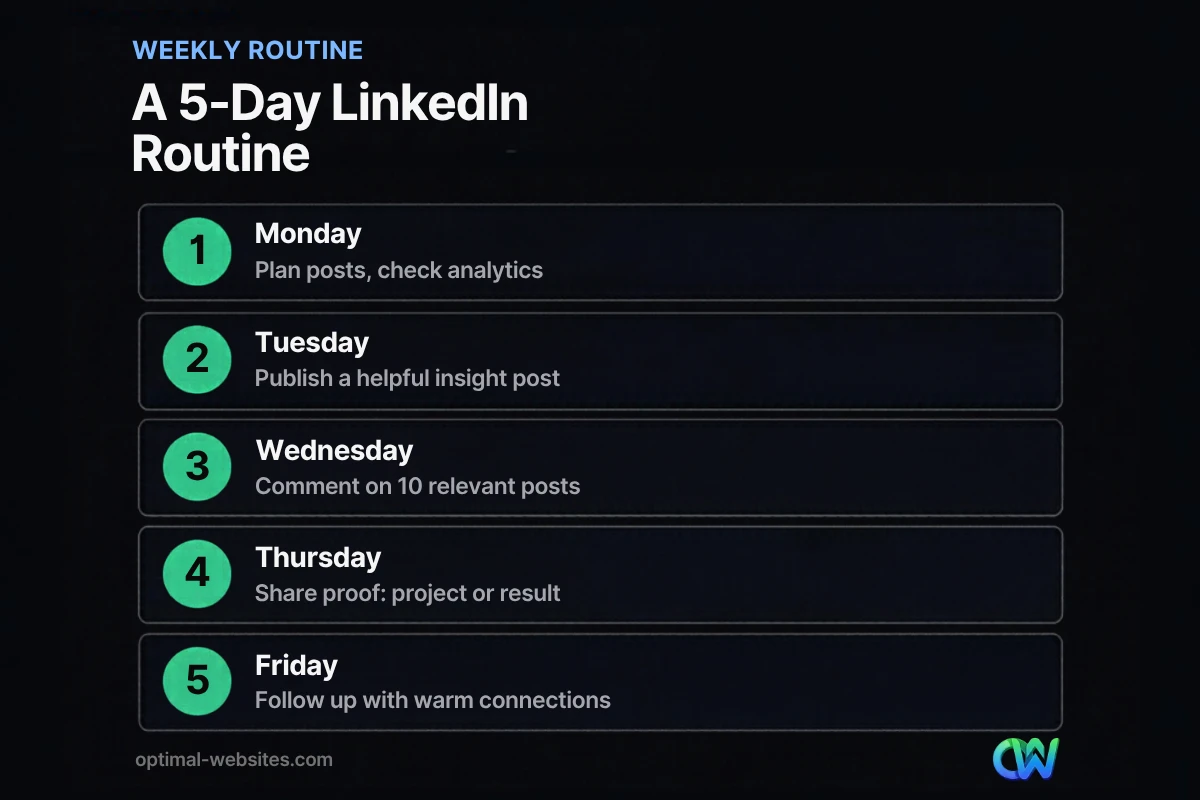
Monday: plan and review (20 minutes)
- Check last week’s post analytics: impressions, comments and profile views.
- Pick two or three post topics for the week from your content plan.
- Draft the posts or outline them in bullet points.
Tuesday: publish an insight post (15 minutes plus replies)
- Share a practical tip, a lesson from a recent project or an answer to a question clients often ask.
- Reply to every comment within the day.
Wednesday: engage (20 minutes)
- Comment thoughtfully on about 10 posts from clients, prospects, partners and peers.
- Add something useful to the conversation, not just “Great post.”
- Accept relevant connection requests and send a few of your own with a short personal note.
Thursday: share proof (15 minutes plus replies)
- Post a project, before-and-after, client milestone (with permission) or behind-the-scenes look at how you work.
- Tag partners or clients only when they have agreed.
Friday: follow up (20 minutes)
- Message people who engaged with your posts or whom you met that week.
- Share a relevant article, ask a question or suggest a short call when it is a natural next step.
- Note any leads in your CRM or spreadsheet.
What should be in a LinkedIn content plan?
A LinkedIn content plan is a short list of recurring post types tied to what your clients care about. Rotate through them so you never stare at a blank screen.
| Content type | Example for a service business | How often |
|---|---|---|
| Practical tip | “Three questions to ask before signing a construction contract” | Weekly |
| Project or proof | Before-and-after of a recent project, with the client’s permission | Weekly or biweekly |
| Behind the scenes | How your team prepares for a job or onboards a client | Biweekly |
| Point of view | Your take on an industry change and what it means for clients | Monthly |
| Team or culture | A new hire, certification or company milestone | Monthly |
| Resource share | A blog post or guide from your website, with the key takeaway in the post | Biweekly |
Write in the first person, keep paragraphs short, and lead with the most interesting line, since only the first few lines show before “see more.” Native posts with images or short documents often earn more attention than bare links, so summarize the key point in the post and add the link in a comment or at the end.
Your LinkedIn strategy should also fit a broader plan. The U.S. Small Business Administration recommends that businesses keep a written marketing plan that covers target market, channels, budget and goals. LinkedIn is one channel inside that plan, not the plan itself.
How do you increase LinkedIn engagement?
Increase LinkedIn engagement by being useful, responsive and personal: write posts that invite a response, reply to every comment, and spend as much time commenting on others’ posts as on your own.
- Ask a real question. End posts with a specific question your audience can answer.
- Reply quickly. Early replies keep conversations going.
- Comment with substance. A thoughtful comment on a prospect’s post is often seen by more of the right people than your own post.
- Use visuals from your work. Real project photos beat stock images.
- Avoid engagement bait. “Comment YES if you agree” posts rarely attract buyers.
- Be consistent. The routine matters more than any single viral post.
How do you turn LinkedIn activity into leads?
Turn LinkedIn activity into leads by moving warm connections from comments to conversations, and from conversations to a clear next step on your website or a call.
- Notice who engages repeatedly with your posts or views your profile.
- Send a short, personal message that references their comment or role, without a sales pitch.
- Offer something useful: an article, a checklist or an answer to a question they raised.
- When there is a real fit, suggest a brief call.
- Send people to a focused page on your website, such as a service page or a free quote form, rather than your homepage.
Our guide to LinkedIn lead generation goes deeper on messaging and prospecting, and our list of B2B lead generation ideas shows how LinkedIn fits with email, referrals and your website.
Make sure your website is ready
LinkedIn can build interest, but your website closes the loop. At Optimal Websites, a WordPress web design agency based in Delaware, we see the same thing across professional services and B2B clients: when a LinkedIn connection clicks through, they look for proof, clear services and an easy way to get in touch. A fast, mobile-friendly site with strong service pages and a simple quote form turns that curiosity into conversations.
How Optimal Websites Can Help
If you want a consistent LinkedIn presence without adding hours to your week, our social media marketing services can plan your content, write posts in your voice, design visuals and report on what works. We also make sure your LinkedIn activity points to a website built to convert, so the attention you earn becomes real leads.
Frequently Asked Questions
How often should a small business post on LinkedIn?
Most small businesses do well with two or three quality posts per week, plus a few minutes of daily engagement with other people’s posts. Consistency matters more than volume. Pick days you can sustain for months, track which posts earn comments and profile views, and adjust your LinkedIn posting schedule based on those results.
What should a small business post on LinkedIn?
Post practical tips, project results and before-and-after examples, behind-the-scenes looks at how you work, your point of view on industry changes, team milestones and summaries of useful articles from your website. Effective LinkedIn marketing for small business focuses on helping your audience make better decisions, not on constant promotion.
Is LinkedIn better than Facebook for small business marketing?
LinkedIn is usually better for B2B services, professional services and businesses that sell to managers and owners, because that is its core audience. Facebook often works better for consumer-focused local businesses. Many small businesses use both, with LinkedIn for relationships and authority and Facebook for local community reach and offers.
Should I post from my personal profile or my company page?
Post most of your content from the owner’s or leaders’ personal profiles, because people engage more with individuals than with brand pages. Use the company page for credibility, project updates, job posts and resharing team posts. A complete, active company page still matters because prospects check it before reaching out.
How do I measure LinkedIn marketing results?
Track impressions, comments, profile views, connection requests from your target audience and messages that turn into calls. Add UTM parameters to links you share so your website analytics show LinkedIn traffic and conversions. Review results monthly and keep the post types that start real conversations with potential clients.
How much time does LinkedIn marketing take each week?
A focused routine takes about two hours a week: roughly 20 minutes on planning, 15 to 30 minutes per post including replies, and 15 to 20 minutes a day of engagement and follow-up. Batching posts on Monday and keeping engagement sessions short makes LinkedIn manageable alongside client work.
Ready to Get Started?
Want LinkedIn and your website working together to bring in better leads? Request a free quote or call (302) 554-9497 to talk about your goals.


