
Quick answer: ChatGPT search optimization means making your business easy for ChatGPT to find, understand and cite. For a local business, that comes down to allowing OpenAI’s search crawler, getting your site indexed in Bing, publishing clear service and location pages, keeping your business details consistent everywhere, and earning reviews and mentions on other trusted sites.
Your customers are starting to ask ChatGPT the same questions they used to type into Google: “Who is a good roofer near me?” or “Which law firm handles car accident cases in Wilmington?” Since OpenAI added web search to ChatGPT, those answers can include real businesses with links to their websites. If your business is not part of the information ChatGPT can find, it simply will not come up. This guide explains how ChatGPT search works, what local businesses can control, and a practical checklist for ChatGPT search optimization that builds on the SEO work you already do.
Key Takeaways
- ChatGPT search launched in October 2024 for paid users and reached all logged-in users in December 2024.
- OpenAI says ChatGPT search draws on third-party search providers and partner content, so traditional search visibility still matters.
- Allow OpenAI’s OAI-SearchBot crawler in robots.txt if you want your pages to appear in ChatGPT search answers.
- Make sure your site is indexed in Bing and your business details are consistent across directories.
- Clear, factual pages and strong reviews help AI tools describe and recommend your business accurately.
What Is ChatGPT Search?
ChatGPT search is a feature that lets ChatGPT look up current information on the web and answer with links to its sources. According to OpenAI’s announcement of ChatGPT search, it launched on October 31, 2024 for paid subscribers and became available to all logged-in users on December 16, 2024.
OpenAI says the feature leverages third-party search providers, along with content provided directly by its partners, to find the information users ask for. In practice, that means ChatGPT search does not build its view of the web from scratch. Being visible in established search indexes, and being described consistently across the web, gives you a better chance of showing up.
How Is ChatGPT Search Optimization Different from SEO?
ChatGPT search optimization builds on traditional SEO rather than replacing it. The fundamentals are the same: be crawlable, be indexed, answer real questions clearly and earn trust. What changes is how the answer is presented.
In a Google results page, a searcher sees ten links and chooses. In ChatGPT, the searcher often gets a short written answer that names a few businesses and links to sources. That raises the bar for clarity. Your pages need to state plainly what you do, where you do it and why someone should choose you, because the AI is summarizing, not browsing.
| Factor | Traditional SEO | ChatGPT search |
|---|---|---|
| Result format | List of links and map results | Written answer with cited sources |
| Crawlers that matter | Googlebot, Bingbot | OAI-SearchBot, plus search provider crawlers |
| What wins | Relevance, authority, user experience | Clear facts, consistency, corroboration across sources |
| Local signals | Google Business Profile, reviews, proximity | Listings, reviews and website details AI can verify |
| Measurement | Search Console clicks and rankings | Referral traffic from chatgpt.com in analytics |
If you are new to the basics, start with our guide to SEO for small business. For Google’s version of AI answers, see our post on AI Overviews for small business.
How Do You Get Found in ChatGPT Search?
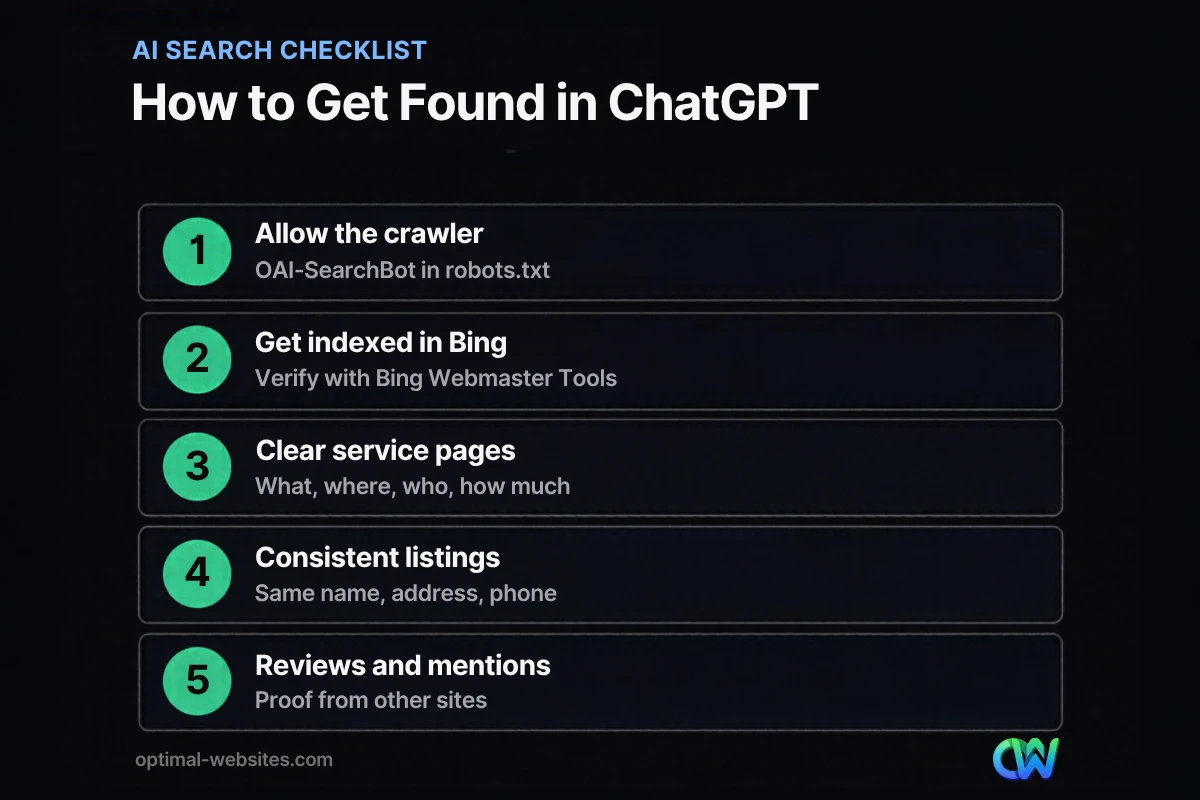
To get found in ChatGPT, make sure OpenAI’s crawler can reach your site, your pages are in major search indexes, and your content answers customer questions with clear, consistent facts.
1. Allow OAI-SearchBot in robots.txt
OpenAI’s crawler documentation explains that OAI-SearchBot is used to surface websites in ChatGPT’s search features, and that sites which block it will not appear in ChatGPT search answers. It is separate from GPTBot, which relates to model training, so you can allow search visibility while blocking training if you prefer. Check your robots.txt file and any security or firewall plugin that might block unfamiliar bots.
2. Make sure Bing has indexed your site
Microsoft announced in 2023 that Bing would be the default search experience inside ChatGPT, and Bing indexing remains a sensible foundation for AI search for local businesses. Verify your site in Bing Webmaster Tools, submit your XML sitemap and check for crawl errors. Many small businesses set up Google Search Console and never think about Bing.
3. Write clear service and location pages
Create one page per main service, and location pages if you serve several areas. Each page should state the service, the area, who it is for, what the process looks like and how to get a quote. Use plain headings that match how people ask questions.
4. Keep business details consistent everywhere
Your business name, address, phone number, hours and services should match across your website, Google Business Profile, Bing Places, Yelp, industry directories and social profiles. Inconsistent details make it harder for any system to trust which information is correct.
5. Earn reviews and mentions on other sites
AI answers lean on corroboration. Reviews, local news coverage, association memberships and industry directory listings give independent confirmation that your business is real and well regarded.
How Does ChatGPT Choose Local Recommendations?
OpenAI has not published a detailed formula for ChatGPT local recommendations. What it has said is that search answers draw on third-party search providers and partner content, which means the same signals that help you in local search tend to help here.
That points to a familiar set of priorities: an accurate, complete business profile, steady reviews, a website that clearly describes your services and service area, and consistent listings. Our guides to local SEO for small business and Google Business Profile optimization cover those foundations step by step. Bing Places for Business is worth claiming too, given Bing’s role in search beyond Google.
What Content Helps AI Tools Cite Your Website?
Pages that answer specific questions directly, with facts that are easy to quote, are the most useful to AI tools. Think of each page as a reference card for your business.
- Direct answers at the top of each section, followed by detail.
- Specific facts: service areas, licenses, years in business, pricing ranges you are comfortable publishing.
- FAQ sections written in the words customers use.
- Author and company information that shows who stands behind the content.
- Up-to-date details, especially hours, services and contact information.
Avoid vague marketing language. “We provide quality solutions” gives an AI nothing to work with; “We install and repair asphalt shingle and metal roofs for homes in New Castle County, Delaware” does.
How Do You Measure Traffic from ChatGPT?
Check your analytics for referral traffic from chatgpt.com, and ask new customers how they found you. Measurement is still rough, but both signals are useful.
In Google Analytics 4, look at traffic acquisition by session source and filter for chatgpt.com. Numbers may be small at first. Add “ChatGPT or another AI tool” as an option on your contact form’s “How did you hear about us?” field to capture visits that do not show up as referrals.
How Optimal Websites Can Help
At Optimal Websites, a WordPress web design agency based in Delaware, we build fast WordPress sites with clear service and location pages, clean technical SEO and consistent business information, which is the groundwork for both Google and AI search. Our SEO services include crawler and indexing checks for Google and Bing, local listing cleanup and content that answers your customers’ real questions.
Frequently Asked Questions
Can I pay to appear in ChatGPT search results?
No paid placement option for ChatGPT search results was announced at launch. Appearing depends on whether ChatGPT can find and trust information about your business. Focus on ChatGPT search optimization basics: allow OpenAI’s search crawler, get indexed in Bing, publish clear service pages and keep your business details consistent across the web.
Does ChatGPT search use Bing?
OpenAI says ChatGPT search draws on third-party search providers and partner content. Microsoft announced in 2023 that Bing would be the default search experience in ChatGPT, so Bing indexing is a sensible foundation. Verify your site in Bing Webmaster Tools, submit your sitemap and fix crawl errors so your pages can be discovered.
What is OAI-SearchBot?
OAI-SearchBot is OpenAI’s crawler for surfacing websites in ChatGPT’s search features. If your robots.txt file or firewall blocks it, your pages will not appear in ChatGPT search answers. It is separate from GPTBot, which relates to training, so you can allow one and block the other depending on your preferences.
How do I get found in ChatGPT as a local business?
To get found in ChatGPT as a local business, keep your Google Business Profile, Bing Places and directory listings accurate and consistent, collect reviews, and publish clear pages for each service and area you serve. Make sure OpenAI’s search crawler can access your site, and track chatgpt.com referrals in your analytics.
Is ChatGPT search replacing Google?
Not for most local businesses. Google remains the main place people look for local services, and its map results remain critical. ChatGPT search is a growing channel worth preparing for, and the good news is that the work overlaps heavily. Strong SEO, accurate listings and helpful content support both Google and AI search for local businesses.
Do I need a separate strategy for AI search?
Not a separate strategy, but a sharper one. The same fundamentals apply: crawlable pages, accurate business information, reviews and helpful content. AI search raises the importance of clear, factual writing and consistency across the web. Review your robots.txt, Bing indexing and service pages, and you will cover most of what matters.
Ready to Get Started?
Want your business to show up wherever customers search, from Google to ChatGPT? Request a free quote or call (302) 554-9497 to talk with our team about SEO and AI search.


