
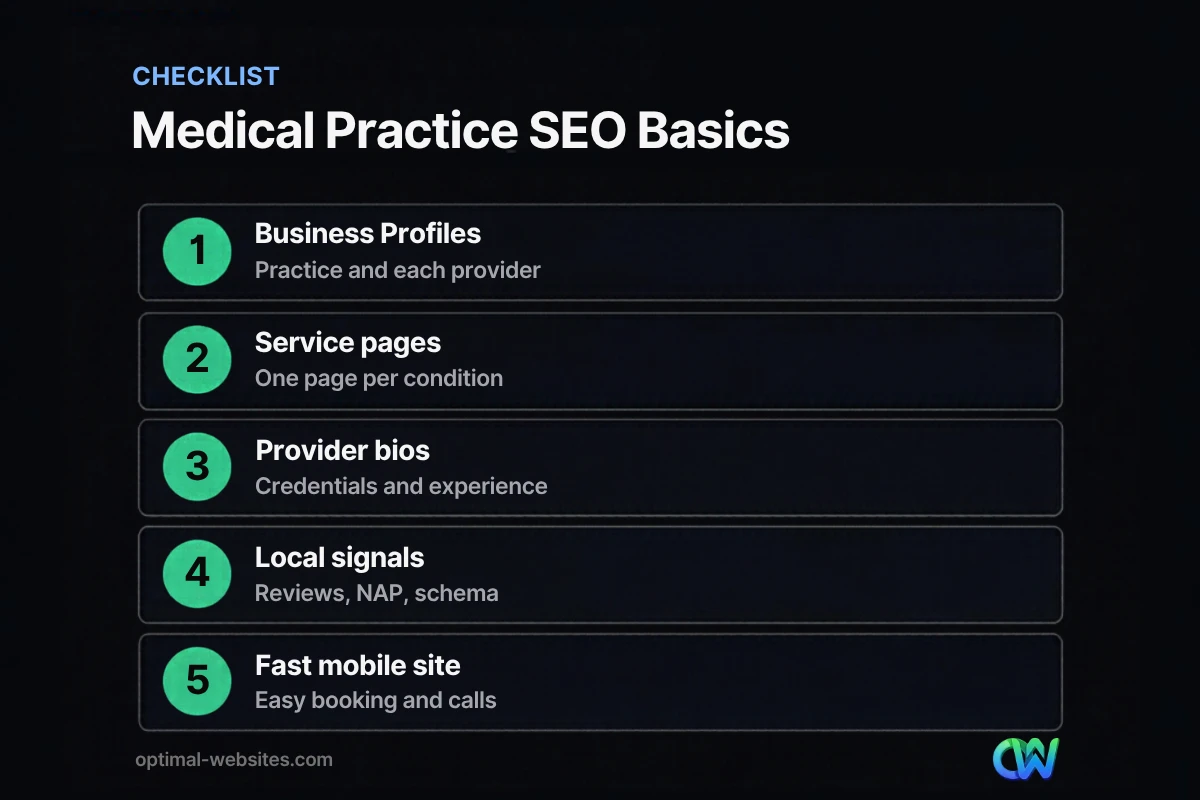
Quick answer: Medical practice SEO is the work of helping new patients find your clinic when they search Google for a condition, treatment or doctor near them. Start with accurate Google Business Profiles for the practice and each provider, clear service pages, detailed provider bios, steady reviews and a fast, mobile-friendly site with easy booking.
Most new patients start with a search. They type a symptom, a treatment or “doctor near me,” compare a few results and call the practice that looks trustworthy and easy to book. If your clinic does not appear, or looks thin next to the practice down the road, those appointments go elsewhere. Medical practice SEO closes that gap. This guide explains how search works for healthcare, what Google looks for in medical content, the local signals that put you on the map and a practical order of work for busy practice managers who do not have time to become SEO experts.
Key Takeaways
- Healthcare search is mostly local. Your Google Business Profile and local signals matter as much as your website.
- Google holds health content to a higher standard. Show who wrote it, their credentials and when it was reviewed.
- Build one clear page per service or condition you treat, written for patients, not for other doctors.
- Reviews, consistent contact details and schema markup help Google trust and understand your practice.
- Make booking simple on mobile. Ranking only helps if patients can call or schedule in a few taps.
What is medical practice SEO?
Medical practice SEO is search engine optimization for clinics, private practices and healthcare providers. It covers your website, your Google Business Profiles and the signals around them so that patients nearby find you for the services you offer.
It differs from general SEO for small business in two ways. First, most healthcare searches have local intent, so map results matter a great deal. Second, health topics fall into what Google calls “Your Money or Your Life” content, where accuracy and trust carry extra weight.
Healthcare SEO vs paid ads
Ads put you at the top of results today and stop the moment you stop paying. Healthcare SEO builds visibility that keeps working, but it takes months. Most practices do best with a strong organic and local foundation and, when needed, targeted ads for high-value services.
How does Google judge medical and health content?
Google gives extra weight to experience, expertise, authoritativeness and trust for health topics. Its guidance on helpful, reliable content says that for topics affecting people’s health, content should be highly accurate and consistent with expert consensus, and that trust matters most.
In practice, that means:
- Show who wrote or reviewed the page. Add a byline or “medically reviewed by” line linked to a provider bio.
- Show credentials. Board certifications, training, years in practice and hospital affiliations belong on provider pages.
- Keep content current. Add a review date and update pages when guidance or your services change.
- Write for patients. Explain symptoms, treatment options and what a visit looks like in plain language.
- Avoid promises. Never guarantee results or make claims you could not defend to a licensing board.
Doctor SEO starts with provider pages
Patients often search for a specific doctor by name, especially after a referral. Each provider should have a dedicated page with a professional photo, credentials, specialties, languages spoken, locations and a booking link. These pages support doctor SEO and help Google connect each provider to your practice.
How do local signals affect medical local SEO?
Local results are shaped by relevance, distance and prominence, according to Google’s explanation of how Google ranks local results. You cannot change distance, but you can improve relevance and prominence with complete profiles, reviews and a strong website.
Set up Business Profiles the right way
Healthcare has specific rules. The Google Business Profile guidelines say public-facing practitioners, such as doctors, may have their own profiles, separate from the practice. When several practitioners share one location, the practice gets its own profile and each practitioner’s profile uses only their own name.
Getting this right helps patients searching for a practice and for a specific doctor. Use the most specific primary category that describes the practice, keep hours accurate (including holidays) and add services and photos of the real office.
Build reviews steadily
Prominence depends partly on reviews. Ask every satisfied patient through a simple text or email after the visit, and reply to reviews professionally. Never confirm that a reviewer is a patient or discuss their care in a reply, since that can create privacy problems. A short, general thank-you is safer.
Keep your contact details consistent
Your practice name, address and phone number should match on your website, Google Business Profile, insurance directories and health listing sites. Inconsistent details confuse both patients and search engines.
Add structured data
Schema markup tells search engines your practice type, address, hours and phone in a format they can read. Our guide to local business schema explains which properties to include and how to test them.
Which pages does a medical practice website need for SEO?
A practice website needs one focused page for each main service or condition, a page for each provider and a page for each location. Those pages give Google clear topics to rank and give patients clear answers.
| Page type | What it should include | Why it matters for SEO |
|---|---|---|
| Service or condition page | Symptoms, treatments, what to expect, FAQs, booking link | Matches specific patient searches |
| Provider page | Photo, credentials, specialties, locations | Captures name searches and builds trust |
| Location page | Address, map, hours, parking, insurance notes | Supports local and “near me” searches |
| New patient page | Forms, insurance accepted, first-visit steps | Answers pre-booking questions |
| Blog or patient education | Answers to common questions, reviewed by a provider | Builds topical authority over time |
If you are planning a new site or a rebuild, our guide to medical practice website design covers layout, booking and accessibility in more detail.
What technical issues hold back healthcare SEO?
The most common technical problems on practice websites are slow mobile pages, booking tools that send patients off-site in confusing ways, missing page titles and duplicate location pages. Each one makes it harder to rank and harder to convert.
- Speed on phones. Large images and heavy plugins slow pages down. Compress images and keep the theme lean.
- Clear titles and headings. Each page should have a unique title that names the service and city.
- No thin location pages. Do not clone the same text across locations with only the city changed. Add real details for each office.
- Secure forms. Use HTTPS everywhere and choose form and booking tools that meet your privacy and HIPAA obligations. Check with your compliance advisor before adding tracking scripts to appointment pages.
- Accessibility. Readable text, good contrast and labeled form fields help every patient, including older adults and people using screen readers.
How long does medical practice SEO take to work?
Most practices see early movement in local results within a few months, while competitive service terms can take six months or longer. Speed depends on competition in your area, how much content you already have and how many reviews you collect.
Track progress with three numbers: calls and bookings from Google Business Profile, organic visits to service pages and form submissions or booking clicks. Rankings matter, but patient acquisition is the number that pays the bills.
What we see when building practice websites
On the WordPress and Elementor Pro sites we build for healthcare and other local service businesses, the quickest wins usually come from fixing the basics: one clear page per service, a visible phone number and booking button on every mobile screen, and Business Profiles that match the website. Fancy features rarely beat those fundamentals.
Should you do medical practice SEO in-house or hire help?
You can handle the basics in-house: claim profiles, ask for reviews and keep hours updated. Hiring help makes sense for technical setup, content planning and ongoing work when your team is already stretched with patient care.
If you hire, look for a provider who explains what they will do each month, reports on calls and bookings, and never promises a guaranteed number one ranking.
How Optimal Websites Can Help
Optimal Websites, a WordPress web design agency based in Delaware, builds fast, mobile-first sites for healthcare and local service businesses and sets them up for search from launch. We can structure your service, provider and location pages, add schema and connect your site to Google Search Console and Analytics.
Learn more about our SEO services for local businesses, or see our package pricing for new practice websites, which start at $999.
Frequently Asked Questions
What is medical practice SEO?
Medical practice SEO is the process of improving a clinic’s visibility in Google search and Maps so new patients can find it. It includes Google Business Profile setup, service and provider pages, local signals like reviews, technical fixes for speed and mobile use, and content that meets Google’s higher standards for health information and trust.
How do doctors get more patients from Google?
Doctors get more patients from Google by keeping complete Business Profiles for the practice and each provider, publishing clear pages for the services they offer, collecting steady reviews and making booking easy on phones. Doctor SEO also benefits from detailed provider bios with credentials, specialties and locations, which help patients searching by name.
Is SEO worth it for a small medical practice?
Yes, for most practices SEO is worth it because patients search before they book, and local results drive calls. A small practice can compete well in its own area by focusing on medical local SEO, accurate profiles and strong service pages. The investment keeps working over time, unlike ads that stop when spending stops.
How long does healthcare SEO take?
Healthcare SEO usually shows early local gains within a few months, while competitive terms in larger cities can take six months or more. Results depend on competition, existing content, review volume and technical health. Measure progress by calls, bookings and form submissions, not only rankings, so you can see real patient acquisition.
Should each doctor have a Google Business Profile?
Public-facing practitioners who see patients directly can have their own Google Business Profile, separate from the practice. Google’s guidelines say each practitioner profile should use only the practitioner’s name when several work at one location. Support staff should not have profiles. Setting this up correctly helps patients searching for a specific doctor.
Can patient reviews create HIPAA problems?
Reviews themselves are fine, but replies can create problems if they confirm someone is a patient or mention their care. Keep responses short, polite and general, and move any specific discussion offline. Ask your compliance advisor to review your reply process, and train staff so every response protects patient privacy.
Ready to Get Started?
Want more new patients to find your practice online? Get a free quote or call (302) 554-9497 to talk through your website and local search setup.


