
Quick answer: In the one page vs multi page website decision, a one-page site suits a single offer, an event or a brand-new business that needs to launch fast. A multi-page site suits almost every local service business, because separate pages for each service and location can rank for more searches and answer customers’ questions in more depth.
When you plan a new website, one of the first decisions is structure. Should everything live on one long scrolling page, or should you build separate pages for services, about, reviews and contact? The choice affects how many searches you can show up for, how quickly you can launch and how easily the site can grow with your business. Pick wrong and you may end up rebuilding within a year. This guide compares the one page vs multi page website options on SEO, cost, speed and lead generation, explains when each one makes sense, and offers a practical middle path many small businesses use.
Key Takeaways
- A one-page website puts all content on a single scrolling page, with menu links that jump to sections.
- A multi-page website gives each topic (each service, area or audience) its own URL that can rank on its own.
- One-page sites are faster to launch and cheaper, but they struggle to rank for more than one main topic.
- Most local service businesses get more leads from a multi-page structure built around services and locations.
- You can start small and grow: a focused multi-page site with five to eight pages is often the sweet spot.
What is a one-page website?
A one-page website (also called a single page website) is a site where all the main content sits on one long page. The navigation menu scrolls the visitor down to sections such as Services, About, Testimonials and Contact instead of loading new pages.
One-page sites became popular because they feel modern, tell a story in order and work well on phones, where people are used to scrolling. They are common for events, product launches, personal portfolios, apps and businesses with one simple offer.
What is a multi-page website?
A multi-page website is a site with separate pages, each with its own URL, for different topics. A typical small business version includes a homepage, one page per service, an about page, a reviews or portfolio page, a contact page and often a blog.
Each page can focus on one subject in depth, have its own title and description in search results, and be linked from other pages and other websites. That makes multi-page sites the default for businesses that rely on search traffic. For a full list of what those pages should include, see our guide on what a business website needs.
One page vs multi page website: how do they compare?
The short version: one-page sites win on speed to launch and simplicity, while multi-page sites win on SEO, depth and growth. Here is how they compare on the points that matter most to a small business.
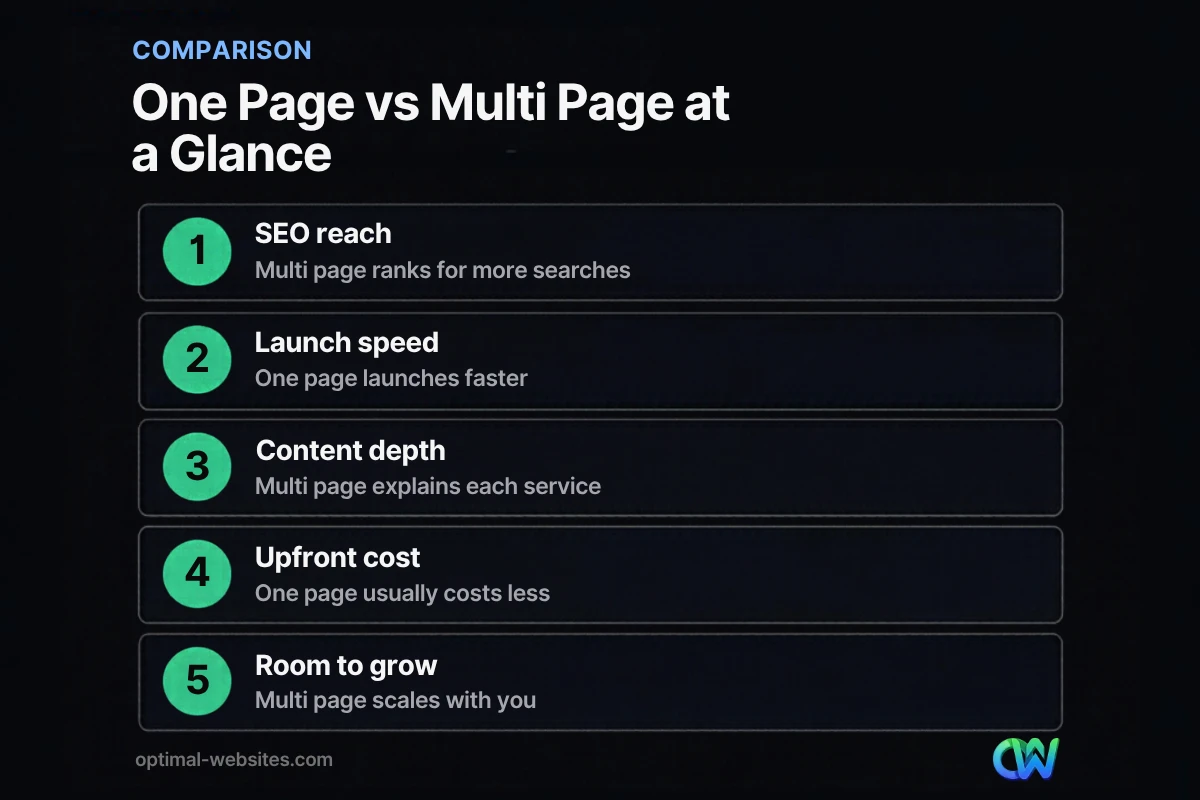
| Factor | One-page website | Multi-page website |
|---|---|---|
| Search visibility | Usually ranks for one main topic | Each page can rank for its own topic |
| Content depth | Limited; long pages get skimmed | Room to explain each service fully |
| Launch time | Fastest | Longer, depends on page count |
| Upfront cost | Lower | Higher, scales with pages |
| Analytics | Harder to see which section drove a lead | Clear page-level data |
| Growth | Gets crowded as you add services | Add new pages without redesigning |
| Best for | Events, single offers, startups testing an idea | Local service businesses, multi-service companies |
Do one-page websites hurt SEO?
One-page websites do not hurt SEO by default, but they limit it. A single URL can have one title tag, one meta description and one main topic. If you offer roof repair, roof replacement and gutter installation, one page cannot compete well for all three searches against competitors with a dedicated page for each.
There is also a technical limit. One-page menus usually link to sections with anchors like “#services.” Google’s URL structure guidance notes that Google Search generally does not support URL fragments, so those sections are not separate pages in Google’s eyes. All the content is judged as one document.
Do people really scroll long pages?
People do scroll, but their attention drops the further they go. Nielsen Norman Group eyetracking research found that 57% of page-viewing time was spent above the fold and 74% within the first two screenfuls. On a long one-page site, the content near the bottom, often your contact form, gets the least attention unless you repeat calls to action along the way.
When does a one-page website make sense?
A one-page website makes sense when you have one clear offer, little content and a need to launch quickly. It is a smart, focused choice in the right situation.
Good fits for a one-page site:
- A brand-new business that needs a credible web presence while services are still being defined
- A single product, event or campaign with one call to action
- A personal brand, speaker or portfolio site
- A business that gets nearly all its customers from referrals, not search
- A temporary site while a larger multi-page build is planned
If your goal is one action from paid traffic, consider a dedicated landing page instead. Our guide to landing page design explains the difference and how to make one convert.
When is a multi-page website the better choice?
A multi-page website is the better choice when you offer more than one service, serve more than one area or want customers to find you through Google. For most local service businesses, that covers almost everyone.
Choose multi-page if:
- You offer several services that people search for separately
- You serve multiple towns and want to rank in each one
- Customers need detailed information before they call (pricing factors, process, credentials)
- You plan to publish blog posts or case studies
- You want clear analytics on which services bring in leads
What we see with local service businesses
Most of the sites we build for roofing companies, construction firms, law firms and other local businesses are multi-page. A law firm that handles personal injury, family law and estate planning needs a page for each practice area, because each one answers different questions for a different client. The same goes for a contractor with separate residential and commercial services. We build these sites on WordPress with Elementor Pro, using one consistent template for every service page so adding a new service later takes minutes, not a redesign.
Is there a middle ground?
Yes. Many small businesses start with a lean multi-page site: a strong homepage that summarizes everything, plus a handful of focused pages for the most important services. That gives you the scannable, story-like homepage people like about one-page sites, and the separate URLs Google needs.
A typical lean structure looks like this:
- Homepage: a short overview of every service, proof (reviews, logos of certifications) and a clear call to action
- Two to four service pages: one for each service people search for separately
- About page: your story, team and credentials
- Reviews or portfolio page: real projects and testimonials
- Contact page: form, phone, address or service area, and hours
You can add location pages and a blog later as the business grows. Our article on homepage design best practices shows how to make that homepage do the heavy lifting.
How much does each option cost?
A one-page site usually costs less because there is less content, design and testing involved. A multi-page site costs more upfront, and the price rises with the number of unique page layouts and the amount of copy needed.
The more important number is the cost of rebuilding. Many owners start with a one-page site to save money, then pay again a year later to restructure it once they realize they are not showing up for their main services. If search traffic matters to your business, planning for a lean multi-page structure from day one is usually cheaper over time.
How Optimal Websites Can Help
Optimal Websites, a WordPress web design agency based in Delaware, helps owners choose the right structure before a single page is designed. We map your services, service areas and customer questions, then recommend the smallest site that can do the job, whether that is a focused one-page site or a lean multi-page build. Our web design services cover planning, mobile-first design in Elementor Pro and launch, usually in 2–4 weeks. You can compare our website packages and pricing, which start at $999.
Frequently Asked Questions
Is a one-page website good for SEO?
A one-page website can rank for one main topic, but it is limited compared with a multi-page site. It has only one title tag and one URL, and Google generally treats anchor sections as part of the same page. If you offer several services or serve several towns, a multi-page structure gives you more chances to rank.
Which is better for a small business, one page or multi page?
For most local service businesses, a multi-page website is better because each service and location can have its own page that ranks and answers specific questions. A one-page website suits a new business, a single offer or a company that relies on referrals rather than search. Many owners choose a lean multi-page site as a middle ground.
How many pages should a small business website have?
Many small business websites work well with five to eight pages: a homepage, one page per main service, an about page, a reviews or portfolio page and a contact page. Add location pages if you serve several areas and a blog if you plan to publish regularly. Quality and focus matter more than page count.
Can I convert a one-page website into a multi-page website later?
Yes. You can split each section into its own page, expand the content and redirect any old URLs if needed. It is easier when the original site was built on a flexible platform like WordPress. Planning the multi-page structure from the start avoids paying for a second round of design and content work.
Are single page websites faster?
Not always. A single page website loads fewer separate pages, but that one page often carries every image, video and script, which can make it heavy. A well-built multi-page site loads only what each page needs. Speed depends more on images, hosting and code quality than on page count.
What are the main one-page site pros and cons?
The pros of a one-page site are a lower cost, faster launch, simple navigation and a clear story that works well on phones. The cons are limited SEO reach, less room for detail, weaker page-level analytics and a layout that gets crowded as you add services. It works best for a single, focused offer.
Ready to Get Started?
Not sure which structure fits your business? Request a free quote or call (302) 554-9497 and we will recommend the right setup for your goals and budget.


