
Quick answer: Good law firm website design builds trust before a prospective client ever calls. It clearly shows the practice areas you handle and where, introduces attorneys with real credentials and photos, answers common legal questions in plain language, follows your state’s attorney advertising rules and makes it easy to request a consultation by phone, form or booking.
People rarely visit a law firm’s website casually. They are dealing with an injury, a divorce, a business dispute, an estate or a criminal charge, and they are deciding who to trust with something that matters. Before they call, most will compare a few firms online. The firm whose website feels clear, credible and approachable usually gets the first conversation. That is the job of law firm website design. This guide covers what prospective clients look for, the pages every firm needs, how to write attorney bios and practice area pages, the ethics and accessibility points to keep in mind, and the intake features that turn visitors into consultations.
Key Takeaways
- Prospective clients look for relevant practice areas, attorney credentials, clear explanations and an easy way to reach the firm.
- Each practice area deserves its own detailed page written for clients, not other lawyers.
- Attorney bios with real photos and specific experience are among the most persuasive pages on a law firm site.
- Legal topics are “Your Money or Your Life” content in Google’s terms, so accuracy and clear authorship matter.
- Follow your state bar’s advertising rules for testimonials, results and specialization claims.
What do prospective clients look for on a law firm website?
Prospective clients look for four things on a law firm website: proof that you handle their type of problem, evidence that your attorneys are qualified, a sense of what working with you will be like, and a simple way to get in touch. If any of those is hard to find, they move on to the next firm.
Behind those checks are very human questions:
- “Do they handle cases like mine?” Clear practice area navigation and specific descriptions.
- “Are they qualified?” Bar admissions, education, years of practice, professional memberships.
- “Will they understand me?” Plain language, a calm tone, real photos of the team.
- “What happens next, and what will it cost?” Consultation details, fee structure basics and a clear process.
- “How do I reach them?” A visible phone number, a short form and office details.
Nielsen Norman Group’s research on web credibility points to design quality, upfront disclosure of key information, comprehensive and current content, and connections to the wider web as signals people use to judge trustworthiness. For a law firm, those signals carry extra weight.
Which pages should law firm website design include?
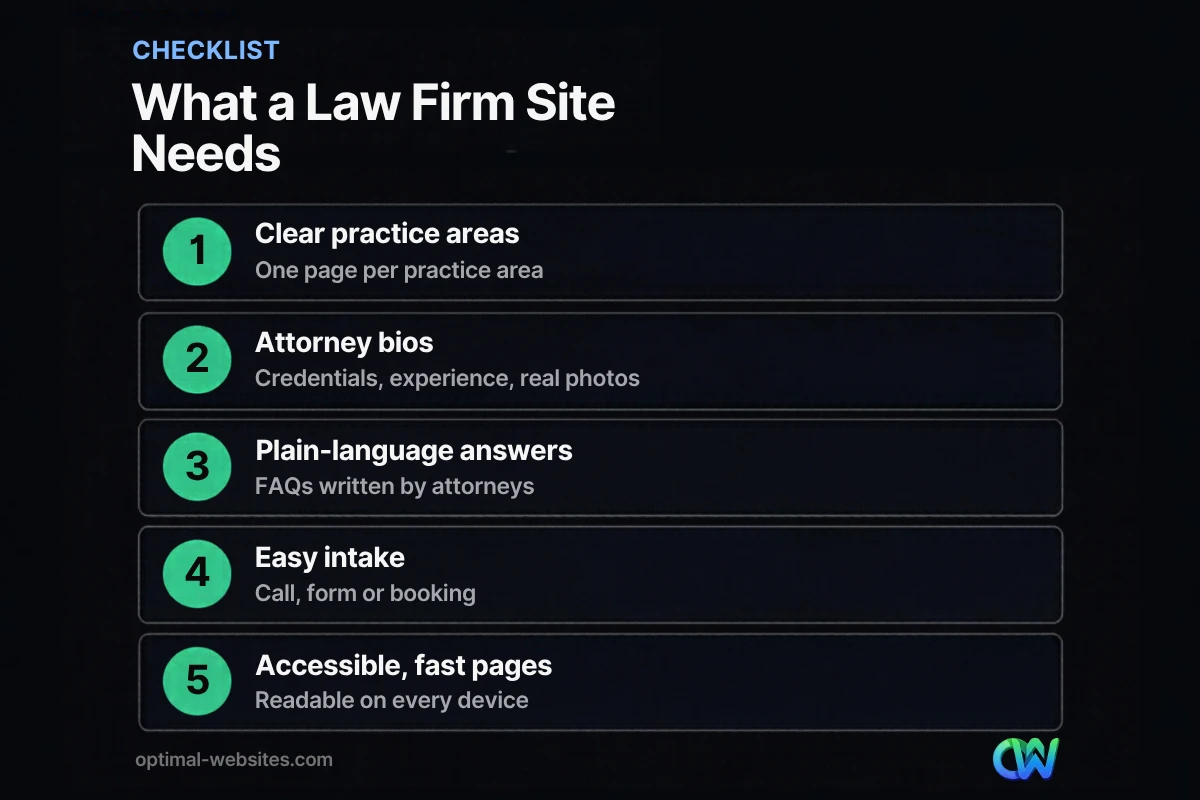
Law firm website design should include a homepage, one page for each practice area, attorney bio pages, an about page, a contact page with intake form, and resources such as FAQs or articles. Firms serving several cities often add location pages.
| Page | Purpose | Include |
|---|---|---|
| Homepage | Orient visitors quickly | Practice areas, location, attorneys, consultation call to action |
| Practice area pages | Show depth in each area | Who you help, common situations, process, FAQs |
| Attorney bios | Build personal trust | Photo, education, bar admissions, experience, focus areas |
| About the firm | Explain your approach | History, values, community involvement |
| Contact and intake | Convert | Phone, form, office address, hours, map |
| Resources or blog | Answer questions | Plain-language articles and FAQs written or reviewed by attorneys |
| Locations | Serve local searches | Office details and the communities you serve |
For the general list of pages every business site should have, see essential pages every business website needs. The sections below focus on what is specific to legal websites.
How should a law firm homepage be designed?
A law firm homepage should tell visitors within seconds what kinds of cases you handle, where you practice and how to start a conversation. It is a guide that routes each visitor to the right practice area or attorney.
A structure that works well for many firms:
- A headline naming your practice focus and location, with a consultation button and phone number.
- Practice area tiles linking to each detailed page.
- A short statement about your approach to clients.
- Attorney photos linking to bios.
- Credentials and memberships, presented accurately.
- A plain explanation of how a consultation works.
- A final call to action and contact details.
Our homepage design best practices cover layout and hierarchy in more depth.
How do you write practice area pages for a lawyer website?
Write practice area pages for a lawyer website in plain language for the person facing the problem, not for other attorneys. Explain the situations you handle, what the process typically involves and what the visitor should do next.
A strong practice area page usually covers:
- Who the page is for, such as business owners in a contract dispute or families planning an estate.
- Common situations and questions in that area.
- What working with the firm looks like, step by step.
- Important considerations or deadlines, explained generally and accurately.
- Frequently asked questions written or reviewed by an attorney.
- A clear consultation call to action.
Why accuracy and authorship matter for legal content
Legal topics fall into what Google calls “Your Money or Your Life” content. Google’s guidance on helpful, reliable content explains that for these topics, content should be highly accurate and consistent with established expert consensus, and that showing who created content, with bylines where readers expect them, helps build trust. Name the attorney who wrote or reviewed each article, link to their bio and keep content up to date as laws change.
What makes a strong attorney bio?
A strong attorney bio combines a professional, approachable photo with specific credentials and a clear description of the attorney’s focus and approach. Bios matter because clients are hiring people, not a logo.
Include:
- A recent, high-quality photo taken for the site, not a cropped group shot.
- Practice focus and the types of clients served.
- Education, bar admissions and court admissions.
- Professional memberships, publications and speaking, if relevant.
- A short personal note that helps visitors relate.
- A direct way to contact or schedule with that attorney.
What ethics rules affect attorney website design?
Attorney website design must follow the advertising and communication rules of each state bar where the firm practices. Many states regulate how firms present testimonials, case results, endorsements and claims of specialization, and some require disclaimers.
Practical steps for legal website design:
- Review testimonials and case results with your state’s rules before publishing, and add any required disclaimers.
- Avoid claims such as “expert” or “specialist” unless your state permits them for your certification.
- Make clear that website content is general information, not legal advice.
- Be careful that contact forms do not create the impression of an attorney-client relationship before conflicts are checked.
Your firm, not your web designer, is responsible for compliance, so build a review step into the publishing process.
Why does accessibility matter for law firm web design?
Accessibility matters for law firm web design because people with disabilities need legal help too, and a site they cannot use is a barrier to representation. Accessible design also tends to make a site clearer and easier for everyone.
WCAG 2.2, the W3C’s Web Content Accessibility Guidelines, is the widely used standard. Practical basics include:
- Sufficient color contrast between text and background.
- Descriptive alt text for meaningful images.
- Forms with visible labels and clear error messages.
- Full keyboard navigation and visible focus states.
- Headings used in a logical order.
- Captions for videos.
How do law firm websites turn visitors into consultations?
Law firm websites turn visitors into consultations by making contact easy, reassuring and private. Visitors are often anxious, so clarity about what happens next matters as much as the button itself.
- Keep a phone number and “Request a Consultation” button visible on every page, including a click-to-call button on phones.
- Use a short intake form: name, contact details, practice area and a brief, optional description.
- Explain how quickly someone will respond and whether the first consultation is free or paid.
- Offer online booking if your intake process supports it.
- Route each inquiry to the right person immediately and follow up quickly.
For firms that rely on local clients, pair the website with a strong Google Business Profile and local signals; our local SEO starter plan explains the essentials.
What we see building websites for law firms
Optimal Websites, a WordPress web design agency based in Delaware, has built websites for law firms including Wright Ryon & Maher and F. J. Collins Law, both featured among the law firms in our portfolio. In legal projects, the content work matters as much as the design: clear practice area pages, accurate attorney bios and a calm, professional tone. Firms that have their attorney photos and bio details ready before kickoff tend to move through the project much faster.
How Optimal Websites Can Help
We build law firm websites on WordPress with Elementor Pro, with practice area pages, attorney bios, accessible layouts and intake forms designed for phones first. Our WordPress web design for law firms includes training so your team can update bios and publish articles. The same standards behind every professional small business website we build apply here, adapted for the trust and compliance needs of legal practices.
Frequently Asked Questions
What makes good law firm website design?
Good law firm website design makes it easy for prospective clients to confirm you handle their type of case, see attorney credentials, understand the process and request a consultation. It uses plain language, real photos, detailed practice area pages and accessible, mobile-friendly layouts, and it follows the state bar’s advertising rules for testimonials and claims.
What pages should a lawyer website have?
A lawyer website should have a homepage, a separate page for each practice area, individual attorney bios, an about page, a contact page with an intake form, and resources such as FAQs or articles. Firms with multiple offices often add location pages. Each page should answer one set of client questions clearly.
How much does attorney website design cost?
Attorney website design cost depends on the number of practice areas, attorneys, locations and features such as online booking. At Optimal Websites, professional WordPress packages start at $999, $1,499 and $1,999, and most projects launch in 2–4 weeks. Ongoing costs include hosting, domain renewal and maintenance.
Can law firms show client testimonials on their website?
Many law firms can show testimonials, but the rules vary by state. Some state bars require disclaimers or restrict how testimonials and case results are presented. Review your state’s attorney advertising rules before publishing, and make sure every testimonial is genuine and that the client has agreed to share it.
Should a law firm website have a blog?
A blog or resource section helps many law firms answer common questions, show expertise and attract search traffic from people researching legal problems. Because legal topics affect people’s lives, articles should be accurate, written or reviewed by an attorney, clearly attributed and updated as laws change. Quality matters more than frequency.
Does legal website design need to be accessible?
Yes. Legal website design should be accessible so people with disabilities can find information and contact the firm. Following WCAG 2.2 guidelines, such as sufficient contrast, labeled forms, keyboard navigation and alt text, makes the site usable for more people and generally improves clarity for every visitor as well.
Ready to Get Started?
Ready for a law firm website that builds trust before the first call? Request a free quote or call (302) 554-9497 to talk about your practice.


