
Last updated: October 15, 2026
Quick answer: A digital marketing strategy for small business is a written plan that ties online marketing to revenue. Set measurable goals, define your ideal customer, make your website fast and clear, focus on two or three channels, split your budget between proven and test channels, and review a short list of KPIs every month.
Most small business owners do not have a marketing problem. They have a focus problem. Money goes into a boosted post one month, a directory listing the next, and a new logo after that, with no way to tell what actually brought in a customer. A clear digital marketing strategy for small business fixes that by connecting every dollar and hour to a business result you can measure. This guide gives you a seven-step framework, a channel and budget table you can fill in with your own numbers, and the KPIs worth tracking. It works whether you are a roofer, a law firm, or a startup founder.
Key Takeaways
- A marketing strategy starts with revenue goals, not with channels or tools.
- Your website is the headquarters for every channel, so fix speed, clarity, and calls to action first.
- Pick two or three channels your customers actually use and do them well before adding more.
- Split your budget into proven, growth, and experimental money, and move funds based on results.
- Track leads and revenue, not just traffic, and review your numbers every month.
What Is a Digital Marketing Strategy for Small Business?
A digital marketing strategy is a plan that defines who you want to reach online, which channels you will use to reach them, how much you will spend, and how you will measure success. It turns “we should do more marketing” into specific actions with owners and deadlines.
The U.S. Small Business Administration describes a marketing plan as the set of actions you take to persuade potential customers to buy. In the SBA’s guide to writing a marketing plan, it recommends covering your target market, competitive advantage, sales process, goals, budget, and how you will measure return. A digital strategy applies the same thinking to your website, search, social, email, and ads.
Tactics like posting on Instagram or running Google Ads are only useful when they serve a goal you have already agreed on.
How Do You Build a Digital Marketing Strategy Step by Step?
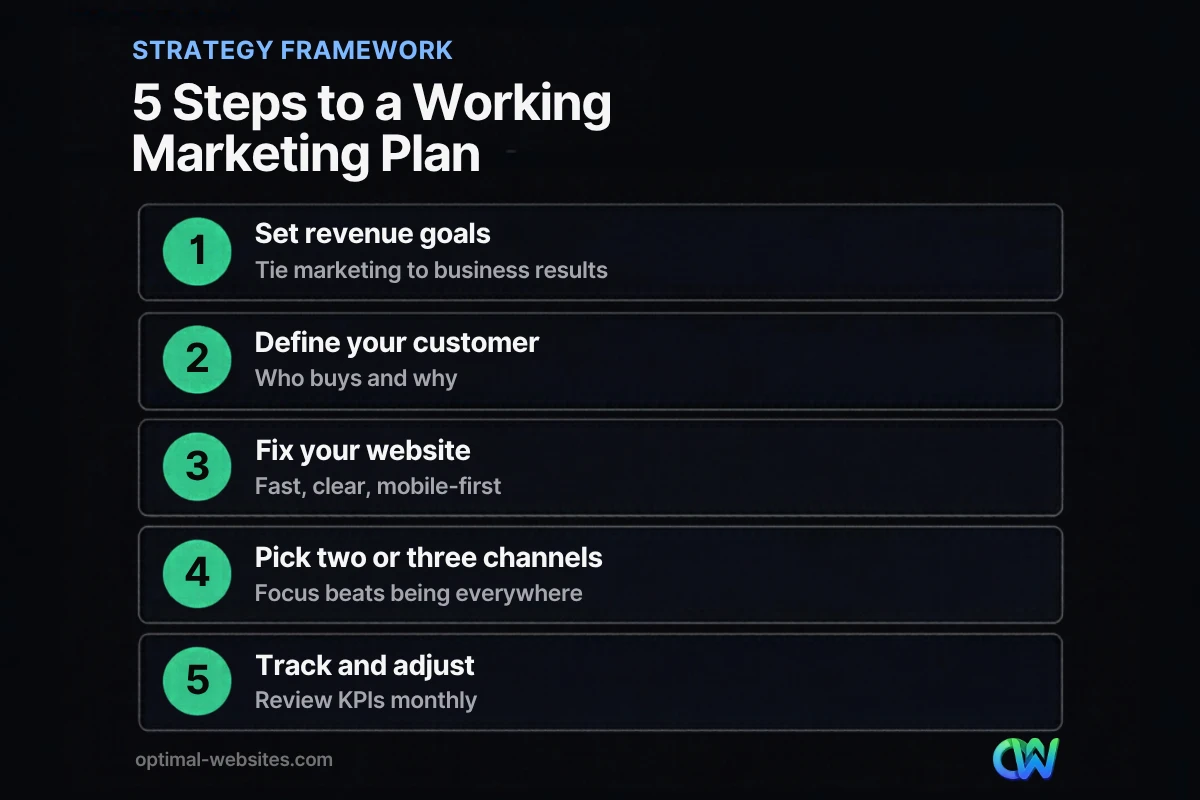
Build it in seven steps: set goals, define your customer, review what worked before, fix your website, choose channels, set a budget, and track results. Each step feeds the next, so do them in order the first time.
Step 1: Set goals tied to revenue
A successful strategy is not about traffic or page views on their own. Link your plan to business results such as more qualified leads, a shorter sales cycle, higher sales, or better customer retention.
Write goals you can measure. “Get more customers” is a wish. “Book 10 more estimate appointments per month from the website by June” is a goal. Decide whether this year is about growth in revenue, launching a new service, or building awareness in a new service area, because each one points to different channels.
Step 2: Define your ideal customer and their next action
Create a simple buyer profile for each type of customer you want more of. Note who they are, what problem sends them searching, what questions they ask, and what makes them hesitate.
Then decide what action you want them to take. For a contractor it might be a quote request or a phone call. For a law firm it might be a consultation form. Knowing the target action keeps your messaging simple and your website focused.
Also consider where each person is in the buying journey. Someone comparing options needs different content than someone ready to call today.
Step 3: Learn from what you have already tried
Before you plan new spending, list what you spent on each channel over the last year and what it produced. Look for money that drained into campaigns with no leads or sales.
Look just as hard for channels that were underfunded but performed well. Those are often your best opportunities. If you have never tracked this, start now so next year’s plan is built on real data.
Step 4: Make your website the headquarters
Every channel sends people to your website, so it needs to be ready before you turn up the traffic. A slow, confusing site wastes every dollar you spend on ads and social.
Check four areas:
- Structure. Pages and menus should follow a clear, logical hierarchy so visitors and search engines understand what you offer.
- Speed. Page speed is how quickly your pages load and respond. Slow pages lose visitors before they read a word.
- Design. Keep layouts, fonts, and colors consistent, with a clear call to action on every page.
- Message. Within a few seconds, a visitor should know what you do, who you help, and how to contact you.
Mobile matters more than ever. Pew Research Center’s mobile fact sheet reports that 91% of U.S. adults own a smartphone (survey fielded in 2025, published November 2025). At Optimal Websites we design every WordPress site mobile-first in Elementor Pro, because for many local service businesses the phone is where the first visit and the first call happen.
Step 5: Choose two or three channels
Different channels reach different people, so pick the ones your customers actually use. You do not need to be everywhere. You need to be visible where your buyers look when they are ready to act.
Buyers often check several sources before they choose a business: search results, reviews, social profiles, and your website. That is why consistency across a few channels beats a thin presence on ten.
Step 6: Build a budget you can adjust
Write down every cost: ad spend, software, content, design, and any outside help. The SBA advises a complete breakdown of the costs in your plan and comparing those costs against the revenue they generate.
A useful starting point is the 70/20/10 approach. Put most of your budget into channels you know work, a smaller share into growing channels, and a small slice into experiments. Even a failed experiment teaches you something about your audience.
Step 7: Track, review, and adjust
A budget is not something you set and forget. Paid search and social ads need frequent review, while SEO and content need patience and a longer view.
Review your KPIs monthly. If something is not working, change one thing, measure again, and repeat.
Which Marketing Channels Should a Small Business Use?
Start with your website, search, and Google Business Profile, then add paid ads, email, or social based on your goals and customers. The table below shows how each channel typically fits. Fill in the budget column with your own numbers; there is no universal right amount.
| Channel | Best for | Speed to results | Budget type | Your monthly budget |
|---|---|---|---|---|
| Website and conversion fixes | Turning existing traffic into leads | Fast once live | Proven (70%) | $____ |
| SEO and content | Long-term organic traffic and trust | Slow, builds over months | Proven or growth | $____ |
| Google Business Profile and reviews | Local searches and calls | Moderate | Proven (often low cost) | $____ |
| Paid search ads | Buyers searching right now | Fast, stops when spend stops | Proven or growth | $____ |
| Social media | Awareness, referrals, community | Moderate | Growth (20%) | $____ |
| Email marketing | Repeat customers and follow-up | Moderate | Growth | $____ |
| New platforms or formats | Testing new audiences | Unknown | Experimental (10%) | $____ |
Content and SEO: the slow drip
Content marketing means creating useful material, such as blog posts and guides, that answers your customers’ questions. Over time it builds trust and search visibility. Google’s SEO Starter Guide recommends helpful, reliable, people-first content and notes that some changes can take several months to show an effect. For a deeper walkthrough, see our guide to SEO basics for small business owners.
Paid ads: the garden hose
Think of content as drip irrigation and paid ads as a garden hose you can turn on and off. Ads bring targeted traffic quickly and teach you how your audience behaves on your site.
Local listings and reviews
For local businesses, your Google Business Profile is often the first thing a customer sees. Keep your name, address, phone, hours, and services accurate everywhere you are listed. Our guide to optimizing your Google Business Profile covers the details.
Social media and email
Use social media to promote your content, show your work, and stay visible to past customers. Email brings customers back and follows up with leads who were not ready yet.
What KPIs Should You Track for Digital Marketing?
Track the numbers that connect marketing to revenue: leads, conversion rate, cost per lead, and revenue per channel. Traffic and followers are useful signals, but they do not pay the bills.
A common mistake is measuring success by attention instead of sales. A post can get a lot of views and still produce zero customers. Focus on this short list:
- Leads by source: form submissions, calls, and chats, tagged by the channel that produced them.
- Website conversion rate: the percentage of visitors who take your target action.
- Cost per lead: total channel spend divided by leads from that channel.
- Customer acquisition cost: total marketing spend divided by new customers won.
- Lead-to-customer rate: how many leads actually become paying customers.
- Revenue per channel: sales you can trace back to each channel.
- Marketing ROI: revenue generated compared to what you spent to get it.
- Search visibility: clicks and impressions in Google Search Console.
- Page speed and Core Web Vitals: LCP, INP, and CLS, checked in PageSpeed Insights.
To calculate a simple marketing ROI, subtract marketing cost from the revenue it generated, then divide by the marketing cost. Some channels, like word of mouth, are hard to measure, so apply the same method consistently and compare channels against each other over time.
How Much Should a Small Business Spend on Digital Marketing?
There is no single right number. Base your budget on your revenue goals, what a new customer is worth to you, and what each channel has produced in the past.
Start by working backward. Estimate how many new customers you need, how many leads it takes to win one, and what you can afford to pay per lead while staying profitable. That gives you a budget grounded in your own numbers instead of a guess.
Plan for the full year and account for changes such as a new location, a new service, or seasonal busy periods. Forecasting keeps you from spending money you do not have.
Why Do Marketing and Website Teams Need to Work Together?
Marketing works best when the people creating campaigns and the people maintaining the website share the same goals. When they work separately, ads point to slow pages and new content never gets the technical care it needs.
In our experience building WordPress sites for contractors, construction firms, and law firms, the strongest results come when the website, messaging, and campaigns are planned together. Many owners play both roles, which makes a written plan even more valuable.
How Optimal Websites Can Help
Optimal Websites, a WordPress web design agency based in Delaware, builds fast, mobile-first, conversion-focused websites with Elementor Pro, then helps clients bring the right visitors to them. If search visibility is your priority, our SEO services for small businesses focus on on-page SEO, content, and local search. If you need more inquiries from the traffic you already have, our lead generation services concentrate on forms, calls to action, and landing pages. For ideas you can apply yourself, read our guide to turning more website visitors into leads.
If your strategy starts with a new website, compare our website packages and pricing. Packages start at $999, and most projects launch in 2–4 weeks.
Frequently Asked Questions
What is the best digital marketing strategy for small business?
The best digital marketing strategy for small business is the one tied to your revenue goals and your customers. For most local businesses, that means a fast, mobile-friendly website, solid SEO, an accurate Google Business Profile, and one or two additional channels such as paid search or email. Focus beats spreading a small budget across every platform at once.
How do I create a small business marketing plan?
Start by setting measurable goals and defining your ideal customer. Then review what worked in the past, fix your website, choose two or three channels, write a budget with every cost listed, and pick the KPIs you will track. The SBA recommends reviewing your marketing plan at least once a year and updating it as results come in.
What is the 70/20/10 rule in marketing?
The 70/20/10 rule is a budgeting approach that puts most of your money into channels you know work, a smaller share into newer or growing channels, and a small slice into experiments. It protects your proven lead sources while still giving you room to test new ideas and learn what your audience responds to.
How long does digital marketing take to work?
It depends on the channel. Paid ads can bring traffic as soon as they go live, while SEO and content usually take months to build momentum. Google’s own guidance notes that some search changes can take several months to show an effect. Plan for quick wins from ads and website fixes while long-term channels grow.
Which marketing KPIs matter most for a small business?
The KPIs that matter most connect marketing to revenue: leads by source, website conversion rate, cost per lead, customer acquisition cost, and revenue per channel. Traffic and social followers are useful signals, but a digital marketing strategy for small business should be judged on customers won and the return on what you spent.
Do I need a website before I start digital marketing?
Yes, in almost every case. Your website is where ads, search results, social posts, and emails send people, so it needs to load fast, work well on phones, and make it easy to call or request a quote. Sending paid traffic to a slow or confusing site wastes budget and makes every channel look worse than it is.
Ready to Get Started?
A clear plan and a website built to convert make every marketing dollar work harder. Tell us about your business and goals, and we will recommend where to start: request a free quote or call us at (302) 554-9497.


