Last updated: October 15, 2026
Quick answer: Website optimization is the ongoing work of making your site faster, easier to use on any device, easier for Google to understand, accessible, secure and better at turning visitors into leads. It matters because every improvement raises the value of the traffic you already have, so you get more calls, forms and sales without paying for more visitors.
You pay for traffic in some form: ads, SEO, social posts or the time it took to earn a referral. Website optimization decides what happens after that visitor arrives. A slow page or a contact form that breaks on mobile quietly throws that investment away. This guide explains why website optimization is important for revenue, covers the six areas that make up a well-optimized site, and shows you which free tools measure each one, so you can find your weakest spot and fix it first.
Key Takeaways
- Website optimization covers six connected areas: speed, mobile usability, SEO, user experience and conversion, accessibility, and security.
- Google uses Core Web Vitals in its ranking systems, but a perfect score alone will not carry a weak page to the top.
- Clear calls to action, short forms and visible phone numbers often pay off faster than chasing new traffic.
- Every area can be measured with free tools such as PageSpeed Insights, Google Search Console, GA4 and WAVE.
- Optimization is a routine, not a one-time project. Measure, fix, test and repeat.
What Is Website Optimization?
Website optimization is the process of improving how a website performs for both visitors and search engines, measured by speed, usability, visibility and conversions. It is not one setting or plugin; it is a set of habits applied across the whole site.
A conversion is any action you want a visitor to take: submitting a quote form, calling your office, booking a consultation or buying a product. Optimization removes whatever stands between a visitor and that action, and search engines reward many of the same improvements.
Why Is Website Optimization Important for Your Business?
Website optimization is important because it raises the return on every visitor you already attract. If a better page turns a few more monthly visitors into leads, that growth costs nothing extra in ads.
It protects the money you spend on traffic
Visitors who leave before the page loads, or who cannot find your phone number, are paid traffic wasted. Optimization plugs those leaks so your marketing budget works harder.
It helps you rank and get clicked
Google states plainly that Core Web Vitals “are used by our ranking systems,” according to Google’s page experience guidance. The same page also notes that good scores do not guarantee top rankings, because helpful content still comes first. Clear titles, useful meta descriptions and well-structured pages help you earn the click once you appear.
It builds trust before the first conversation
A homeowner comparing three roofers, or a client choosing between two law firms, judges credibility in seconds. A fast, polished, working site signals that you take details seriously.
It reduces risk and long-term cost
Optimized sites are easier to maintain and less likely to need an emergency rebuild. See the hidden costs of an outdated website.
What Does Website Optimization Include?
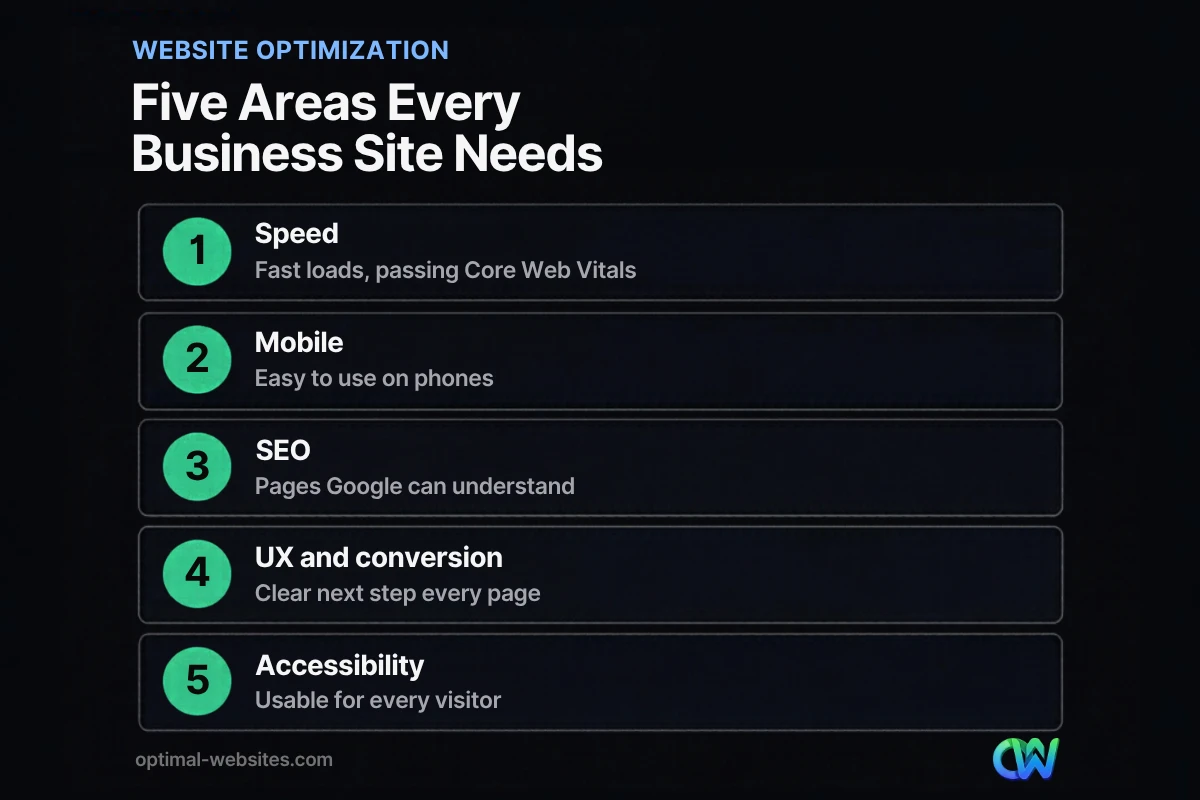
Website optimization includes six areas: speed, mobile usability, SEO, user experience and conversion, accessibility, and security. Each one affects the others, so a weak area can drag down the rest.
1. Speed and Core Web Vitals
Page speed is how quickly a page loads and responds to a visitor. Google measures it through Core Web Vitals: Largest Contentful Paint (LCP) for loading, Interaction to Next Paint (INP) for responsiveness, and Cumulative Layout Shift (CLS) for visual stability. INP replaced First Input Delay (FID) in March 2024. According to Google’s Core Web Vitals thresholds, a good experience means LCP of 2.5 seconds or less, INP of 200 milliseconds or less and CLS of 0.1 or less, measured at the 75th percentile of page loads.
The fixes (images, caching, hosting, scripts) are covered in our step-by-step guide to improving page speed.
2. Mobile usability
Google uses the mobile version of your pages for indexing and ranking, a practice it calls mobile-first indexing, and it recommends responsive design as the easiest pattern to maintain. Responsive design means one site that adapts its layout to any screen size. Mobile usability also means easy tap targets, readable text without zooming and a tap-to-call phone number. For a deeper checklist, see our article on optimizing your site for mobile search.
3. SEO fundamentals
On-page SEO is the work of helping search engines understand what each page is about. The basics still matter:
- Content that matches intent. Use the words your customers use and answer their real questions. Write for people first; they are the ones who convert.
- Descriptive title tags. Keep them concise so they display fully in search results, with the most important words first.
- Meta descriptions. A meta description is the short summary that often appears under your title in search results. A clear, specific one can improve your click-through rate.
- Clean, readable URLs. Short URLs with the main topic up front are easier for people and search engines to scan.
- Internal links. Links between related pages show search engines how your site is organized and give visitors a logical next page to read.
- Image alt text. Alt text describes an image for search engines and for people using screen readers, so it supports both SEO and accessibility.
4. User experience and conversion
Conversion rate optimization (CRO) is the practice of increasing the percentage of visitors who take a desired action. The basics are less about tricks and more about removing friction:
- Give every page one obvious next step, such as “Get a Free Quote” or “Call Now.”
- Keep navigation simple, with your main services reachable in one or two clicks.
- Shorten forms to the fields you truly need.
- Show proof near your calls to action: testimonials, reviews, project photos or short videos.
- Consider live chat for visitors who want a quick answer.
Friction is expensive. Baymard Institute’s cart abandonment research, which averages 50 studies, puts the documented online cart abandonment rate at about 70%, and about 17% of US shoppers in its survey abandoned an order because checkout was too long or complicated. Long quote forms create the same friction for service businesses. For more ideas, read our list of ways to increase your inbound leads.
5. Accessibility
Website accessibility means people with disabilities can perceive, navigate and use your site, including visitors who rely on screen readers, keyboards or high contrast. Most sites still fall short. The 2026 WebAIM Million report found detectable WCAG 2 failures on 95.9% of the top one million home pages, with low-contrast text (83.9%) and missing image alt text (53.1%) leading the list. Fixing these issues widens your audience and reduces legal exposure.
6. Security
Website security is the set of protections that keep your site, your visitors and your data safe. At a minimum that means HTTPS on every page, current versions of WordPress, themes and plugins, strong admin passwords with limited user access, and automatic offsite backups. A hacked site loses trust instantly, and recovery costs far more than prevention.
How Do You Measure Website Optimization?
You measure website optimization by tracking a few numbers for each area with free tools on a regular schedule. The table maps each area to what it affects and how to measure it.
| Optimization area | What it affects | How to measure (tool) |
|---|---|---|
| Speed and Core Web Vitals | Bounce rate, rankings, conversions | PageSpeed Insights; Core Web Vitals report in Google Search Console |
| Mobile usability | Mobile rankings, calls, form completions | Lighthouse in Chrome DevTools; device emulation; testing on your own phone |
| SEO | Impressions, clicks, organic traffic | Google Search Console (Performance and Pages reports) |
| UX and conversion | Leads, calls, sales, conversion rate | Google Analytics 4 key events; heatmap tools such as Microsoft Clarity |
| Accessibility | Reach, legal risk, usability | WAVE by WebAIM; Lighthouse accessibility audit; keyboard-only testing |
| Security | Trust, uptime, search warnings | Security issues report in Search Console; WordPress Site Health; uptime monitoring |
A simple measurement routine
- Set a baseline. Record your current Core Web Vitals, monthly organic clicks, conversion rate and number of leads.
- Pick the weakest area. Fix what affects the most visitors first, often mobile speed or a hidden call to action.
- Change one thing at a time. That way you know what caused the result.
- Test when traffic allows. A/B testing (split testing) shows two versions of a page to different visitors and compares results. Low-traffic sites may need weeks for a reliable answer.
- Review monthly. Check the same numbers each month and log your changes.
Conversion rate basics
Conversion rate is conversions divided by visitors, shown as a percentage: 40 form submissions from 2,000 visitors is 2%. Track calls, forms and bookings as key events in GA4, and watch your own month-over-month trend rather than industry averages.
Is Website Optimization Worth It for a Small Business?
Yes. Website optimization for small business is often the cheapest growth lever available, because it improves results from traffic you already have. A local service company does not need millions of visitors; it needs the ones it gets to call.
In our work building WordPress sites with Elementor Pro for contractors, roofers, construction firms and law firms, the same patterns repeat. Older sites tend to load heavy images, bury the phone number on mobile and use a long, generic contact form. A mobile-first rebuild with a lean layout, a sticky click-to-call button and a short quote form fixes all three. We see this across the industries in our portfolio, from roofing companies like PCS Roofs to law firms like F. J. Collins Law.
New content, plugins and design changes can slow a site or break a form over time, so regular checkups keep your gains in place.
How Optimal Websites Can Help
Optimal Websites, a WordPress web design agency builds fast, mobile-first, conversion-focused websites with Elementor Pro. If your site is slow, our website speed optimization service targets Core Web Vitals and the technical issues holding you back. If a rebuild makes more sense, packages start at $999, most projects launch in 2–4 weeks, and every client gets video tutorials for editing their own site. You can compare options on our website package pricing page.
Frequently Asked Questions
Why is website optimization important?
Website optimization is important because it turns more of your existing visitors into leads and customers. A faster, clearer, mobile-friendly site keeps people on the page, helps Google understand your content and removes friction from forms and calls. You get better results without increasing your marketing budget.
What are the main types of website optimization?
The main types are speed optimization, mobile optimization, SEO, user experience and conversion rate optimization, accessibility, and security. They overlap: a faster page improves user experience and can help rankings, while accessible design makes forms easier for everyone. Measure all six, then fix the weakest area first.
How do I know if my website needs optimization?
Run your homepage through PageSpeed Insights and check the Core Web Vitals report in Google Search Console. Then try calling or submitting a form from your own phone. If pages feel slow or the next step is unclear, your site needs work. Falling leads with steady traffic is another warning sign.
How long does website optimization take to show results?
Speed and conversion fixes can show results within weeks, because visitors respond right away. SEO improvements usually take a few months, since Google needs time to recrawl pages and collect Core Web Vitals field data. Record a baseline before you start so you can compare fairly.
What are conversion rate optimization basics for a small business?
Conversion rate optimization basics start with one clear call to action per page, a visible phone number, short forms and social proof such as reviews or project photos near the call to action. Track calls and form submissions as key events in Google Analytics 4. Change one element at a time and compare results month over month.
Does website optimization help SEO?
Yes. Google uses Core Web Vitals in its ranking systems, indexes the mobile version of your site, and relies on clear titles, headings, internal links and alt text to understand your pages. Website optimization will not replace helpful content, but it removes technical barriers that can hold good content back in search results.
How much does website optimization cost?
Cost depends on whether your site needs targeted fixes or a rebuild. Technical tune-ups are usually quoted per project, while a redesign costs more but solves several problems at once. At Optimal Websites, new website packages start at $999, and a free consultation and quote will show you the right path.
Ready to Get Started?
Find out where your site is losing visitors. Request your free quote or call us at (302) 554-9497 to talk with our team.