

Last updated: October 15, 2026
Quick answer: Content marketing for small business means publishing useful content, such as blog posts, guides, FAQs, videos and emails, that answers the questions your customers already ask. Done consistently and paired with basic SEO, it helps people find you on Google, builds trust before the first call, and turns your website into a steady source of leads.
Most small business owners know they “should be doing content,” but few have a plan that fits a busy week. The result is a blog with three posts from years ago and a website that only gets visits from people who already know your name. That costs real money, because the customers searching for answers right now end up calling whoever answered them first. This guide explains content marketing for small business in plain terms: what it is, which content types are worth your time, a simple monthly plan you can follow, and how SEO fits in so your work actually gets found.
Key Takeaways
- Content marketing is creating helpful content that attracts and earns the trust of the people you want as customers, instead of interrupting them with ads.
- The best topics come straight from the questions customers ask on calls, in emails and in reviews.
- One strong, well-structured post per month that you keep updated beats four rushed posts you never touch again.
- SEO and content work as a pair: content gives people a reason to visit, and SEO helps them find it.
- Your website is the hub. Every piece of content should point readers to a clear next step, like a quote request or a call.
What Is Content Marketing?
Content marketing is the practice of creating and sharing useful information, such as articles, videos, guides and emails, to attract a specific audience and earn their trust so that some of them become customers. Unlike a billboard or radio spot that stops working when you stop paying, a helpful article keeps answering searchers for months or years.
For a small business, content marketing usually looks like this:
- A blog post or guide that answers a common customer question.
- A service page that clearly explains what you do, who it is for and what happens next.
- A short video showing a process, a finished project or a tip.
- An email to past customers with seasonal advice.
- FAQ content that handles objections before the sales call.
Why content marketing matters for small businesses
Content marketing matters because buyers research before they reach out. By the time someone fills in your contact form, they have often read several pages on your site and on your competitors’ sites. Good content means you are part of that research instead of missing from it.
It also does work your team would otherwise do by hand. An article that explains your process, timeline and pricing factors answers the same questions your staff hears every day. Visitors who read it arrive better informed and closer to a decision.
What Types of Content Work Best for Small Businesses?
The content types that work best for most small businesses are blog posts and guides, strong service pages, FAQs, short videos and email. You do not need all of them at once. Start with the ones that match how your customers make decisions.
| Content type | Best for | Effort level | How often |
|---|---|---|---|
| Blog posts and how-to guides | Answering search questions and building trust | Medium | 1–4 per month |
| Service and location pages | Ranking for “service + city” searches and converting visitors | Medium | Create once, review quarterly |
| FAQ pages and sections | Handling objections and quick search answers | Low | Add as new questions come in |
| Project spotlights and case stories | Showing real work to prospects | Low to medium | When a project wraps up |
| Short videos | Explaining processes and showing personality | Medium | 1–2 per month |
| Email newsletters | Staying in touch with past customers and leads | Low | Monthly |
| Social media posts | Distributing content and staying visible | Low | Weekly |
| Google Business Profile posts | Local visibility and updates | Low | Weekly or biweekly |
Start with content your customers already ask for
The fastest way to pick topics is to write down every question you heard this month. Ask your front desk, your estimators and your sales team. Look at your reviews and your inbox. Each real question is a potential article, and it is one you know people care about.
For example, a roofing contractor might hear “Do I need a permit for a new roof?”, “How long does a roof replacement take?” and “Will insurance cover storm damage?” A law firm might hear “How long does a personal injury case take?” or “What should I bring to my first consultation?” These questions make better topics than anything a generic idea generator will give you.
Don’t skip the pages that sell
Blog posts attract visitors, but service pages close them. Many small business sites we review have thin service pages with two sentences and a phone number. Before you write your tenth blog post, make sure each core service has a page that explains the problem you solve, your process, what it typically costs or what affects the price, and a clear call to action.
Distribute what you publish
Publishing is half the job. Share each new post with your email list, post a short version on social media, and add a highlight to your Google Business Profile. If you serve a local area, our guide to optimizing your Google Business Profile shows how to make that profile work harder alongside your website.
How Do You Create a Simple Content Marketing Plan?
A simple content marketing plan for a small business is one focused piece of content per month, repurposed across channels, with a short monthly review. That rhythm is realistic for a busy owner and consistent enough to build results over time.
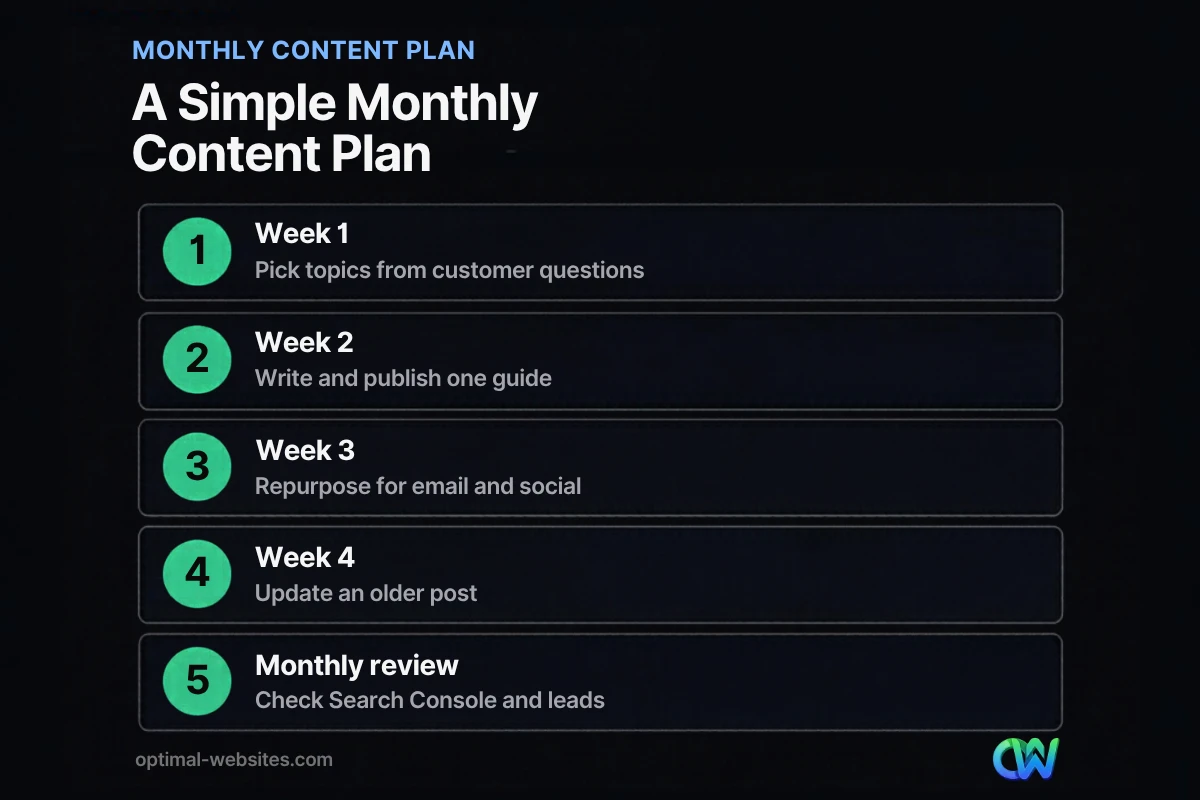
The 4-week content rhythm
- Week 1: Choose your topic. Pick one question from your customer list. Search it on Google and look at what already ranks. Note what those pages miss, such as local details, real pricing factors or your own process.
- Week 2: Write and publish one guide. Answer the question directly in the first two sentences, then expand. Use clear headings, short paragraphs and, where it helps, a table or checklist. Add photos of your own work when you can.
- Week 3: Repurpose it. Turn the guide into an email to your list, two or three social posts and a Google Business Profile update. If you are comfortable on camera, record a two-minute video covering the main point.
- Week 4: Update an older post. Pick one existing page and refresh it. Fix outdated facts, add new questions you have heard, improve the headings and add internal links to your newer content.
Your monthly review checklist
At the end of each month, spend 30 minutes checking:
- [ ] Which pages got the most search clicks in Google Search Console.
- [ ] Which search queries are showing your pages but getting few clicks (a sign the title needs work).
- [ ] How many quote requests or calls came from content pages.
- [ ] New customer questions to add to next month’s topic list.
- [ ] Any older posts that are now out of date.
According to the U.S. Small Business Administration’s marketing guide, a marketing plan should cover your target market, goals, budget and how you will measure results, and it should be reviewed at least once a year. Your content plan fits inside it as the part that runs every month.
What a realistic content budget looks like
Your content budget is mostly time or the cost of a writer. If you write in-house, plan for four to eight hours per month for one solid guide, plus an hour to repurpose it and an hour for the monthly review. If that time is not available, outsourcing the writing is common. Our article on when it makes sense to hire a blog writer covers what to look for and what to ask before you hire.
How Does SEO Fit Into Content Marketing for Small Business?
SEO and content marketing work as a pair: content gives people a reason to visit your site, and SEO helps search engines understand that content and show it to the right people. Great content that nobody can find does not bring in customers, and SEO without useful content has nothing to rank.
Search engine optimization (SEO) is the process of making your pages easier for search engines to crawl, understand and show in search results. For content marketing, that comes down to a few practical habits.
Write for people first
Google is clear that its ranking systems aim to reward content made to help people, not content made mainly to attract search traffic. Google’s guidance on helpful, people-first content suggests asking whether your content shows first-hand experience, offers original insight and leaves the reader satisfied. It also flags warning signs, such as writing to hit a word count. Your real experience with local customers is exactly what that guidance rewards.
Use the words your customers use
Before you write, think about what your audience would type into Google. Customers often describe problems differently than experts do. A homeowner might search “roof leaking after storm” rather than “flashing failure.” Google’s SEO Starter Guide makes the same point: people new to a topic search with different words than specialists, so write in plain language your customers recognize.
You do not need to repeat a keyword over and over. Put the main phrase in your title, your first paragraph and at least one heading, then write naturally.
Favor evergreen topics
Evergreen content is content that stays useful for a long time, like “how to choose a contractor” or “what to expect at your first consultation.” It is usually a better investment than trending news. Search visibility builds gradually, and a trending topic may fade before your post gains any traction. An evergreen guide keeps bringing in readers, especially if you update it once or twice a year.
Link your content together, and earn links from others
Links help search engines discover and understand your pages. Google’s SEO Starter Guide notes that most new pages Google finds each day are discovered through links. Inside your own site, link each new post to related posts and to the matching service page, using descriptive anchor text instead of “click here.”
Links from other websites to yours also matter. You earn them by publishing content worth referencing: local guides, original checklists, clear explanations of permits or regulations in your area. Partners, suppliers, local organizations and industry associations are natural places to start.
Be patient and measure
SEO results are not instant. Google’s own documentation says some changes take effect in a few hours while others can take several months, and it suggests waiting a few weeks before judging a change. Track your progress in Google Search Console, which shows the searches bringing people to your site, and connect it to leads from your contact forms.
If you want the full picture of technical and local SEO, start with our guide to SEO for small business.
What Mistakes Should Small Businesses Avoid With Content Marketing?
The most common content marketing mistakes are publishing inconsistently, writing about yourself instead of the customer’s problem, and ending posts without a clear next step. Each one is easy to fix once you see it.
- Writing generic content. Posts that could appear on any website give readers no reason to choose you. Add local details, real examples and your own process.
- Ignoring the call to action. Every post should tell the reader what to do next: request a quote, call, or read the related service page.
- Letting content go stale. Outdated prices, old tool names and past-year dates in titles make a business look inactive. Review your top posts at least once a year.
- Sending readers to a slow, confusing site. Content can bring visitors in, but a slow page or a hidden contact form loses them. Our guide to turning more website visitors into leads covers the fixes that matter most.
A note from our own builds
When we build WordPress sites with Elementor Pro for contractors, construction firms and law firms, we plan the content structure from the start: a clear page for each core service, a blog organized by the questions customers ask, and internal links that connect the two. That structure makes every future post easier to publish and easier for Google to understand. Clients also get video tutorials so they can add and update posts themselves without calling a developer.
How Optimal Websites Can Help
Optimal Websites, a WordPress web design agency based in Delaware, builds fast, mobile-first websites designed to turn content into leads. Every site we build gives your content a strong home: clear service pages, a blog that is easy to update, and calls to action that guide readers toward a quote request or a call.
If writing is the part you never get to, our blog writing service can research and write search-friendly posts based on the questions your customers actually ask. If you need a new or rebuilt site first, you can compare our website packages and pricing to see what fits. Most projects launch in 2–4 weeks.
Frequently Asked Questions
What is content marketing for small business?
Content marketing for small business is the practice of publishing helpful content, such as blog posts, guides, FAQs, videos and emails, that answers your customers’ questions. The goal is to attract people who are already searching for solutions, earn their trust before they contact you, and guide them toward a quote request or call. It works best when done consistently and paired with basic SEO.
How often should a small business publish blog posts?
Most small businesses do well with one to four quality posts per month. Consistency matters more than volume, so pick a pace you can keep for a full year. One well-researched guide per month, plus a monthly update to an older post, is a realistic rhythm that builds a useful library of content over time without overwhelming a small team.
How long does content marketing take to work?
Content marketing usually takes several months to show steady results. Google notes that some changes take effect in hours while others can take several months. Early wins often come from refreshing existing pages and improving titles. New posts tend to gain visibility gradually, which is why evergreen topics and consistent publishing matter for long-term growth.
Is content marketing worth it for a local business?
Yes, content marketing is worth it for most local businesses because customers research online before they call. Local guides, clear service and location pages, and answers to common questions help you appear in searches in your area. Pair your website content with an active Google Business Profile so customers find you in both regular results and map listings.
What is the difference between SEO and content marketing?
Content marketing is creating useful content for your audience, while SEO is making that content easy for search engines to find, understand and show. They overlap heavily. Content gives people a reason to visit, and SEO brings it in front of the right searchers. A small business gets the best results by planning both together instead of treating them separately.
Should I write my own content or hire a writer?
Write your own content if you have time and enjoy it, since your first-hand experience is valuable. Hire a writer if content keeps getting pushed aside. A good writer will interview you, use your real customer questions and your expertise, and handle the structure and SEO. Many small businesses combine both: the owner supplies ideas and a writer turns them into posts.
Ready to Get Started?
If you want a website that turns helpful content into calls and quote requests, we can help you plan it, build it and keep it growing. Request a free quote or call us at (302) 554-9497 to talk through your goals.


