
Quick answer: Generative engine optimization (GEO) is the practice of making your content easy for AI tools like ChatGPT search, Google AI Overviews and Perplexity to find, understand and cite in their answers. For small businesses, GEO builds on SEO: crawlable pages, direct answers, verifiable facts, consistent business details and mentions on trusted sites.
More of your customers now ask a question and get a written answer instead of a list of links. Google shows AI Overviews at the top of many results, ChatGPT can search the web, and tools like Perplexity summarize sources in seconds. If your business is not one of the sources those answers draw from, you can lose visibility even when your rankings look fine. Generative engine optimization is how you respond. This guide explains what GEO is, how it differs from traditional SEO, what the research says actually works, and a practical checklist a small business can follow without chasing every new trend.
Key Takeaways
- Generative engine optimization means shaping your content so AI search tools can understand it, trust it and cite it.
- GEO does not replace SEO. AI tools still rely on pages that are crawlable, indexed and clearly written.
- Research on GEO found that adding quotations, statistics and cited sources increased visibility in AI answers, while keyword stuffing hurt.
- For local businesses, consistent business details, reviews and mentions on other trusted sites matter as much as on-site content.
- Start with your most important service pages: direct answers, real facts, clear structure and FAQs.
What is generative engine optimization?
Generative engine optimization is the process of improving how often and how accurately your business appears in answers produced by AI search tools. A generative engine is any system that writes a response by combining information from multiple sources, such as Google AI Overviews, ChatGPT search, Microsoft Copilot or Perplexity.
The term comes from the research paper that coined the term, published by researchers from Princeton University and other institutions in late 2023. They described a shift from search engines that rank links to engines that synthesize answers, and they tested ways content creators could improve their visibility in those answers. You may also see related terms such as AI search optimization, answer engine optimization (AEO) or LLM visibility. They describe the same goal: being part of the answer.
How is GEO different from SEO?
SEO aims to rank a page in a list of results; GEO aims to have your content quoted, summarized or cited inside an AI-generated answer. The two overlap heavily, because most AI search tools still find information by searching the web.
| Traditional SEO | Generative engine optimization | |
|---|---|---|
| Goal | Rank pages in search results | Be cited or mentioned in AI answers |
| Unit of success | A click from a results page | A citation, mention or recommendation |
| What gets evaluated | Whole pages | Passages, facts and claims within pages |
| Key signals | Relevance, links, page experience | Clarity, verifiable facts, trusted mentions, plus SEO basics |
| Measurement | Rankings, clicks, conversions | Citations, referral traffic, branded searches |
The practical takeaway: a page that is hard to crawl, thin or vague will struggle in both. A page that answers questions directly with specific facts tends to do well in both. For the fundamentals, see our guide to SEO for small business.
Why does generative engine optimization matter for small businesses?
It matters because AI answers are becoming a front door to search, and they often recommend a short list of businesses or sources. Being left out of that list is a visibility problem even if your site still ranks.
The scale is real. In Google’s AI Overviews announcement in May 2024, Google said the feature was rolling out to everyone in the U.S. and expected to reach over a billion people by the end of that year. Google also said the links included in AI Overviews get more clicks than if the page had appeared as a traditional web listing for that query. In other words, being cited is valuable traffic, not just exposure.
For local service businesses, AI tools are increasingly where people ask “who is a good roofer near me” or “what should I ask a personal injury lawyer.” Our AI Overviews guide for small businesses covers Google’s side, and our post on ChatGPT search optimization covers how ChatGPT finds and recommends local businesses.
What does the research say works for GEO?
The original GEO study tested several content changes and found that adding quotations, statistics and cited sources produced the biggest gains, while keyword stuffing made visibility worse. The authors reported that the best methods could boost visibility by up to 40% in generative engine responses.
In their benchmark, the top-performing changes were:
- Quotation addition: including relevant quotes from credible sources.
- Statistics addition: replacing vague claims with specific numbers.
- Fluency optimization: making the text clearer and easier to read.
- Citing sources: referencing where facts come from.
Keyword stuffing, the old SEO habit of repeating a phrase, performed worse than doing nothing. The researchers also noted that results varied by topic, so there is no single trick that works everywhere. The lesson for small businesses is encouraging: the things that help are the same things that make content better for people.
How do you optimize your website for generative engines?
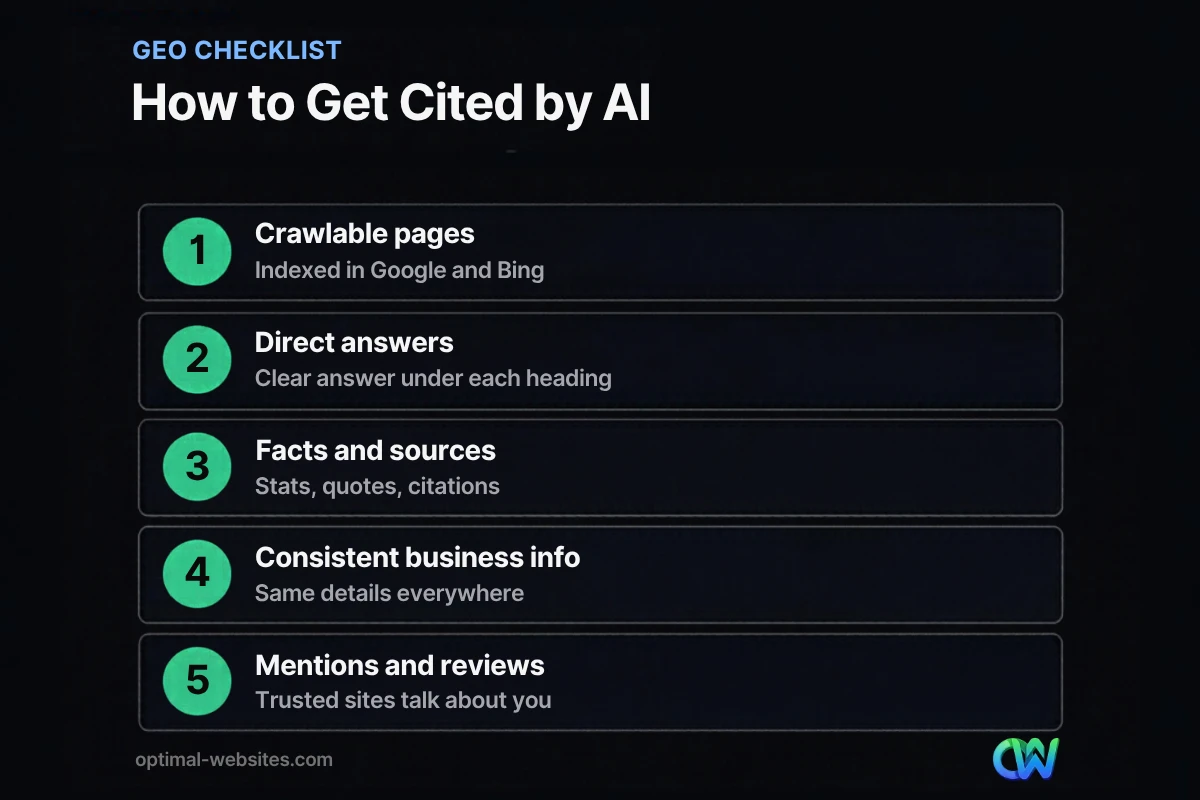
Make your site easy to crawl, answer real questions directly, back claims with facts, and keep your business information consistent everywhere. Here is the checklist we use.
1. Make sure AI tools can reach your pages
AI search tools rely on search indexes and their own crawlers. Check that your important pages are indexed in Google (via Google Search Console) and in Bing (via Bing Webmaster Tools), since several AI tools use Bing’s index. Do not block legitimate search crawlers in your robots.txt file unless you have a specific reason.
2. Put a direct answer under every heading
Write headings as the questions customers ask, and answer each one in the first one or two sentences. AI tools extract passages, so a clear, self-contained answer is easier to quote than a paragraph that builds up slowly.
3. Add specific facts, numbers and sources
Replace “we have years of experience” with specifics you can verify: service areas, licenses, warranties, response times, project types. When you cite outside data, link to the original source. This matches what the GEO research found works.
4. Use clear structure: lists, tables and FAQs
Comparison tables, step-by-step lists and FAQ sections give AI tools well-defined chunks of information. They also make your page easier for humans to scan.
5. Keep business information consistent
Your business name, address, phone number, hours and services should match across your website, Google Business Profile, social profiles and directories. AI tools cross-check sources, and inconsistent details reduce confidence.
6. Earn mentions on trusted sites
AI answers often lean on third-party sources: reviews, local news, industry associations, directories and “best of” lists. Encourage reviews, join relevant associations, and share expertise with local publications.
7. Add structured data
Schema markup such as LocalBusiness, Service and FAQPage describes your business in a machine-readable way. It does not guarantee citations, but it removes ambiguity about who you are and what you offer.
Should you worry about llms.txt and other new standards?
Not yet, for most small businesses. llms.txt is a file format proposed in September 2024 to help large language models read a website’s key content, but it is a proposal, and no major AI provider has confirmed using it.
Spend your time on fundamentals first: crawlable pages, clear answers, verified facts and consistent business details. Those help in Google, Bing, ChatGPT search and whatever comes next.
How do you measure GEO results?
Track AI referral traffic, branded searches and leads, and spot-check AI answers for your key services. Measurement is still imperfect, so look for trends rather than exact numbers.
- Analytics: look for referral visits from AI tools such as chatgpt.com, perplexity.ai and copilot.microsoft.com in Google Analytics 4.
- Search Console: watch impressions and clicks on question-style queries for your service pages.
- Spot checks: once a month, ask ChatGPT search, Perplexity and Google the questions your customers ask, and note whether your business or content appears.
- Leads: ask new customers how they found you, and add “AI assistant” as an option on your intake form.
What we see when building websites for AI search
Most small business sites we audit are not invisible to AI because of some missing AI trick. They are invisible because the service pages are vague, the business details differ between the website and Google Business Profile, and nobody outside the company has written about them.
When we build or rebuild a WordPress site with Elementor Pro, we structure service pages around real customer questions, add FAQ sections and schema, keep business details consistent, and make sure pages are fast and indexable. That foundation serves traditional search and AI search at the same time. For a wider view of where AI is heading in website work, see how AI is changing web design.
How Optimal Websites Can Help
Optimal Websites, a WordPress web design agency based in Delaware, helps small businesses build sites that search engines and AI tools can understand. Our SEO services include rewriting key service pages with direct answers and verifiable facts, adding FAQ content and structured data, and cleaning up inconsistent business information.
If you are not sure where your business stands, we can check how your key pages show up in Google and AI answers and tell you which fixes matter most.
Frequently Asked Questions
What is generative engine optimization in simple terms?
Generative engine optimization means making your website content easy for AI tools to find, understand and quote in their answers. Instead of only trying to rank as a link, you aim to become one of the sources that ChatGPT search, Google AI Overviews or Perplexity cite when they answer a customer’s question about your services.
Is GEO replacing SEO?
No. GEO builds on SEO rather than replacing it. AI search tools still depend on pages that are crawlable, indexed and clearly written, so strong SEO remains the foundation. GEO adds extra focus on direct answers, verifiable facts, cited sources and mentions on trusted sites, which also tend to improve traditional rankings.
How do I get my business cited by ChatGPT?
Make sure your site is indexed in Bing and Google, answer common customer questions directly on your service pages, and keep your business details consistent across your website and listings. Reviews and mentions on trusted third-party sites also help, because ChatGPT search often draws on multiple sources when it recommends businesses.
What is the difference between GEO and AEO?
Answer engine optimization (AEO) and generative engine optimization (GEO) describe nearly the same goal: being part of the answer rather than just a link. AEO is an older term often tied to featured snippets and voice search, while GEO usually refers to AI tools that write new answers from multiple sources.
Does schema markup help with AI search optimization?
Schema markup can help AI search optimization by describing your business, services and FAQs in a structured, machine-readable format. It does not guarantee that an AI tool will cite you, but it reduces ambiguity about who you are and what you offer. Treat it as one part of a complete approach, not a shortcut.
How long does generative engine optimization take to work?
Generative engine optimization timelines vary. Changes to pages that are already indexed can show up in AI answers within weeks, while building trust through reviews and third-party mentions takes months. Because AI answers change often, track trends in referral traffic and spot checks over several months instead of judging results from a single search.
Ready to Get Started?
Want your business to show up when customers ask AI for recommendations? Request a free quote or call (302) 554-9497, and we will review how your site performs in search and AI answers.


