
Quick answer: Social media for contractors works best when it shows real work: before and after photos, short job-site videos, customer reviews and quick tips. Focus on Facebook for local reach and referrals, Instagram for visual proof, and your Google Business Profile for searchers ready to call. Post two to three times a week and always point back to your website.
Most contractors know they should be on social media. The trouble is what to post, where, and how to find the time between estimates and job sites. So the Facebook page goes quiet for months, then gets a burst of posts, then goes quiet again. Meanwhile, homeowners scroll past a competitor’s fresh kitchen remodel and call them instead. This guide to social media for contractors covers which platforms matter for local trades, a simple weekly posting plan, the post types that bring in quote requests, and how to connect it all to your website so likes turn into leads.
Key Takeaways
- Pick two platforms you can keep up with, usually Facebook and Instagram, plus regular posts on your Google Business Profile.
- Before and after posts, short job-site videos and real customer reviews do more for contractors than generic quotes or stock graphics.
- A steady rhythm of two to three posts a week beats daily posting for a month and then silence.
- Every post should give people an easy next step: call, request a quote, or see more projects on your website.
- Your website is where social media traffic becomes a lead, so it needs a clear quote form and project gallery.
Is social media for contractors worth the time?
Yes, if you treat it as proof of your work rather than a place to advertise. Homeowners check a contractor’s photos, reviews and recent activity before they call, and social media is where much of that checking happens.
The audience is already there. According to Pew Research Center, 68% of U.S. adults say they use Facebook, 83% use YouTube and 47% use Instagram. Your future customers are on these platforms every day; the question is whether they see your work when they are thinking about a new roof, deck or bathroom.
Social media rarely replaces referrals or search. It strengthens them. A neighbor recommends you, the homeowner looks you up, and an active page full of recent jobs confirms the recommendation.
Which social media platforms should contractors use?
Most contractors should focus on Facebook, Instagram and their Google Business Profile, then add YouTube or Nextdoor if they have time. Pick based on where local homeowners spend time and what you can keep up with.
| Platform | Best for | What to post | Effort |
|---|---|---|---|
| Local reach, referrals, reviews, community groups | Project albums, reviews, team news, seasonal tips | Medium | |
| Visual proof of craftsmanship | Before and after carousels, Reels of job sites, Stories | Medium | |
| Google Business Profile | Searchers ready to call | Project photos, updates, offers | Low |
| YouTube | Long-lived how-to and project walkthroughs | Project tours, “what to expect” explainers | High |
| Nextdoor | Neighborhood word of mouth | Recommendations, local updates | Low |
| Commercial and B2B work | Commercial projects, safety records, hiring | Low to medium |
Facebook for contractors
Facebook is still the default platform for local home services. Homeowners ask for recommendations in community groups, leave reviews on business pages, and share posts with neighbors. Use project photo albums by job type (roofing, siding, decks) so visitors can browse your work. Our guide to Facebook marketing tips for small businesses covers page setup and ads in more detail.
Instagram for contractors
Instagram for contractors is about visual proof. Carousels let you show a project from start to finish, and short Reels of a crew at work or a final walkthrough tend to hold attention. Keep captions practical: what the problem was, what you did, and where the job was.
Your Google Business Profile
Your Google Business Profile is not a social network, but it behaves like one for local search. Google’s help page on Business Profile posts explains that you can publish updates, offers and events with photos and a button that links to your website. Those posts appear on your profile in Search and Maps, right where people are deciding who to call.
What should contractors post on social media?
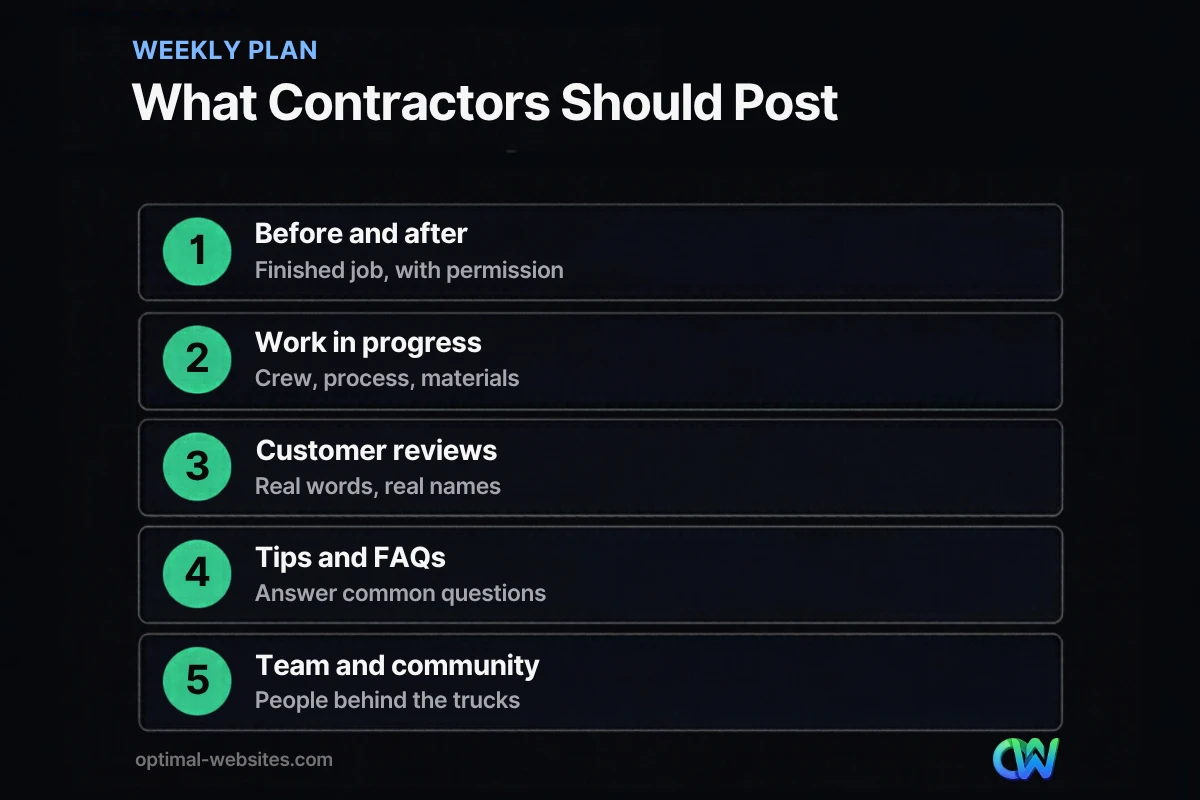
Post your real work, your real customers and your real team. The best contractor social media ideas show skill and reliability, which is exactly what a homeowner is trying to judge.
Before and after posts
Before and after posts are the strongest content most contractors have. Shoot the “before” from the same angle you will use for the “after,” in similar light. Add a short caption: the problem, the solution, the town, and how long it took. Always get the homeowner’s permission, and never show house numbers or anything that identifies their address.
Work-in-progress photos and short videos
Homeowners want to know what happens between “signed contract” and “finished job.” Show tear-offs, framing, inspections, cleanup and the crew at work. A 20-second clip of a clean job site says more about how you work than a paragraph of claims. Our post on short-form video has tips for filming on a phone.
Customer reviews and stories
Share real reviews from Google or Facebook as simple graphics or screenshots, with the customer’s permission. A photo of the finished project next to the review makes it more believable.
Tips and answers to common questions
Answer the questions you hear on every estimate: “How long does a roof replacement take?” “Should I repair or replace?” “What permits do I need?” These posts show expertise and save time on sales calls.
Team, safety and community
Introduce crew members, celebrate certifications, show safety training, and share local sponsorships or volunteer days. People hire people they trust, and seeing the faces behind the trucks helps.
How often should contractors post on social media?
Two to three posts a week per platform is a realistic goal for most contractors. Consistency matters more than volume, so choose a pace you can sustain during your busiest season.
A simple weekly plan:
- Monday: a before and after or finished project from last week.
- Wednesday: a work-in-progress photo or short video from a current job.
- Friday: a review, a tip, or a team spotlight.
Batch the work. Take photos on every job (before, during, after), save them to one shared folder, and spend an hour each week writing captions and scheduling posts with a free scheduling tool or the platforms’ built-in schedulers.
How do contractors turn social media followers into leads?
Give every post a clear next step and send people to a website that makes it easy to request a quote. Likes do not pay invoices; calls and form submissions do.
- Link to the right page. A post about a deck build should link to your deck page or project gallery, not your homepage.
- Add your phone number and service area to your profile bio and pinned post.
- Reply fast. Treat comments and messages like phone calls. A homeowner asking “do you service Newark?” is a lead.
- Use a short quote form on your website, with only the fields you need.
- Ask happy customers for reviews and to tag or share your post about their project.
This is where your website matters. A page full of great project photos on Instagram loses its value if the link leads to a slow, outdated site with no quote form. Our post on contractor website design covers the pages and features that turn that traffic into calls.
What social media mistakes should contractors avoid?
The biggest mistakes are posting inconsistently, using stock photos, and ignoring messages. Each one tells a homeowner you might be just as unreliable on the job.
- Posting only ads or discounts, with no real work shown.
- Using stock photos of projects you did not do.
- Sharing customer homes without permission or showing their address.
- Leaving reviews and messages unanswered for days.
- Spreading thin across six platforms instead of doing two well.
- Linking to a website that is slow or hard to use on a phone.
What we see when building contractor websites
When we build WordPress websites for contractors, roofing companies and construction firms, social media and the website are designed to work together. Project photos from social posts become gallery entries on the site, organized by service, so visitors who click through see more of the same work. We add tap-to-call buttons, short quote forms and links to the company’s social profiles, and we build pages in Elementor Pro so the team can add new projects themselves after training.
The pattern we notice most: contractors with strong social pages often have websites that do not match. Fixing that gap is usually faster than growing a bigger audience. If you want the broader picture of how social fits into marketing, see our guide to social media marketing for small business.
How Optimal Websites Can Help
Optimal Websites, a WordPress web design agency based in Delaware, helps contractors with both sides of the equation. Our social media marketing services can plan and manage your posting so your profiles stay active during busy season, and our website builds give that traffic a fast, mobile-friendly place to land.
If your site is not ready for the attention, you can compare our website packages to see what a modern contractor website includes.
Frequently Asked Questions
What is the best social media platform for contractors?
For most local contractors, Facebook is the best starting point because homeowners use it for recommendations, reviews and community groups. Instagram is a strong second platform for visual proof of your work. Keep your Google Business Profile updated with photos and posts too, since it reaches people actively searching for a contractor near them.
How often should contractors post on social media?
Two to three posts a week per platform is a realistic and effective pace for most contractors. Consistency matters more than volume. Batch your photos and captions once a week, schedule posts in advance, and keep posting during busy season so your profiles never look abandoned to homeowners checking you out.
What are good contractor social media ideas?
Good contractor social media ideas include before and after photos, short videos of work in progress, customer reviews, answers to common homeowner questions, crew introductions, safety training and community involvement. Focus on content that proves your skill and reliability, and include the town or neighborhood so local homeowners recognize the work.
Should contractors pay for social media ads?
Paid ads can help contractors reach homeowners in a specific area, especially for seasonal services. Start with a solid organic presence first, though: ads send people to your profile and website, and an inactive page or weak site wastes ad spend. Test a small budget, track calls and quote requests, and scale only what works.
Do I need permission to post photos of a customer’s home?
Yes, always ask the homeowner before posting photos of their project, and get permission in writing if you can. Avoid showing house numbers, license plates, family members or anything else that reveals their address or identity. Many contractors add a photo permission line to their contract to make this simple.
How do before and after posts help contractors get leads?
Before and after posts show the result a homeowner is paying for, which builds trust faster than any claim. Include the problem, the solution and the town in the caption, then link to a matching project page or quote form on your website so interested viewers can take the next step right away.
Ready to Get Started?
Want social media and a website that work together to bring in jobs? Get a free quote or call (302) 554-9497 to talk through what your contracting business needs.


